08 · Bird evolution

The Last Dinosaurs

Birds are living theropod dinosaurs — relatives of Velociraptor and Tyrannosaurus. This is one of the best-supported conclusions in palaeontology. How feathers, flight and the modern bird body plan came together is still being worked out, fossil by fossil.

Established
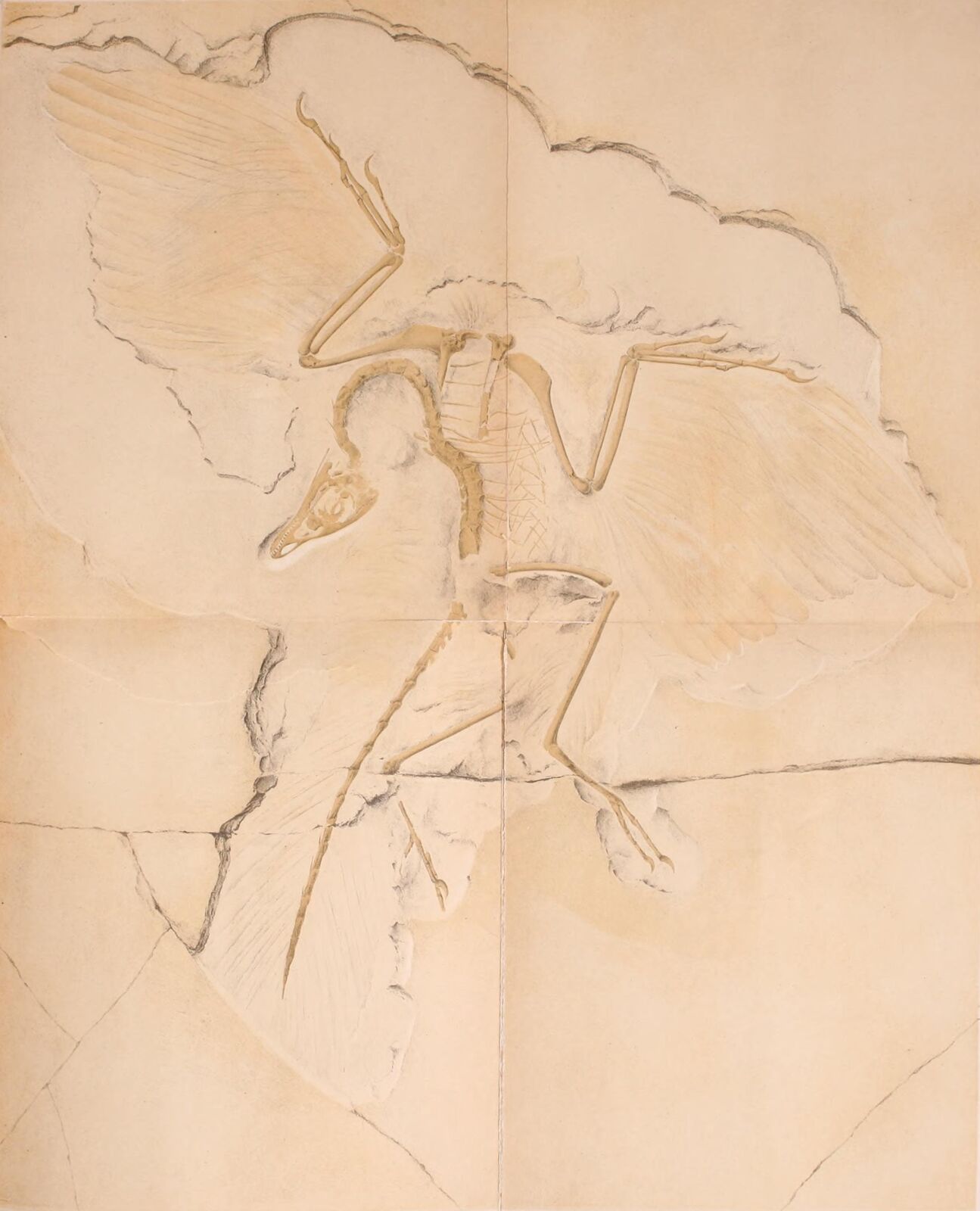
Tinted lithograph of the Berlin Archaeopteryx fossil on its limestone slab: a crow-sized skeleton with the head thrown back, toothed jaws, clawed fingers, outspread wings with clear feather impressions and a long bony tail fringed with feathers
An 1884 lithograph of the Berlin Archaeopteryx, drawn from the fossil itself, which was found near Eichstätt, Bavaria, in the 1870s. About 150 million years old (Late Jurassic), it combines teeth, clawed fingers and a long bony tail with fully formed flight feathers.Illustration: Lithograph of the Berlin specimen, Taf. I in W. Dames, 'Ueber Archaeopteryx', Palaeontologische Abhandlungen 2 (Berlin: G. Reimer, 1884). Scan: Smithsonian Libraries via Biodiversity Heritage Library / Internet Archive, 1884 · Public Domain · Source · Cropped to the plate (page margins and caption removed); resized. Fold creases are in the original plate
The evidence

Why birds are dinosaurs

Features once thought unique to birds keep turning up in their theropod relatives.

  1. 01Hollow, air-filled bones
  2. 02A wishbone (furcula) formed by fused collarbones
  3. 03Three main fingers in the hand
  4. 04Feathers, now known from many non-bird theropods
  5. 05Brooding on nests in a bird-like posture (e.g. oviraptorids)
  6. 06Similar eggshell structure and growth patterns
Feather evolution

From filament to flight feather

A developmental model proposed by Richard Prum describes five stages, each building on the last. Fossils of feathered dinosaurs show many of these stages in real animals.

I

A hollow filament

A single, unbranched tube growing from a follicle — like the fuzz on Sinosauropteryx.

Seen in Sinosauropteryx

Well supported

Schematic drawing. Model: Prum, R.O. (1999). Development and evolutionary origin of feathers. Journal of Experimental Zoology 285: 291–306.

Interactive timeline

160 million years

  1. c. 160 million years ago

    Anchiornis

    Anchiornis huxleyi

    Liaoning, China · fossil

    A small, four-winged feathered dinosaur from the Late Jurassic. Fossilised pigment structures (melanosomes) allowed researchers to reconstruct its colours: grey and black body, white-banded wings and a reddish crest — one of the first dinosaurs whose colours were inferred.

    Well supported

    Ongoing research: Colour reconstructions from melanosomes are well established as a method, but individual reconstructions can be revised.

    Li, Q. et al. (2010). Plumage color patterns of an extinct dinosaur. Science 327: 1369–1372.
  2. Tinted lithograph of the Berlin Archaeopteryx fossil on its limestone slab: a crow-sized skeleton with the head thrown back, toothed jaws, clawed fingers, outspread wings with clear feather impressions and a long bony tail fringed with feathers
    Illustration: Lithograph of the Berlin specimen, Taf. I in W. Dames, 'Ueber Archaeopteryx', Palaeontologische Abhandlungen 2 (Berlin: G. Reimer, 1884). Scan: Smithsonian Libraries via Biodiversity Heritage Library / Internet Archive, 1884 · Public Domain · Source · Cropped to the plate (page margins and caption removed); resized. Fold creases are in the original plate
    c. 150 million years ago

    Archaeopteryx

    Archaeopteryx lithographica

    Solnhofen, Germany · fossil

    Discovered in 1861, two years after Darwin’s On the Origin of Species. It combines reptilian features — teeth, clawed fingers, a long bony tail — with asymmetrical flight feathers and a wishbone. For more than a century it was the earliest known bird.

    Established

    Ongoing research: How well Archaeopteryx could fly — and exactly where it sits among feathered dinosaurs — is still debated.

    Natural History Museum, London — Archaeopteryx (London specimen).
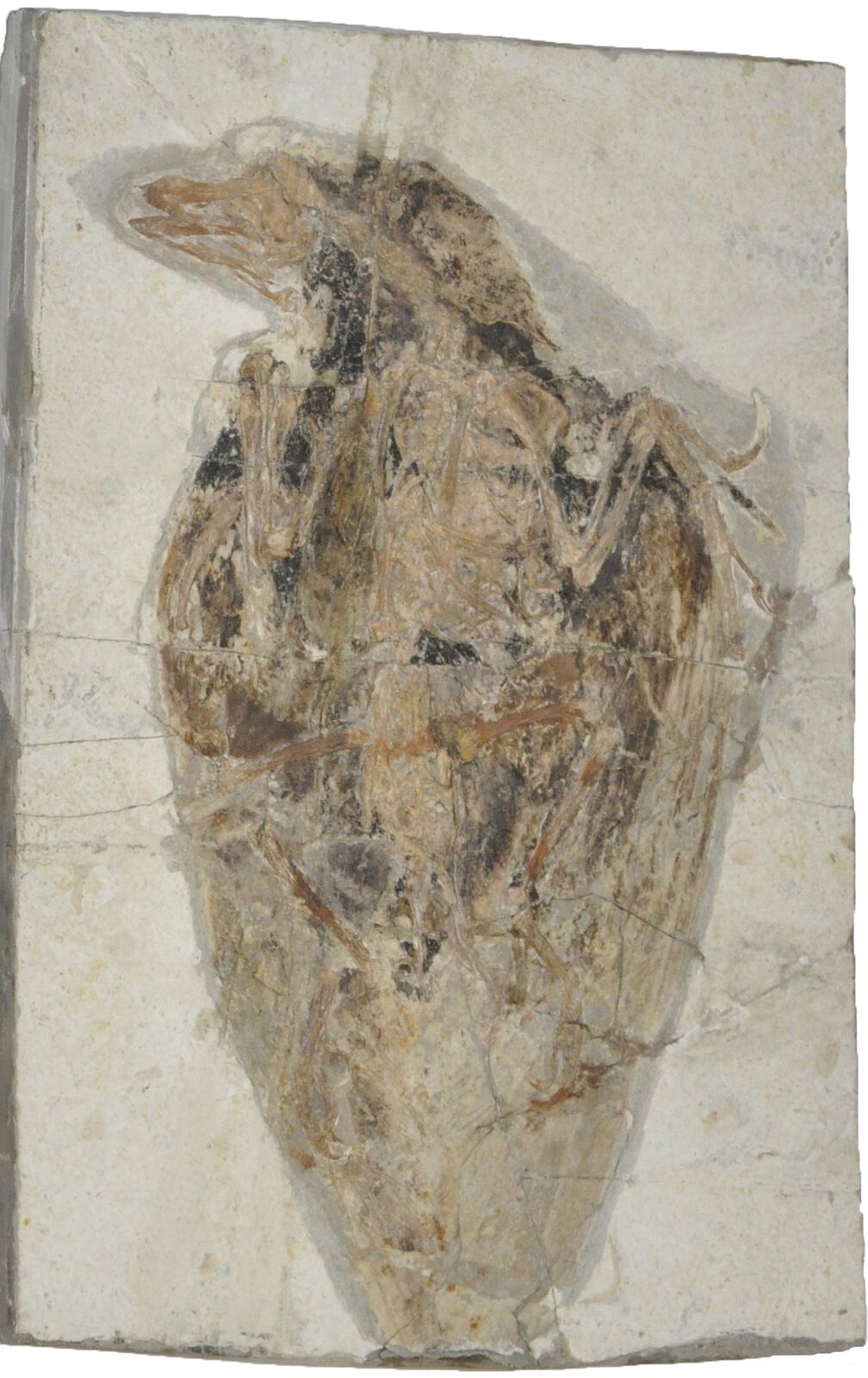
  3. A pale grey stone slab bearing the flattened fossil of Confuciusornis: a dark outline of body feathers around a small skeleton with a toothless beak at the top, folded wings with a large curved claw, and legs
    Specimen photo: Naturalis Biodiversity Center, Leiden (specimen RGM.631750) · CC0 1.0 · Source · Cropped (white background removed); resized
    c. 125–120 million years ago

    Confuciusornis

    Confuciusornis sanctus

    Liaoning, China · fossil

    One of the earliest birds with a toothless, horny beak, known from hundreds — perhaps thousands — of specimens. Some individuals carry a pair of long ribbon-like tail feathers.

    Established

    Ongoing research: Whether the long tail feathers mark males (sexual dimorphism) is debated.

    Chiappe, L.M. et al. (2008). Life history of a basal bird: morphometrics of the Early Cretaceous Confuciusornis. Biology Letters 4: 719–723.
  4. c. 120 million years ago

    Microraptor

    Microraptor gui

    Liaoning, China · fossil

    A crow-sized dromaeosaur with long flight feathers on both arms and legs — four wings. Melanosomes suggest glossy, iridescent black plumage.

    Debated

    Ongoing research: Whether Microraptor glided, flapped, or both — and how the hind wings were held — remains contested.

    Xu, X. et al. (2003). Four-winged dinosaurs from China. Nature 421: 335–340.
  5. c. 130–66 million years ago

    The “opposite birds”

    Enantiornithes

    Worldwide · lineage

    The most diverse birds of the Cretaceous, found on every continent. Most had teeth and clawed wings. They were not ancestors of living birds — they formed a separate branch that vanished completely at the end of the Cretaceous.

    Established
    Chiappe, L.M. & Walker, C.A. (2002). Skeletal morphology and systematics of the Cretaceous Euenantiornithes. In Mesozoic Birds: Above the Heads of Dinosaurs. University of California Press.
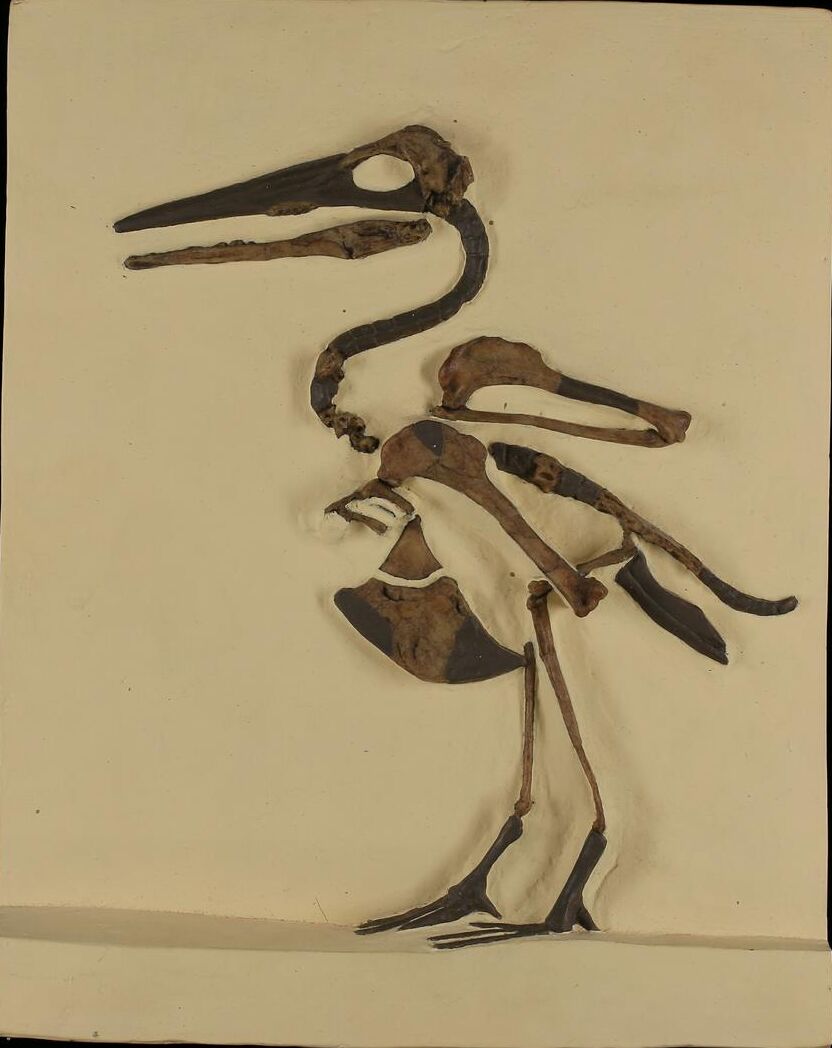
  6. Brown fossil bones of Ichthyornis set in life position in a cream plaster panel: a tern-sized bird with a long toothed jaw, keeled breastbone, folded wing bones and slender legs
    Specimen photo: Arianna D. Lord / Yale Peabody Museum (specimen YPM VP 001450) · CC0 1.0 · Source · Cropped (scale bar and label removed); resized
    c. 90–85 million years ago

    Ichthyornis

    Ichthyornis dispar

    Kansas, USA · fossil

    A tern-sized seabird with a keeled breastbone and strong flight — but still with teeth in its jaws. A 3D skull described in 2018 showed a mix of a modern-bird brain and beak with a dinosaur-like jaw.

    Established
    Field, D.J. et al. (2018). Complete Ichthyornis skull illuminates mosaic assembly of the avian head. Nature 557: 96–100.
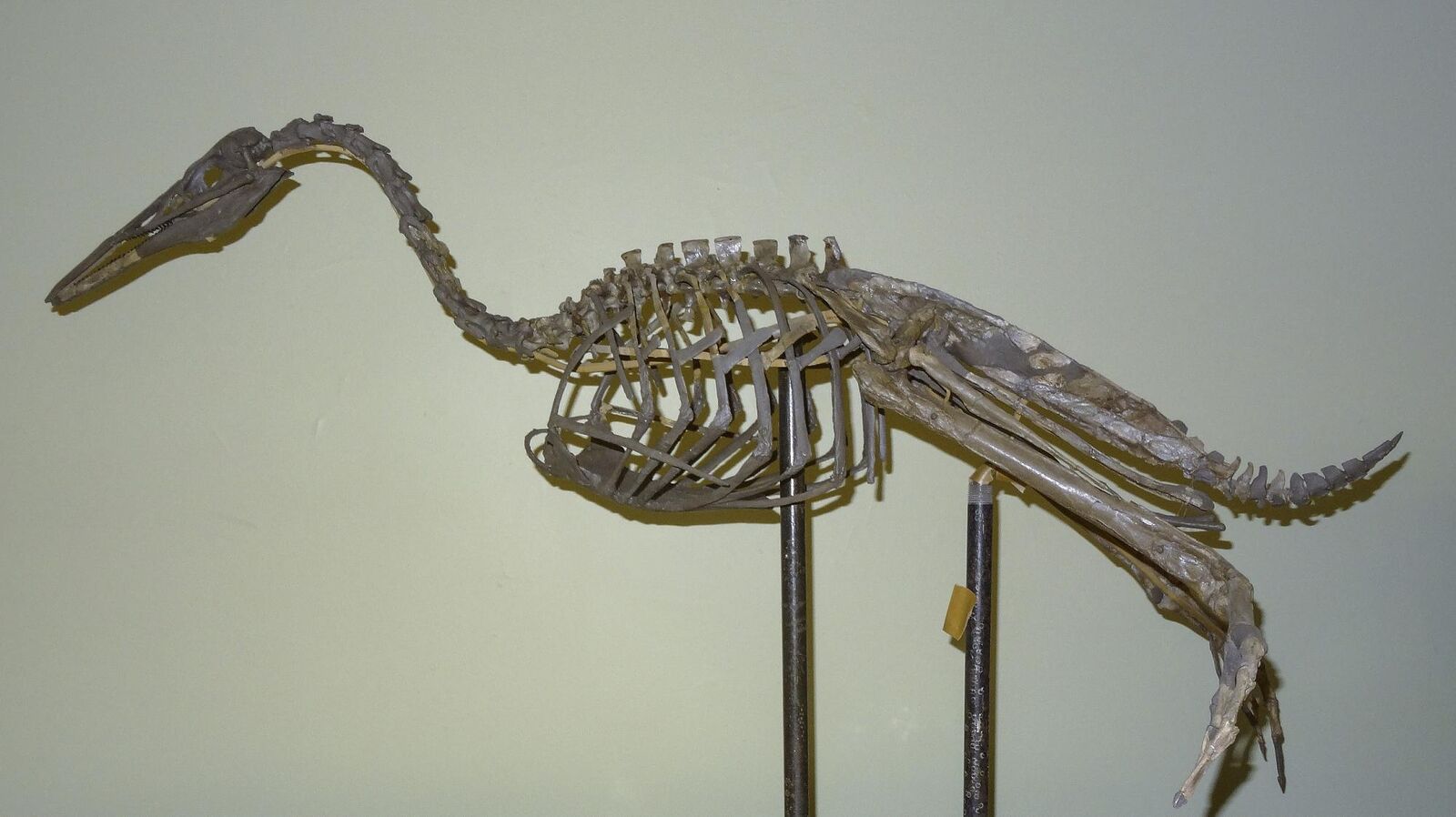
  7. Mounted fossil skeleton of Hesperornis regalis on metal supports against a pale wall: a long, low-slung diving bird with a long pointed beak, slender curving neck, tiny wing bones and powerful legs set far back on the body
    Specimen photo: Michael Brett-Surman / Smithsonian Institution, National Museum of Natural History (specimen USNM V 4978) · CC0 1.0 · Source · Resized
    c. 85 million years ago

    Hesperornis

    Hesperornis regalis

    Kansas, USA · fossil

    A large, toothed, flightless diving bird of the Western Interior Seaway, propelled by powerful feet. Proof that birds evolved flightlessness and diving long before penguins.

    Established
    Yale Peabody Museum — Hesperornis regalis (YPM collections).
  8. 66 million years ago

    The asteroid

    Chicxulub, Mexico — global effects · event

    An asteroid impact ended the Cretaceous. All non-bird dinosaurs died out, along with the opposite birds, the toothed seabirds and every other early bird lineage. Only modern birds (Neornithes) survived — making them the last living dinosaurs.

    Established

    Ongoing research: Why only crown birds survived is debated. One hypothesis: ground-dwelling birds survived the global collapse of forests after the impact.

    Field, D.J. et al. (2018). Early evolution of modern birds structured by global forest collapse at the end-Cretaceous mass extinction. Current Biology 28: 1825–1831.
  9. c. 66–56 million years ago

    The great radiation

    Neoaves

    Worldwide · lineage

    In the few million years after the extinction, surviving birds diversified explosively into the ancestors of most modern orders — from owls and parrots to songbirds and seabirds.

    Well supported

    Ongoing research: The rapid burst is well supported by genomes, but the exact branching order at the base of Neoaves is one of the hardest problems in evolutionary biology.

    Jarvis, E.D. et al. (2014). Whole-genome analyses resolve early branches in the tree of life of modern birds. Science 346: 1320–1331.
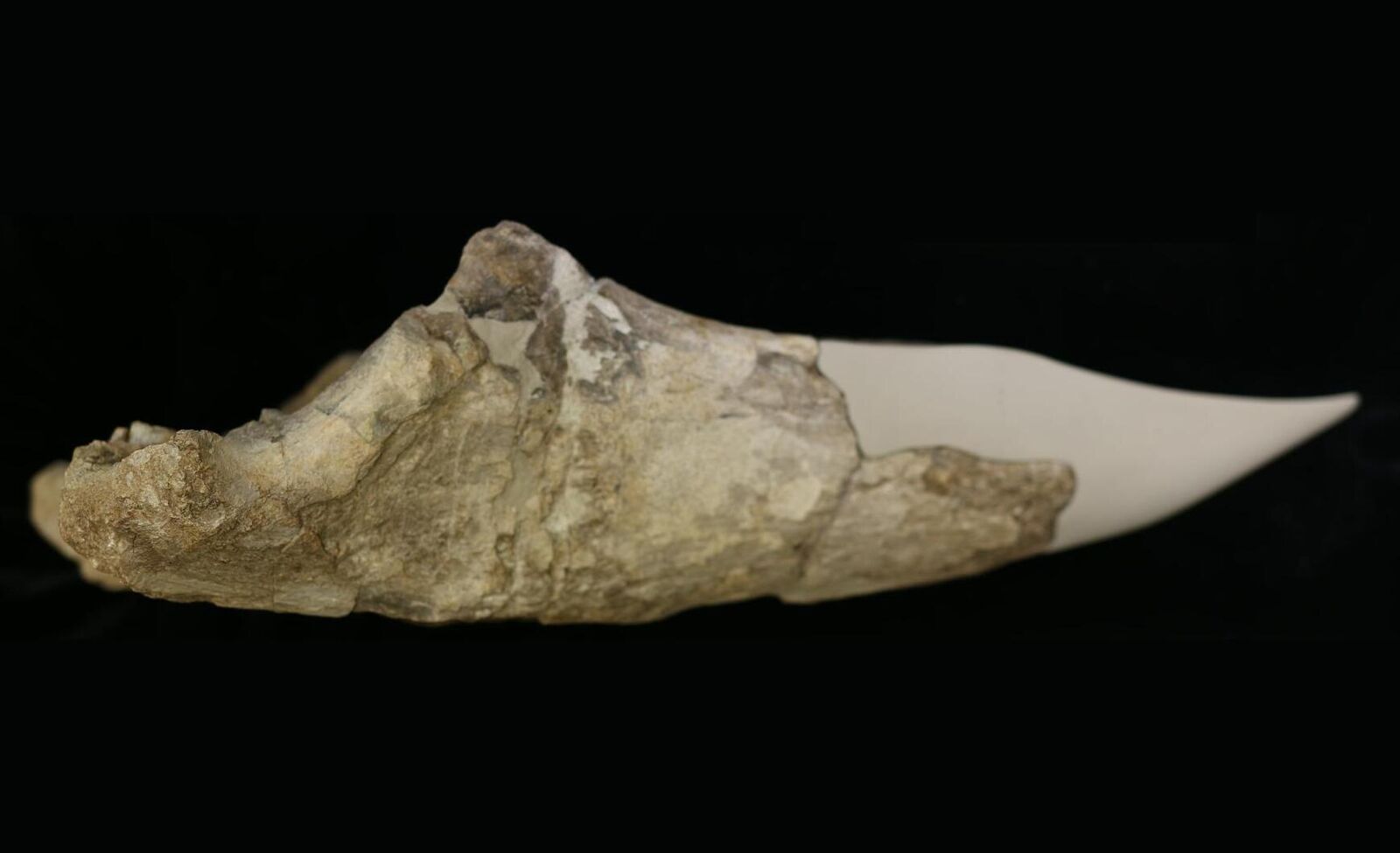
  10. Side view of the massive fossil lower jaw of Gastornis (Diatryma) on a black background: a deep, heavy, sandy-grey bone tapering to a smooth white restored tip
    Specimen photo: Yale Peabody Museum, Division of Vertebrate Paleontology (specimen YPM VP 006352) · CC0 1.0 · Source · Cropped; edge of a museum label masked and the black background extended to a 16:10 frame; resized
    c. 56–45 million years ago

    Gastornis

    Gastornis

    Europe, North America, Asia · fossil

    A giant, flightless bird about two metres tall with a massive beak. Long imagined as a predator of early mammals, it is now more often interpreted as a plant-eater.

    Debated

    Ongoing research: Calcium-isotope and beak-mechanics studies favour herbivory, but its diet is still discussed.

    Angst, D. et al. (2014). Isotopic and anatomical evidence of an herbivorous diet in the Early Tertiary giant bird Gastornis. Naturwissenschaften 101: 313–322.
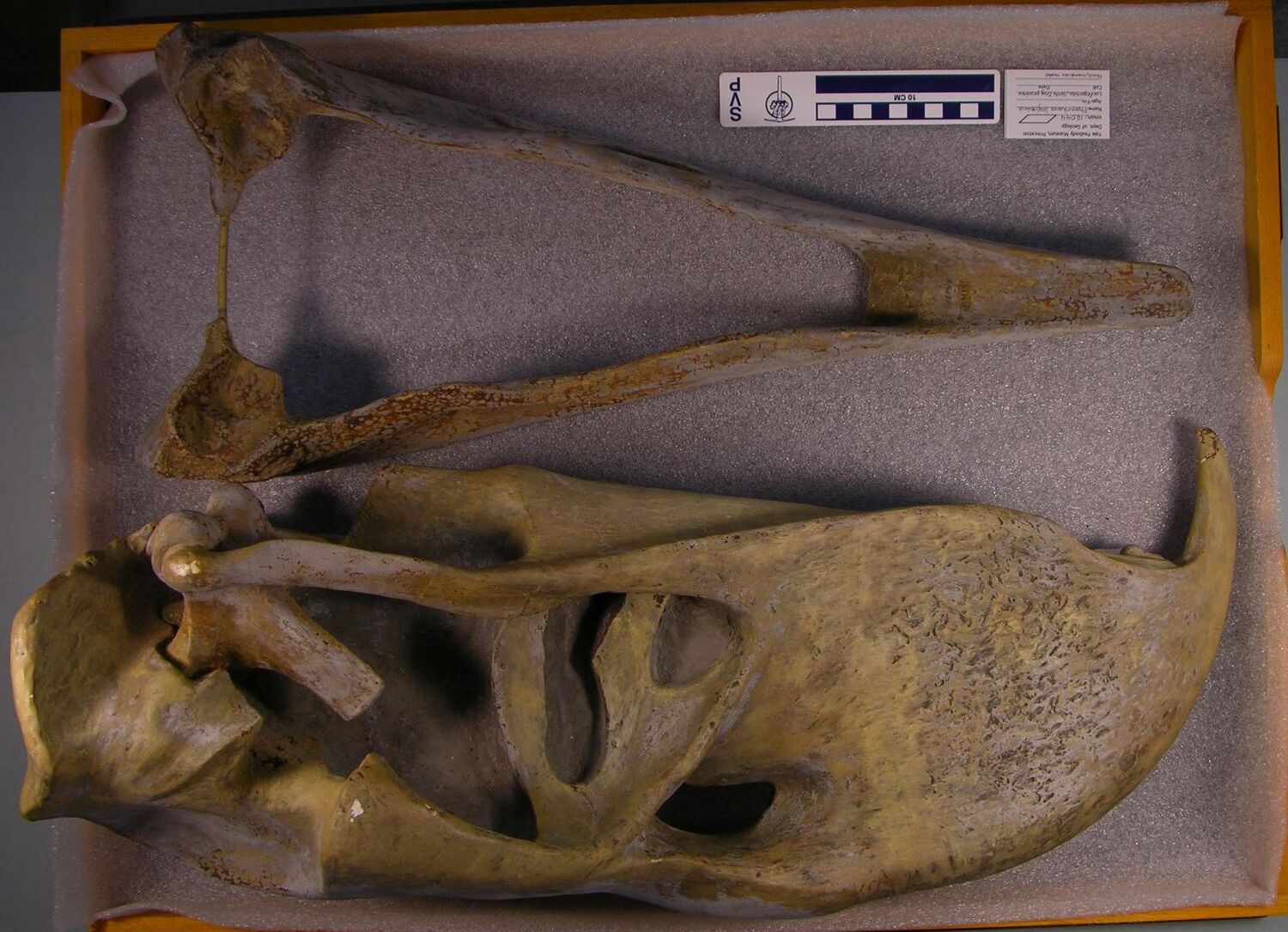
  11. Museum model of the skull and lower jaw of the terror bird Phorusrhacos lying in a padded storage tray: a huge, deep, narrow skull ending in a sharply hooked beak, with the long V-shaped lower jaw above it
    Reconstruction: Marilyn Fox / Yale Peabody Museum (YPM VPPU 016044) · CC0 1.0 · Source · Cropped; resized
    c. 60 – 2 million years ago

    Terror birds

    Phorusrhacidae

    South America (one genus reached North America) · lineage

    Flightless apex predators with huge, hooked beaks that dominated South America for tens of millions of years. Titanis reached North America after the continents joined.

    Established
    Degrange, F.J. et al. (2010). Mechanical analysis of feeding behavior in the extinct “terror bird” Andalgalornis steulleti. PLoS ONE 5: e11856.
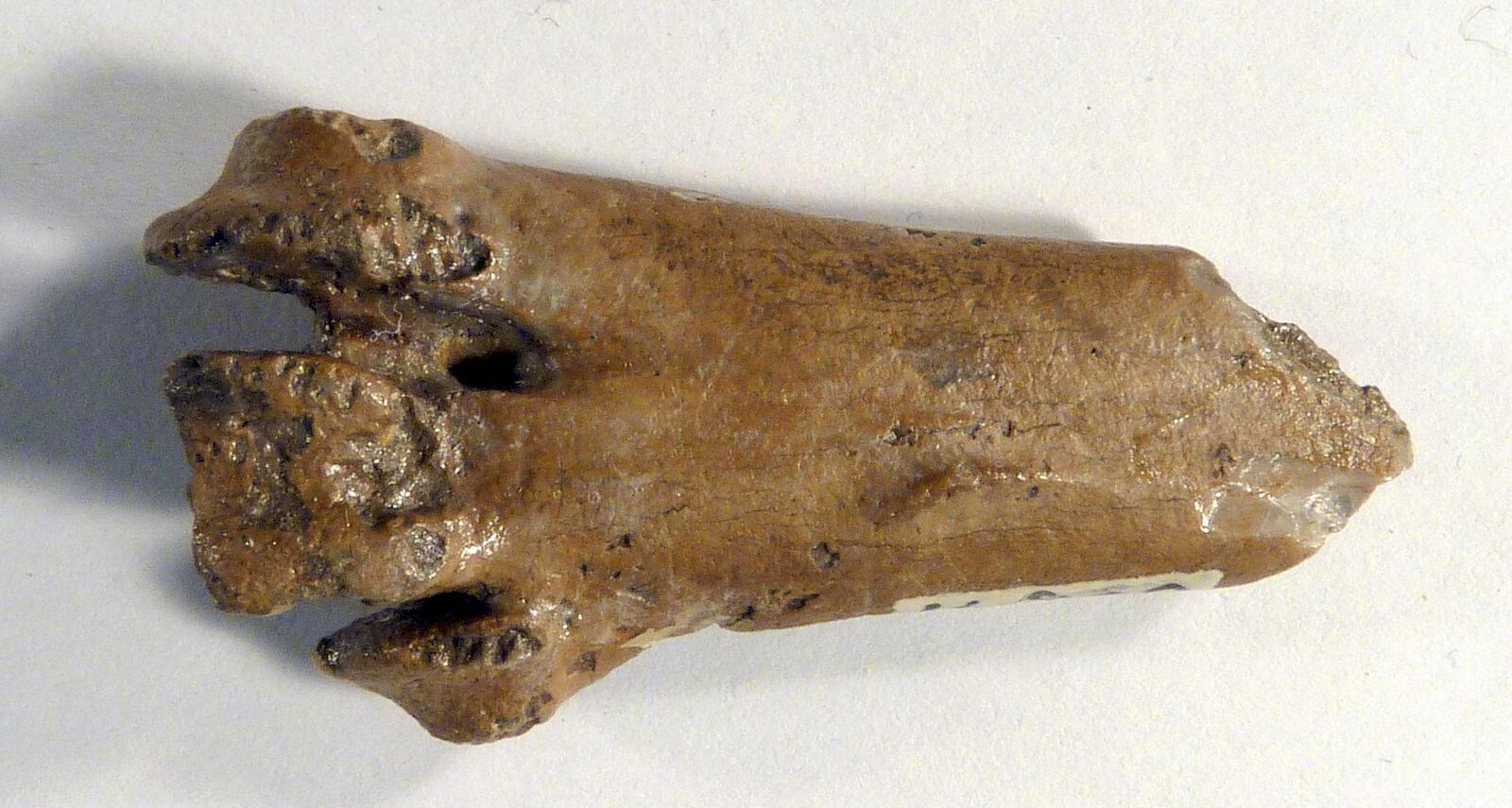
  12. Museum photograph of a brown fossil foot bone on a white background: the lower end of a tarsometatarsus with three knobbly joint surfaces for the toes
    Specimen photo: Michael Brett-Surman / Smithsonian Institution, National Museum of Natural History (specimen USNM V 16809) · CC0 1.0 · Source · Cropped; resized
    c. 25 million years ago

    Pelagornis sandersi

    Pelagornis sandersi

    South Carolina, USA · fossil

    A “bony-toothed” seabird with tooth-like spikes on its jaws and an estimated wingspan of about 6.1–7.4 m — likely the largest wingspan of any known flying bird. Models suggest it was a superb glider.

    Well supported

    Ongoing research: Wingspan is estimated from incomplete bones and flight models.

    Ksepka, D.T. (2014). Flight performance of the largest volant bird. PNAS 111: 10624–10629.
  13. c. 6 million years ago

    Argentavis

    Argentavis magnificens

    Argentina · fossil

    A giant relative of today’s condors and an exceptional soaring bird of the late Miocene, probably riding thermals over the Andean foothills and pampas.

    Well supported

    Ongoing research: Size estimates vary widely between studies because the skeleton is incomplete.

    Chatterjee, S., Templin, R.J. & Campbell, K.E. (2007). The aerodynamics of Argentavis, the world’s largest flying bird from the Miocene of Argentina. PNAS 104: 12398–12403.
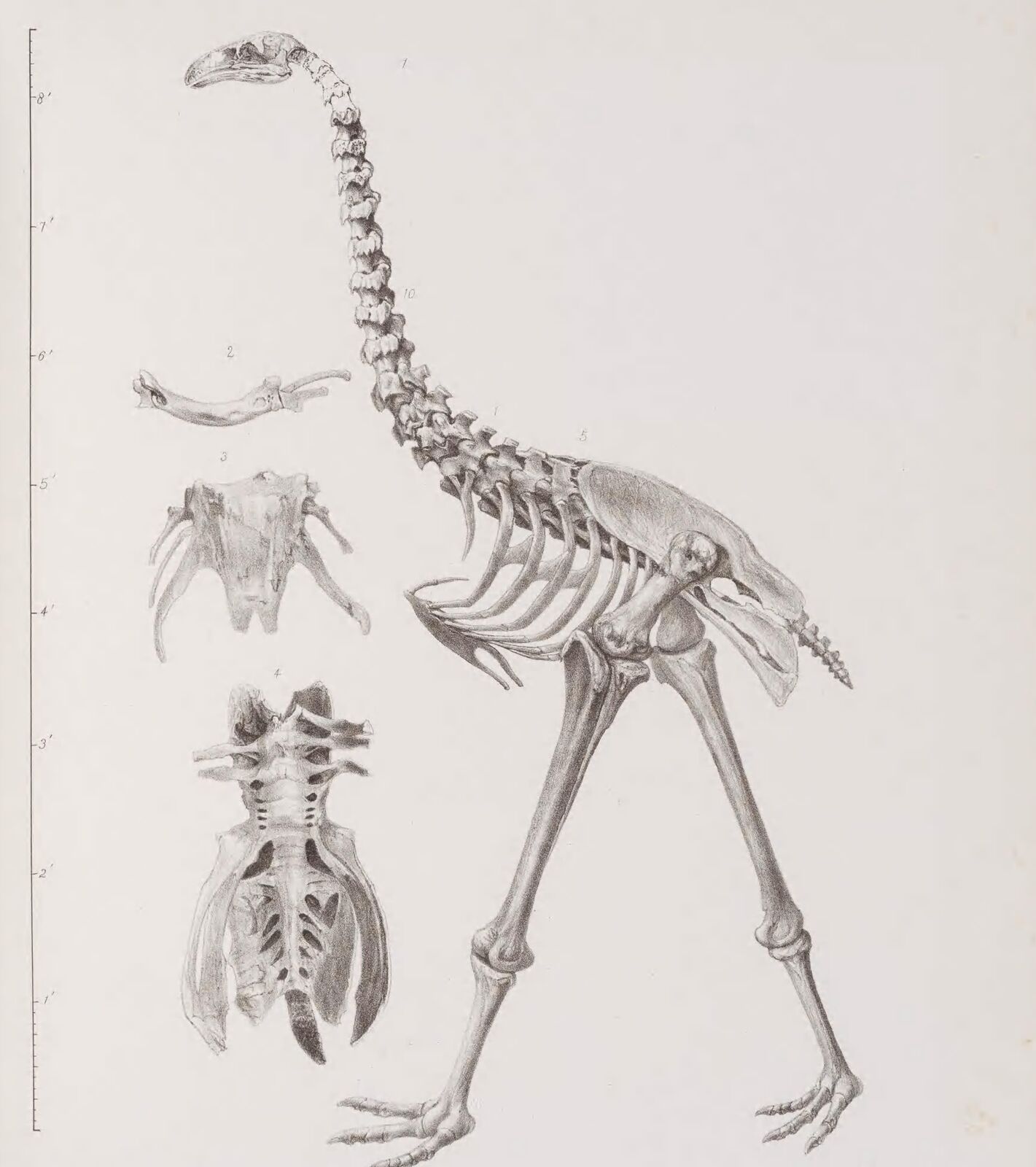
  14. Lithograph of the skeleton of a South Island giant moa in side view beside a vertical scale in feet: long arched neck, small head, deep ribcage, broad pelvis and very long legs with no wing bones; details of the breastbone and pelvis drawn at left
    Illustration: J. Erxleben (on stone; 'R. Owen del.'), printed by M. & N. Hanhart; Plate XCVI in Richard Owen, Memoirs on the Extinct Wingless Birds of New Zealand, vol. 2 (London: John van Voorst, 1879). Scan: Auckland War Memorial Museum Library via Biodiversity Heritage Library / Internet Archive, 1879 · Public Domain · Source · Cropped to the plate (page margins, title and printer's credits removed); resized
    Last few thousand years

    The island giants fall

    Madagascar, New Zealand, Mauritius and beyond · event

    Elephant birds, moa and Haast’s eagle survived until people arrived. Their extinctions — within a few centuries of human settlement — begin the story told in the Extinct Birds archive.

    Established
    Continue to the extinct-birds archive Perry, G.L.W. et al. (2014). A high-precision chronology for the rapid extinction of New Zealand moa. Quaternary Science Reviews 105: 126–135.
Open questions

What scientists still debate

Today there are roughly 11,000 recognised species of birds. The exact number depends on which taxonomic authority is followed — species are split and lumped as research advances.

BirdLife International — Data Zone (global species list).

Competing ideas include “trees-down” gliding, “ground-up” running and leaping, and wing-assisted incline running (flapping to climb slopes, as young partridges do). Flight-related features may also have evolved more than once among feathered dinosaurs.

Debated