04 · Extinct birds

The Archive
of Lost Birds

A digital museum of species that no longer exist. At least 187 bird species are confirmed or suspected to have gone extinct since 1500 — most of them island birds, most because of hunting, introduced predators and the destruction of their habitats.

Figure: BirdLife International (2022), State of the World’s Birds. Extinction dates below are the last confirmed records or best estimates, and are labelled as such.
The collection

9 species, 9 stories

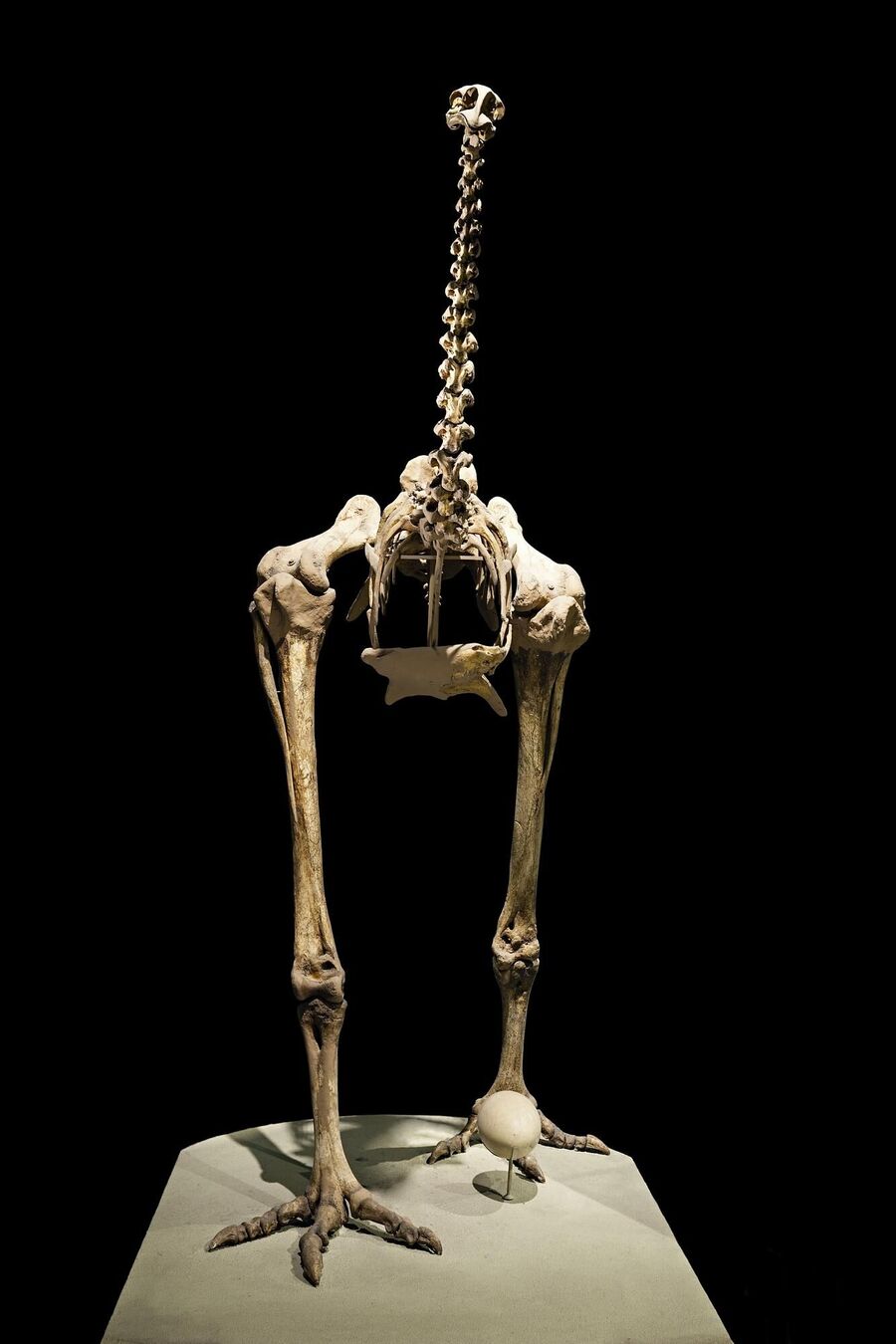
  1. (01)South Island Giant Moa
    Museum photograph of the mounted skeleton of a South Island giant moa seen from the front against a black background: a very long upright neck, broad pelvis and massive, long leg bones standing on a grey plinth
    Dinornis robustusSouth Island, New Zealandc. 1420–1470 CE (most likely c. 1440–1445), estimatedHunting & harvesting · Habitat destruction
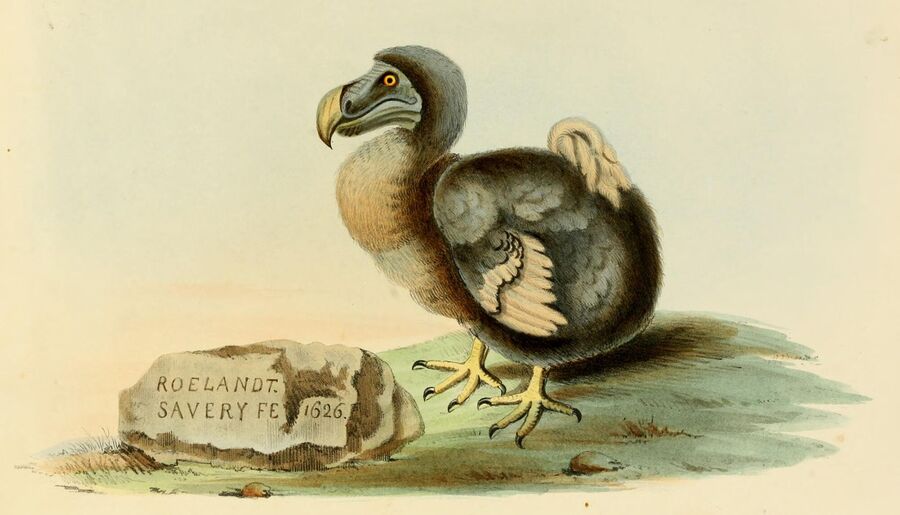
  2. (02)Dodo
    Hand-coloured lithograph of a dodo standing on a grassy patch beside a rock inscribed 'Roelandt Savery fe 1626': a plump grey bird with a large hooked yellowish bill, small pale wings and a curled tuft of tail feathers
    Raphus cucullatusMauritius, Indian OceanLast accepted sighting 1662; extinct by c. 1693 at the latestHunting & harvesting · Introduced predators · Introduced herbivores & competitors
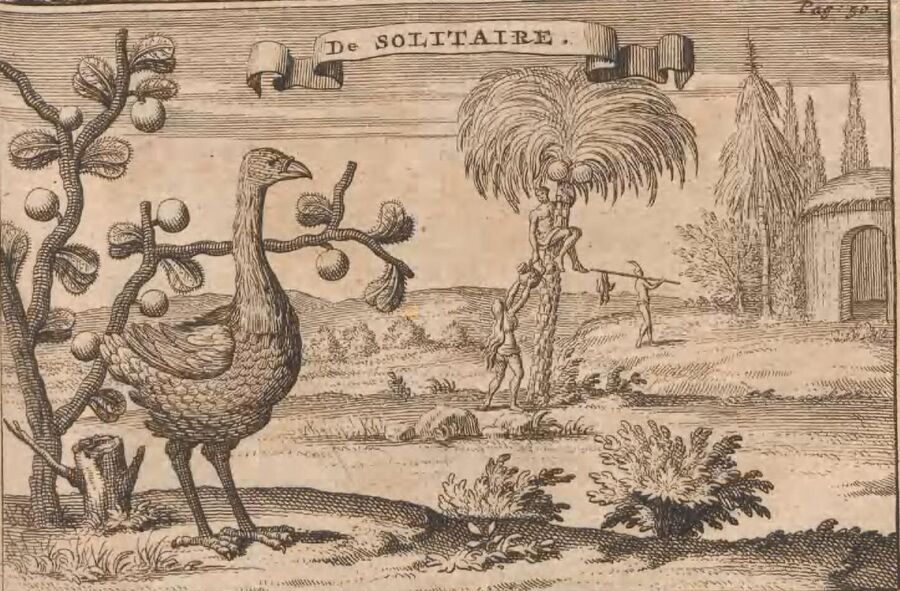
  3. (03)Rodrigues Solitaire
    Copper engraving titled 'De Solitaire': a tall, long-necked solitaire stands among fruiting shrubs in the foreground, while in the background people climb a palm tree and another walks with a pole on his shoulder past a hut on Rodrigues
    Pezophaps solitariaRodrigues, Mauritius, Indian OceanReported as rare in 1761; probably extinct in the 1760sHunting & harvesting · Introduced predators · Habitat destruction
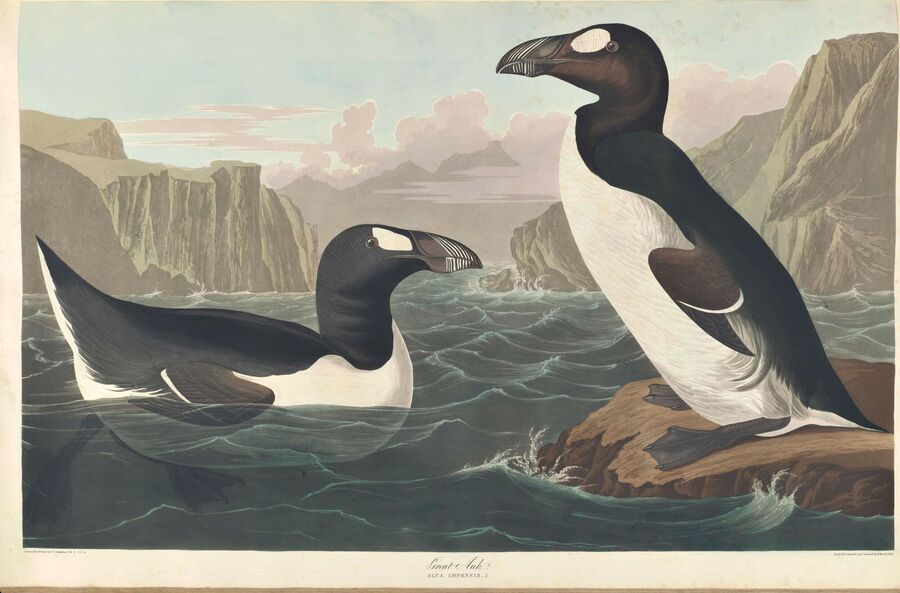
  4. (04)Great Auk
    Hand-coloured engraving of two great auks on a rocky North Atlantic shore: large upright black-and-white seabirds with heavy grooved bills and a white patch in front of each eye, one on a rock and one among breaking waves, with cliffs behind
    Pinguinus impennisNorth Atlantic: Canada, Greenland, Iceland, Faroe Islands, Britain and IrelandLast confirmed pair killed June 1844; a live bird reported in 1852Hunting & harvesting · Specimen & trade collecting
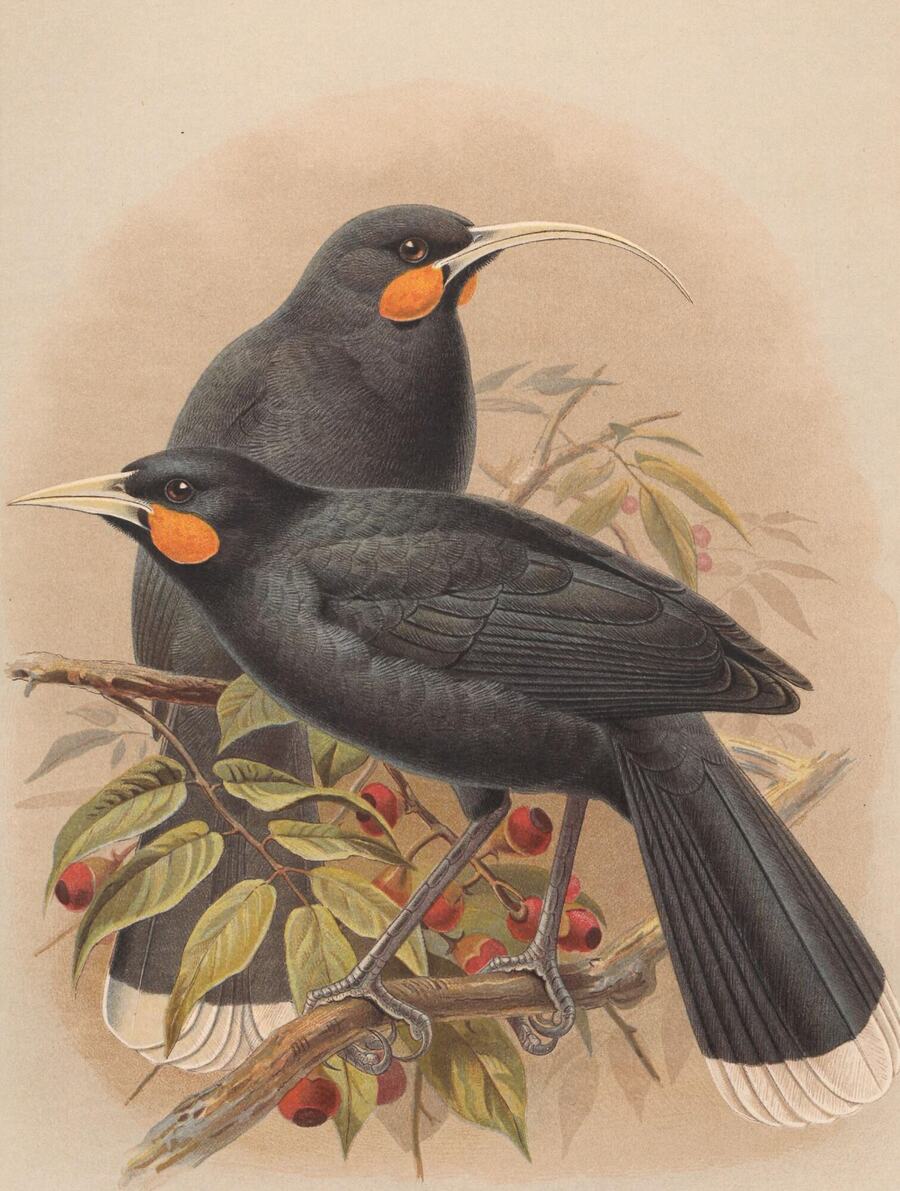
  5. (05)Huia
    Hand-coloured lithograph of a pair of huia on a berry-laden branch: the male in front with a short, stout bill and the female behind with her long, curved bill; both black with orange wattles and white-tipped tails
    Heteralocha acutirostrisNorth Island, New ZealandLast “generally accepted” record 1907 (now questioned); unconfirmed reports into the 1920sHabitat destruction · Introduced predators · Hunting & harvesting · Specimen & trade collecting · Disease
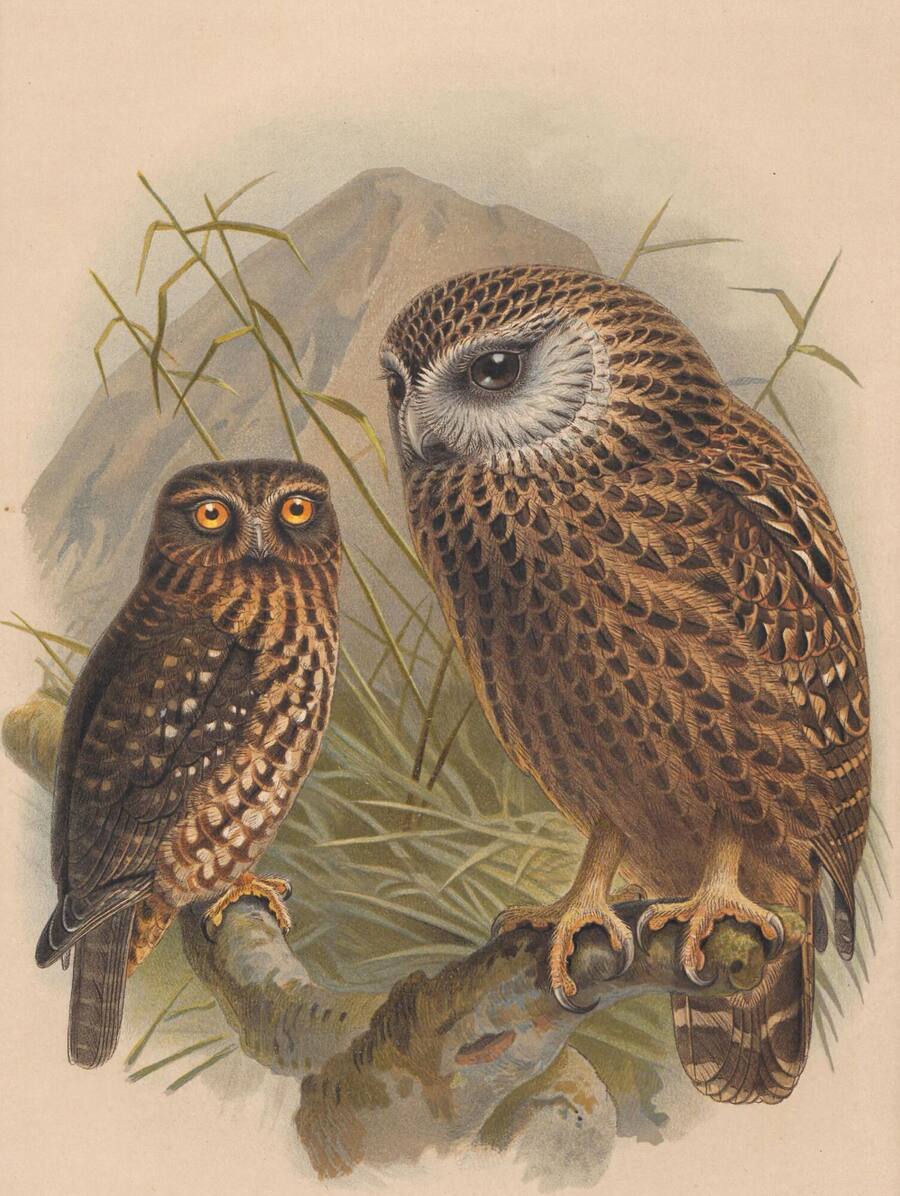
  6. (06)Laughing Owl
    Hand-coloured lithograph of a laughing owl perched on a mossy branch, large and streaked brown with a pale whitish face, beside a smaller dark morepork, with tussock grass and a mountain behind
    Ninox albifaciesNew ZealandLast confirmed record 1914 (found dead); probably extinct by c. 1940Introduced predators · Habitat destruction · Specimen & trade collecting
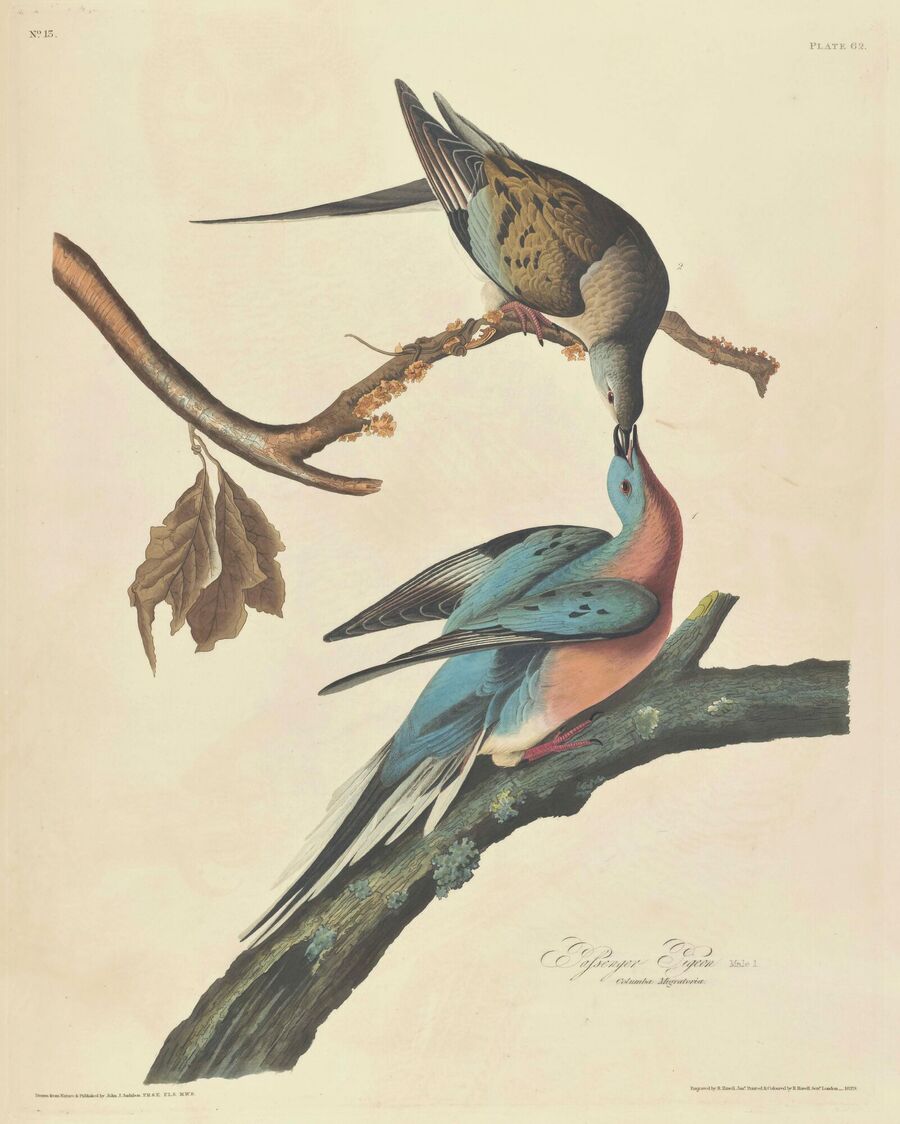
  7. (07)Passenger Pigeon
    Hand-coloured engraving of a pair of passenger pigeons on bare branches: the brownish female above leans down to meet the blue-grey, rose-breasted male below, beak to beak
    Ectopistes migratoriusEastern and central North AmericaLast wild records 1900–1902; last captive bird died 1 September 1914Hunting & harvesting · Habitat destruction
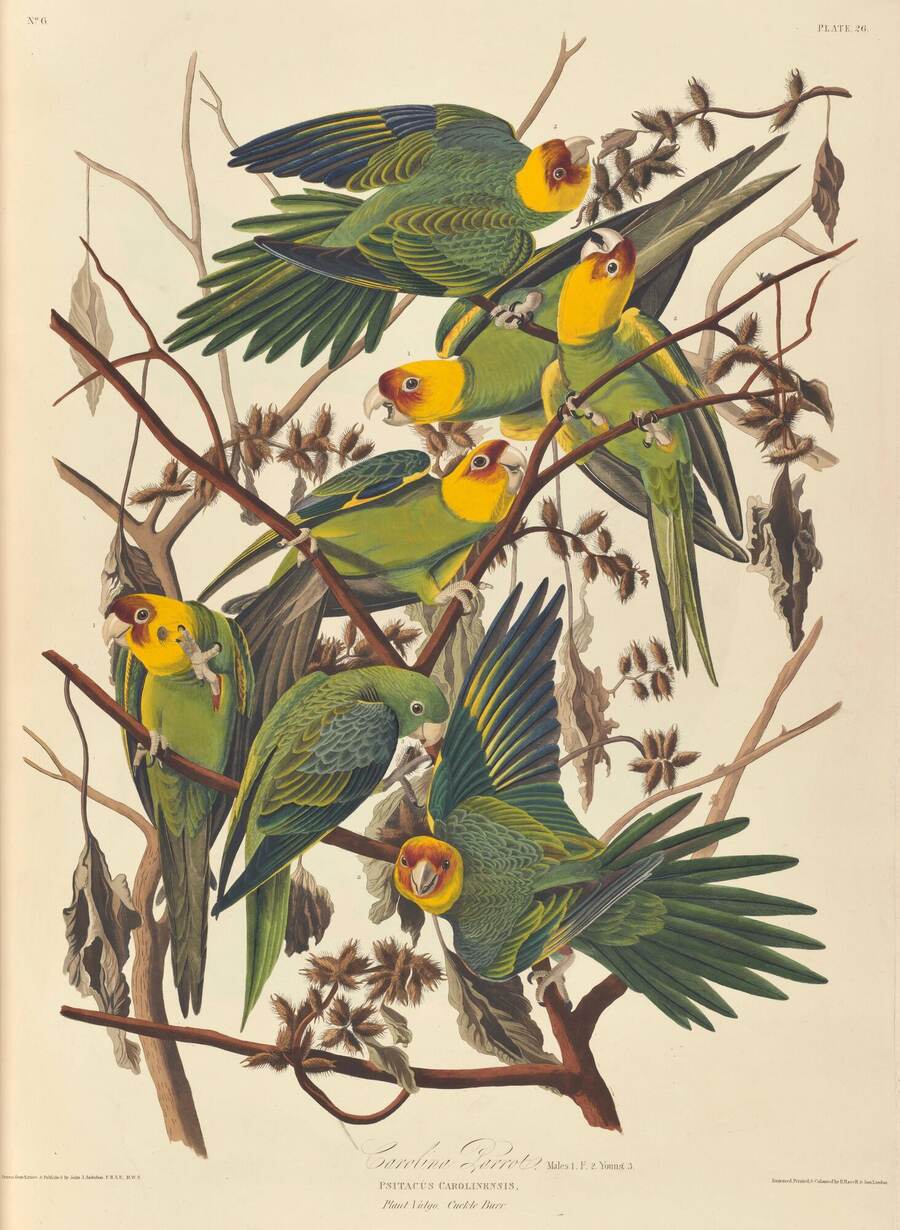
  8. (08)Carolina Parakeet
    Hand-coloured engraving of seven Carolina parakeets clambering and feeding among cocklebur stems: green birds with yellow heads and orange-red faces, and one all-green young bird
    Conuropsis carolinensisEastern and central United StatesLast captive bird died 21 February 1918; last accepted wild records 1904–1910, with later claims debatedPersecution · Habitat destruction · Hunting & harvesting
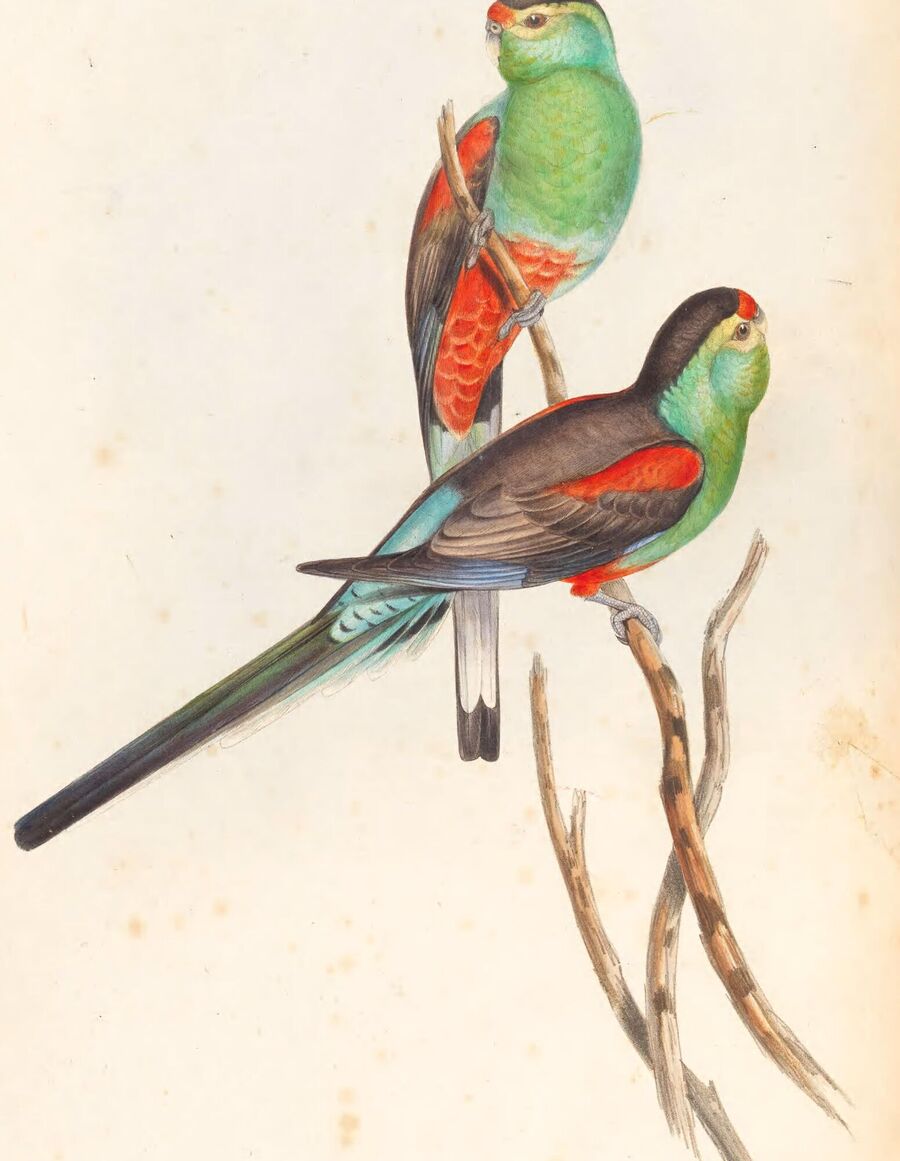
  9. (09)Paradise Parrot
    Hand-coloured lithograph of two paradise parrots perched on bare twigs: slender, long-tailed parrots with turquoise faces and breasts, a dark cap with a red forehead, scarlet shoulder patch and belly, and dark brown back
    Psephotellus pulcherrimusSouth-eastern Queensland, AustraliaLast confirmed sighting 1927; later reports unconfirmedIntroduced herbivores & competitors · Other / unknown · Habitat destruction · Introduced predators · Specimen & trade collecting
The full timeline ↓
Extinction timeline

A thousand years of loss

29 documented extinctions, from the giant birds of Madagascar and New Zealand to the last Hawaiian honeycreepers. Filter by region or cause, and select a point to read its story.

Region
Cause
1000150016001700180019002000

Scale compressed before 1500. Filled markers have a full profile in the atlas.

Select a marker on the timeline, or browse the list below.

Why birds disappear

The causes

Most extinctions have more than one cause. Hunting, forest clearance and introduced animals — rats, cats, pigs, mongooses, monkeys — often acted together, and island birds that evolved without mammalian predators were especially vulnerable.

Extinctions in this timeline linked to each cause (a species can have several)

Counts refer only to the 29 extinctions in this atlas’s timeline, not to all bird extinctions.

Image creditsSouth Island Giant Moa — specimen: James Di Loreto / Smithsonian Institution, National Museum of Natural History (specimen USNM V 5521) · CC0 1.0 · Source · ResizedDodo — illustration: After Roelandt Savery (painting, 1626); lithograph by Vincent Brooks, frontispiece of H.E. Strickland & A.G. Melville, The Dodo and its Kindred (London, 1848). Scan: Smithsonian Libraries via Biodiversity Heritage Library / Internet Archive, 1848 · Public Domain · Source · Rotated upright; cropped to the image (page margins and caption removed); resizedRodrigues Solitaire — illustration: Engraving from François Leguat, De gevaarlyke en zeldzame reyzen (Utrecht: Willem Broedelet, 1708), Dutch edition of Leguat's Voyage et avantures (1708). Scan: Naturalis Biodiversity Center via Biodiversity Heritage Library / Internet Archive, 1708 · Public Domain · Source · Cropped to the lower engraving on the plate (upper engraving of a tree and page margins removed)Great Auk — illustration: John James Audubon (drawn from nature); engraved, printed and coloured by R. Havell, London, 1836. The Birds of America, Plate 341. Scan: Oak Spring Garden Foundation, Upperville, Virginia, via Internet Archive, 1836 · Public Domain · Source · Rotated upright; cropped to the plate area (page margins and binding removed); resizedHuia — illustration: J.G. Keulemans (drawn and lithographed), in W.L. Buller, A History of the Birds of New Zealand, 2nd ed., vol. 1 (1888). Scan: Naturalis Biodiversity Center via Biodiversity Heritage Library / Internet Archive, 1888 · Public Domain · Source · Cropped to the printed image area (page margins and caption removed); resizedLaughing Owl — illustration: J.G. Keulemans (drawn and lithographed), in W.L. Buller, A History of the Birds of New Zealand, 2nd ed., vol. 1 (1888). Scan: Naturalis Biodiversity Center via Biodiversity Heritage Library / Internet Archive, 1888 · Public Domain · Source · Cropped to the printed image area (page margins and caption removed); resizedPassenger Pigeon — illustration: John James Audubon (drawn from nature); engraved, printed and coloured by R. Havell Jr. and R. Havell Sr., London, 1829. The Birds of America, Plate 62. Scan: Oak Spring Garden Foundation, Upperville, Virginia, via Internet Archive, 1829 · Public Domain · Source · Cropped to the plate area (page margins and binding removed); resizedCarolina Parakeet — illustration: John James Audubon (drawn from nature); engraved, printed and coloured by R. Havell & Son, London. The Birds of America, Plate 26 (vol. 1, issued 1827–1830). Scan: Oak Spring Garden Foundation, Upperville, Virginia, via Internet Archive, c. 1828 · Public Domain · Source · Cropped to the plate area (page margins and binding removed); resizedParadise Parrot — illustration: John Gould and H.C. Richter, The Birds of Australia, vol. 5 (London, 1848). Scan: State Library of New South Wales via Biodiversity Heritage Library / Internet Archive, 1848 · Public Domain · Source · Cropped (page margins and edge staining removed); resized