Passenger Pigeon
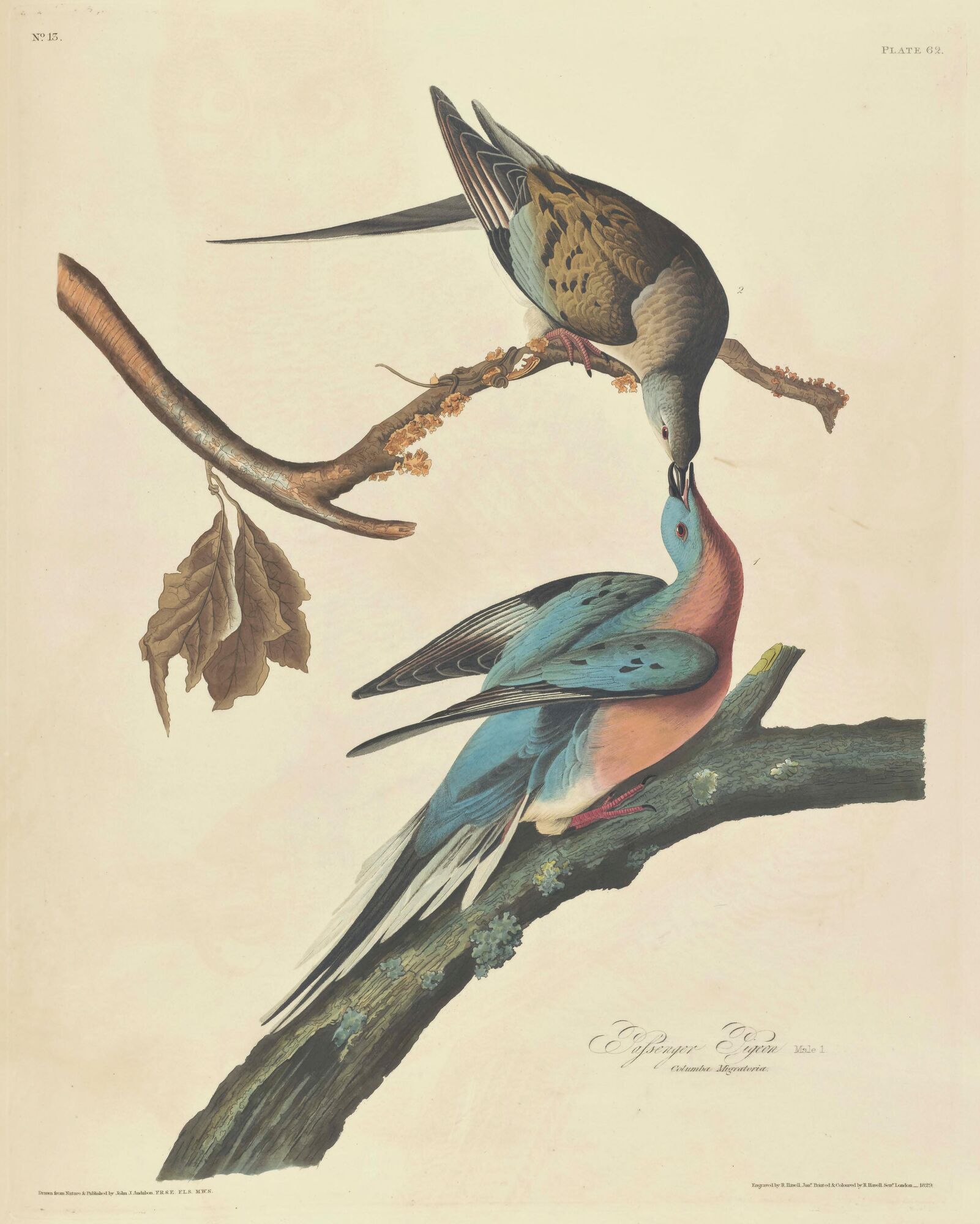
Once perhaps the most abundant bird in North America, it was gone from the wild within a few decades.
What it was like
The Passenger Pigeon was a nomadic forest pigeon of eastern North America that travelled and nested in flocks of millions. In the 19th century, forest clearance and industrial-scale hunting, helped by railways and the telegraph, drove it from abundance to extinction. The last known bird, Martha, died at Cincinnati Zoo on 1 September 1914.
Appearance
A slender, long-tailed pigeon with a small head and pointed wings, built for fast flight. The Smithsonian gives the male’s average length as about 16½ inches (c. 42 cm), with females about an inch shorter. Published weights for males are about 260–340 g.
Plumage & colour
Males were blue-grey above with a pinkish breast and iridescent neck feathers. Females were browner above and paler below, with duller colours.
Behaviour
Highly social. It foraged in flocks of millions and nested in April or May in vast colonies, typically about 16 by 5 km (BirdLife International). BirdLife suggests that scouting for food and sharing information probably required flocks above a certain size, and that below it survival would have suffered.
Measurements: Smithsonian Institution (length, converted from inches); weight of males as summarised by Wikipedia (citing Fuller 2014)
Did you knowMartha’s museum placard records that she died at 1 p.m. on 1 September 1914, at the age of 29.
Historical range shown at country level (countries of regular occurrence). Historical range. Occasional wanderers to Mexico and Cuba are not shown.
- Where
- Forests of eastern and central Canada and the United States, occasionally wandering south to Mexico and Cuba.
- Continents
- North America
- Habitat
Deciduous and mixed forests where beech, oaks and chestnuts produced large crops of nuts (mast). Its nesting habitat was largely lost as these forests were cleared for farming.
- Movement · nomadic
- Moved in huge flocks to wherever tree seed crops were good, so the places it nested and fed changed from year to year.
What it ate
Mainly tree mast: beechnuts, acorns and chestnuts (BirdLife International).
Feeding strategy
Flocks found and exploited seasonally abundant crops of tree seeds, moving on as crops were used up. A study of acorn production over the past 21,000 years (Hung et al. 2014) suggests its food supply varied greatly from year to year.
- PlantBeechnuts
- PlantAcorns
- PlantChestnutsAmerican chestnut.
What hunted it
The animals that preyed on the Passenger Pigeon, grouped by the life stage they attacked.
EggsWho ate its eggs
No predators documented at this stage.
ChicksWho killed its chicks
No predators documented at this stage.
AdultsWho killed grown birds
- PeoplePeopleDocumentedShot and netted in huge numbers, including for commercial markets.
Natural predation on Passenger Pigeons is not covered by the sources used here. People were by far the most important predator in the 19th century.
Its place in nature
Flocks of millions concentrated on tree seed crops and gathered in vast roosts and nesting colonies. Ecologists have hypothesised that they shaped eastern forests: by eating huge quantities of acorns and nuts; by breaking branches and covering the ground with dung at roosts; and possibly by changing fire patterns that favoured some oaks. These are plausible but untested ideas, because the bird vanished before it could be studied.
- Feeds onDocumentedBeech, oaks and American chestnut
Its main foods were the nuts of these trees (BirdLife International).
- Competes withHypothesisedWhite-footed mouse
Blockstein (1998) suggested that pigeon flocks eating acorns in mast years would have reduced food for mice. Mice are a key host of the Lyme disease bacterium. This is an untested hypothesis.
How it disappeared
- Extinct
- Last wild records 1900–1902; last captive bird died 1 September 1914
- Last confirmed record
- Wild: bird shot near Laurel, Indiana, 3 April 1902 (Indiana Historical Bureau), or the earlier Pike County, Ohio, bird of 24 March 1900 (BirdLife’s “1900”). Captive: Martha, died at 1 p.m. on 1 September 1914, Cincinnati Zoological Garden.
- Where
- Eastern and central North America
In the early 19th century the Passenger Pigeon lived in flocks of millions and nested in colonies that, according to BirdLife International, typically covered an area of about 16 by 5 km.
The same habits made them easy to exploit. As eastern forests were cleared, the birds lost food and nesting sites. The telegraph let hunters learn where colonies had formed, and railways carried their catches to city markets. Enormous numbers were killed.
By the 1890s only scattered birds remained. The last wild birds were shot in 1900 in Ohio and, according to later research, in 1902 in Indiana. A search in 1910–1911 found none.
A few survived in captivity. Martha, the last of them, died at Cincinnati Zoo on 1 September 1914. Her body was frozen and sent to the Smithsonian Institution.
The human role
Human-caused. Large-scale forest clearance and commercial hunting are considered the main drivers. Hung et al. (2014) hypothesised that natural population swings made the species more vulnerable, but this interpretation is disputed by Murray et al. (2017).
About the date. BirdLife International gives 1900 as the last reliable wild record and notes that searches in 1910–1911 found none. Schorger chose a bird shot at Sargents, Pike County, Ohio, on 24 March 1900. Later research by Joel Greenberg, followed by the Indiana Historical Bureau, accepts a bird shot near Laurel, Indiana, on 3 April 1902. It was verified by the ornithologist Amos Butler, but the specimen was later destroyed. The species ended with the death of Martha in captivity in 1914.
What was lost
Eastern North America lost a bird that, in sheer numbers, may have been a major consumer of tree seeds and a source of large disturbances in forests. Proposed consequences, such as changes in oak regeneration, forest structure and Lyme disease risk, are hypotheses that cannot now be tested.
Historical population
The commonly quoted figure is 3–5 billion birds in the 1800s. This is a historical estimate based on observers’ accounts, not a count. Genetic studies disagree about whether such numbers were typical over the long term.
- Oaks, beech and other mast trees
With billions of birds eating acorns and nuts, their loss may have changed which seeds survived to become trees. It has been proposed that pigeon roosts, through dung, branch breakage and fires, favoured certain oak species. This may have influenced the make-up of eastern forests. Forest clearance and the many other changes since European settlement make any such effect impossible to isolate.
- White-footed mice and Lyme disease
Blockstein (1998) proposed that, without pigeons eating mast, mouse populations boom more after good acorn years, which could increase Lyme disease risk. Blockstein himself has said the idea cannot be tested and does not claim pigeons would have prevented Lyme disease.
- Forest soils at roost and nesting sites
Huge roosts deposited large amounts of dung, adding nutrients to the soil and killing ground vegetation. These local disturbances ended with the species, but their long-term effects were never measured.
Uncertainty. The scale and even the stability of the pigeon’s population are debated. Hung et al. (2014) argued that its numbers fluctuated greatly; Murray et al. (2017) found evidence of a large population whose low genetic diversity was shaped by natural selection, which contradicts the fluctuation explanation. Ecological effects of its loss remain unmeasured.
Legacy
No effective protection came in time. A search in 1910–1911 found no wild birds. The Passenger Pigeon became a lasting warning that even the most abundant species can be lost, and Martha’s mounted body is kept by the Smithsonian Institution.
Sources
Conservation status: IUCN Red List (assessed by BirdLife International), assessed 2019. Media credits accompany each image and recording; see Sources & credits.
Taxonomy. Genomic work (Murray et al. 2017) compared it with band-tailed pigeons, described as its closest living relatives.
- BirdLife International (2019). Species factsheet: Passenger Pigeon Ectopistes migratorius.
- Hung, C.-M. et al. (2014). Drastic population fluctuations explain the rapid extinction of the passenger pigeon. PNAS 111: 10636–10641.
- Murray, G.G.R. et al. (2017). Natural selection shaped the rise and fall of passenger pigeon genomic diversity. Science 358: 951–954.
- U.S. Fish & Wildlife Service. Passenger pigeon (Martha’s museum display and placard).
- Indiana Historical Bureau. Historical marker: Passenger Pigeon Extinction (Laurel, 1902), with review notes.
- Smithsonian Institution. Spotlight: The passenger pigeon.
- Johnson, M. (2018). What does the passenger pigeon have to do with Lyme disease? WisContext / WPR (on Blockstein’s hypothesis).
- Wikipedia. Passenger pigeon (summary of the size, ecology and forest-structure hypotheses, incl. Ellsworth & McComb 2003).