Great Auk
A flightless North Atlantic seabird hunted from millions to none, its last pair killed for collectors.
What it was like
The Great Auk was a large, flightless diving seabird that bred on rocky islands across the North Atlantic. From about 1500 onwards European seamen killed it for meat, eggs, feathers and oil, and as it became rare collectors paid for the last specimens. The last confirmed pair was killed in Iceland in June 1844.
Appearance
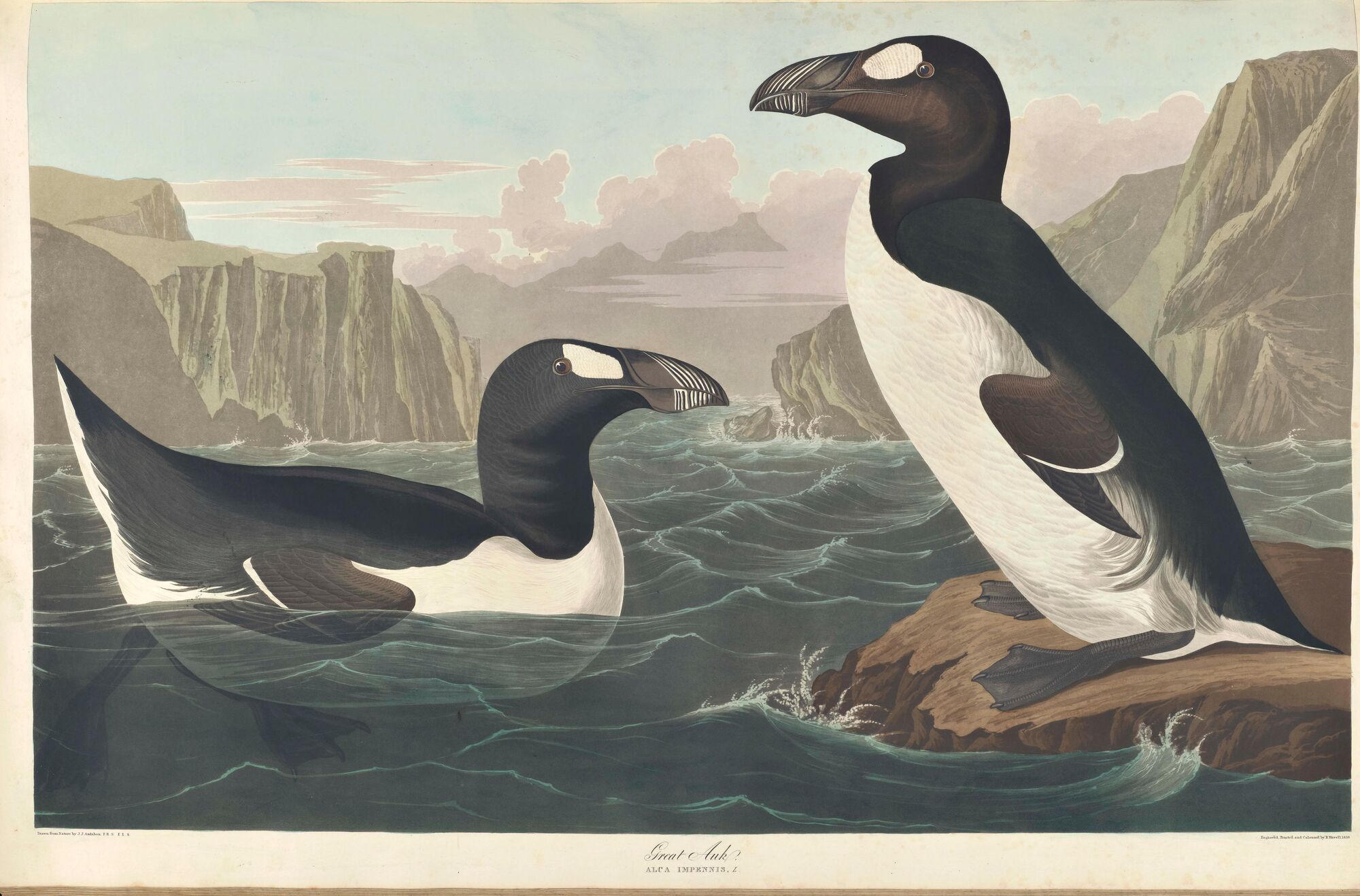
A large, upright, flightless auk with short wings used for swimming underwater, and a deep, heavy, grooved bill. The Canadian Encyclopedia gives a length of about 65 cm and a probable weight of 5.5–8 kg. Other published estimates differ, because all measurements come from old skins, eggs and bones.
Plumage & colour
Black back and white underparts. In summer it had a large white patch in front of each eye, which Audubon described as “a large oblong patch”. In winter this patch was replaced by other white markings. The black bill was crossed by white grooves.
Behaviour
Bred in dense colonies. Each pair laid a single large egg directly on bare rock, and the whole breeding cycle took about seven weeks. On land it was slow and could not fly, so whole colonies could be driven and killed by people.
Measurements: The Canadian Encyclopedia (D.N. Nettleship), estimates based on museum material
Did you knowBy the time of the last confirmed Great Auks, their skins and eggs had become valuable collectors’ items. BirdLife describes specimen collecting as the immediate cause of the extinction.
Historical range shown at country level (countries of regular occurrence). Historical range. Winter range at sea is approximate; archaeological records are not mapped.
- Where
- Bred in scattered colonies across the North Atlantic, from Canada (notably Funk Island, Newfoundland) through Greenland, Iceland and the Faroe Islands to Britain and Ireland. Wintered at sea south to New England and southern Spain. Archaeological finds extend from European Russia to France.
- Continents
- North America · Europe
- Habitat
Lived at sea and came ashore only to breed. In historical times it bred only on remote, rocky islands, probably because it had already been wiped out from easier-to-reach sites (BirdLife International).
- Movement · migratory
- Left its breeding islands after the summer and dispersed south at sea, reaching New England and southern Spain in winter.
What it ate
Adults dived for fish. Stable-isotope work on bones suggests that immature birds probably fed on plankton (BirdLife International, citing Hobson & Montevecchi 1991).
Feeding strategy
Pursued prey underwater, using its wings to swim.
- FishFishMain food of adults. Exact prey species are not well documented.
- InvertebratePlanktonProbably eaten by immature birds.
What hunted it
The animals that preyed on the Great Auk, grouped by the life stage they attacked.
EggsWho ate its eggs
No predators documented at this stage.
ChicksWho killed its chicks
No predators documented at this stage.
AdultsWho killed grown birds
- PeoplePeopleDocumentedKilled in very large numbers for food, bait, feathers and oil, and finally for specimens.
Natural predators of the Great Auk were never recorded. Every documented cause of death in historical times involved people.
Its place in nature
The Great Auk was a large diving predator of fish in the North Atlantic. Its colonies were once very large; the Canadian Encyclopedia describes Funk Island as the largest and best documented. Like other colonial seabirds, it would have carried nutrients from the sea to its breeding islands, but no one measured this before it disappeared.
- Preys onDocumentedFish of the North Atlantic shelf
Adults dived for fish (BirdLife International). Which species mattered most is not well documented.
- Competes withHypothesisedRazorbill
Its closest living relative, which also dives for fish in the same waters. Whether the two competed for food has not been studied.
How it disappeared
- Extinct
- Last confirmed pair killed June 1844; a live bird reported in 1852
- Last confirmed record
- Last confirmed: two birds killed on Eldey, Iceland, 3 June 1844. Last reported: one live bird off the Newfoundland Banks, 1852 (accepted by BirdLife International).
- Where
- North Atlantic: Canada, Greenland, Iceland, Faroe Islands, Britain and Ireland
For centuries Great Auks bred in dense colonies on a few remote North Atlantic islands. Once European fishing fleets began working the Newfoundland banks around 1500, the flightless birds became an easy source of fresh meat. The crews of two fishing vessels were reported to have caught about 1,000 in half an hour.
Funk Island off Newfoundland held the largest known colony. Hunters stayed there through the summer to kill birds, using them for food and bait and, from the late 1700s, for feathers. By about 1800 the Funk Island colony had been destroyed.
The last birds survived on rocky islets off Iceland. As they grew rare, collectors and museums offered money for skins and eggs. In June 1844 men landing on Eldey killed the last known pair, at a time when collectors were paying for specimens. A single bird was reported off Newfoundland in 1852, and after that there were no more.
The human role
Entirely human-caused. Genetic and modelling evidence (Thomas et al. 2019) found no sign that the species was at risk before intensive human hunting began, and showed that hunting alone could have been enough to cause its extinction. Earlier, Bengtson (1984) had suggested, as a conjecture, that environmental change might also have contributed.
About the date. The last reliably recorded breeding pair was killed on Eldey, a rock off south-west Iceland, in June 1844. The Canadian Encyclopedia gives the date as 3 June; some popular sources say July. BirdLife International also accepts a live bird seen off the Newfoundland Banks in 1852, but Thomas et al. (2019) regard the reliability of post-1844 sightings as uncertain.
What was lost
The North Atlantic lost its largest diving seabird, a fish predator that bred in huge colonies. Effects on fish stocks and island nutrient cycles are plausible but were never measured and remain unknown.
Historical population
No counts were ever made. The species is thought to have numbered in the millions. Thomas et al. (2019) modelled starting populations of 2 and 6 million birds. They estimated that annual harvests of about 210,000 birds plus fewer than 26,000 eggs (for 2 million birds) would have caused extinction.
- Breeding islands (e.g. Funk Island)
Large seabird colonies generally fertilise their islands with droppings. Losing Great Auk colonies probably reduced this input of marine nutrients on some islands, but no historical measurements exist.
- Fish populations
A population thought to have numbered in the millions would have eaten a great deal of fish. Any effect of its loss on fish stocks cannot be separated from the much larger effects of human fishing.
Uncertainty. Very little was recorded about the Great Auk’s diet, numbers or colony sizes before it was wiped out. Any statement about its ecological effects is a hypothesis.
Legacy
No effective protection reached the Great Auk in time. Its story is now used to show that even an abundant, widespread species can be destroyed by intense, local exploitation (Thomas et al. 2019), and that collectors’ demand for rare specimens can speed up the end.
Sources
Conservation status: IUCN Red List (assessed by BirdLife International), assessed 2021. Media credits accompany each image and recording; see Sources & credits.
Taxonomy. The largest member of the auk family and its only flightless member in historical times. Genetic studies place it close to the Razorbill.
- BirdLife International (2021). Species factsheet: Great Auk Pinguinus impennis.
- Thomas, J.E. et al. (2019). Demographic reconstruction from ancient DNA supports rapid extinction of the great auk. eLife 8: e47509.
- Nettleship, D.N. (2006, updated 2015). Great Auk. The Canadian Encyclopedia.
- Audubon, J.J. Birds of America: Great Auk (plate and original text). National Audubon Society.
- Bengtson, S.-A. (1984). Breeding ecology and extinction of the Great Auk (Pinguinus impennis): anecdotal evidence and conjectures. The Auk 101: 1–12.