Great Hornbill
A giant fruit-eater that carries tree seeds for kilometres while the female waits sealed inside the nest.
Meet the bird
The Great Hornbill is one of the largest hornbills, found in the forests of South and South-East Asia. It eats mainly figs and other fruit and swallows seeds that it later drops far from the parent tree, which makes it an important disperser of large-seeded forest trees. During nesting the female seals herself into a tree cavity and depends entirely on the male for food. Forest loss and hunting have made it Vulnerable.
Appearance
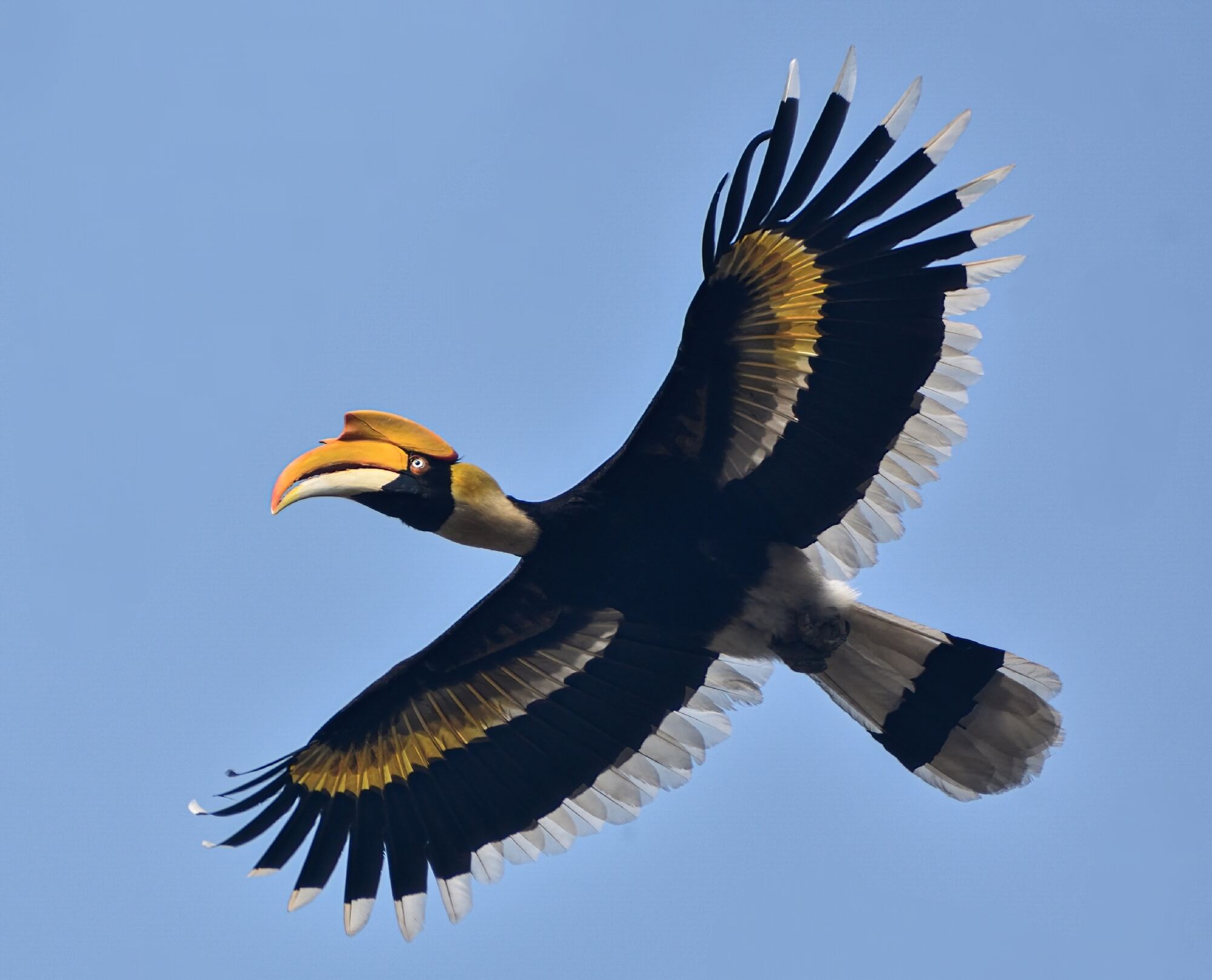
A very large, black-and-white hornbill with a huge yellow bill topped by a broad, flat casque. In the male the casque is forked at the front and edged with black. Flight is heavy, with deep wingbeats and long glides. Pairs often duet with loud, reverberating "kok" calls.
Plumage & colour
Mostly black and white, with a white neck, broad pale wing bands and a white tail crossed by a black band. Males have red eyes with a black rim; females have white eyes with a red rim and a smaller casque without black lines. Juveniles have blue-grey eyes, and the bill and casque take about five years to grow to full size.
Behaviour
Great Hornbills live in pairs or family groups and gather in large numbers at fruiting trees and communal roosts; on Langkawi (Malaysia) at least 150 have been seen at a fruiting fig. The nest is usually a tall, slit-like cavity in a large tree. The female enters it and seals the entrance, staying inside while the male brings food through the narrow opening. The chick hatches about 40 days after she enters, and the whole nesting period lasts about 120 days (102–144 days). Most nests produce a single chick. Females drop or regurgitate seeds while confined, so seedlings can sprout beneath nest trees.
Measurements: Length: sources disagree, Animal Diversity Web 95–120 cm vs. IUCN SSC Hornbill Specialist Group (male 121–150 cm, female 112–125 cm); weight: IUCN Hornbill Specialist Group (male 2,610–3,900 g, female 2,157–3,350 g); wingspan: Animal Diversity Web
Did you knowWhile she is sealed inside the nest, the female drops seeds from the fruit the male brings, so young trees can sprout beneath hornbill nests.
Range shown at country level (countries of regular occurrence). Now rare or highly localised in several countries (e.g. Viet Nam, Cambodia, Sumatra), and lost from many unprotected forests.
- Where
- India (Himalayan foothills, the hill forests of north-east India and the Western Ghats), Nepal, Bhutan, Bangladesh (Chittagong Hill Tracts), south-west China (Yunnan, south-east Tibet), Myanmar, Thailand, Laos, Viet Nam, Cambodia, Peninsular Malaysia and Sumatra (Indonesia). The bulk of the population is in India, mostly inside protected areas.
- Continents
- Asia
- Habitat
Wet evergreen and mixed deciduous forest, ranging into more open deciduous areas to visit fruiting trees, up to at least 1,560 m in southern India and 2,000 m in Thailand. It needs large, old trees for nesting and is most common in unlogged forest. In the Anamalai Hills of south-west India it also breeds in shade-coffee plantations where big nest and fig trees have been kept.
- Movement · resident
- Not migratory. Breeding pairs stay in small home ranges of about 0.7–7 km², but outside the breeding season birds roam widely to track fruiting trees, over about 50 km² in north-east India and up to 138 km² recorded in Thailand.
What it eats
Mainly fruit, especially figs, plus lipid-rich fruits of the custard-apple, laurel, mahogany and nutmeg families. It also eats flowers and buds and takes eggs, insects, amphibians, reptiles, small mammals and small birds.
Feeding strategy
Feeds in the canopy, often in pairs or family groups, and roams widely between fruiting trees. Figs make up a larger share of the diet outside the breeding season. Animal prey is caught by hopping along branches and probing crevices, then tossed in the bill to get a better grip.
- PlantFigs (Ficus spp.)A major part of the diet.
- PlantFruits of Annonaceae and LauraceaeLipid-rich drupes.
- PlantArillate fruits of Meliaceae and Myristicaceae (nutmeg family)Large-seeded fruits.
- InsectInsects and other arthropods
- OtherSmall mammals, birds, reptiles and amphibians
What eats it
The animals that prey on the Great Hornbill, grouped by the life stage they attack: its eggs, its chicks, or grown birds.
EggsWho eats its eggs
No predators documented at this stage.
ChicksWho kills its chicks
No predators documented at this stage.
AdultsWho kills grown birds
No predators documented at this stage.
Natural predation on Great Hornbills is not well documented in the sources consulted. People are the main documented cause of mortality, through hunting and the taking of chicks for the pet trade.
Its place in nature
Great Hornbills swallow whole fruits with large seeds that most smaller birds cannot handle, then fly long distances before dropping the seeds. A GPS-tracking study in Pakke Tiger Reserve found that breeding Great Hornbills carried 95% of the seeds they ate away from the feeding tree, with some seeds moved more than 2.5 km; non-breeding birds carried seeds more than 12 km (Naniwadekar et al. 2019). This makes hornbills key planters of large-seeded rainforest trees and links distant forest patches.
- Disperses seeds ofDocumentedLarge-seeded forest trees (nutmeg and mahogany families, among others)
The hornbill eats the large, oily fruits of these trees and disperses most of the seeds away from the parent tree, sometimes many kilometres away.
- Feeds onDocumentedFigs
Figs are a staple, especially outside the breeding season, and fruiting figs attract large gatherings of hornbills.
- Nests in / depends onDocumentedLarge nest trees (e.g. Tetrameles nudiflora, dipterocarps)
Pairs need big, old trees with natural cavities and often reuse the same nest. Logging of such trees removes nest sites, and hornbill abundance is correlated with the density of large trees.
What if it disappeared?
In parts of its range this scenario is already under way: the Great Hornbill has vanished from many unprotected forests in north-east India and South-East Asia. Studies of these places show what is lost.
Press Remove to see which organisms could be affected, how, and how confident scientists are. 3 possible effects are recorded for this species.
Other large hornbills, such as the Wreathed and Rhinoceros Hornbills, eat many of the same fruits, and Wreathed Hornbills also move seeds over long distances. They could partly fill the gap, but they face the same hunting and logging pressures, so they often decline at the same sites.
How many tree species depend on Great Hornbills specifically, rather than on hornbills in general, and how quickly forest composition would change without them, are not well known.
These scenarios summarise published ecology. They are not predictions: ecosystems are complex, other pressures interact, and documented, likely and hypothesised effects are labelled separately.
Conservation
- LCLeast Concern
- NTNear Threatened
- VUVulnerable
- ENEndangered
- CRCritically Endangered
- EWExtinct in the Wild
- EXExtinct
Listed on CITES Appendix I.
- Population estimate
- 13,000–27,000 mature individuals (precautionary estimate inferred from densities at study sites; data quality poor)
- Trend
- Decreasing
- Source
- BirdLife International factsheet (2020 assessment)
No reliable historical time series is available for this species, so no population chart is shown. We do not interpolate or estimate missing data.
Threats
- Forest loss and fragmentation
An analysis of 2000–2012 deforestation estimated 26% forest loss within the range over three generations. The species needs large tracts of forest and cannot persist where lowland forest has been reduced to small fragments; in its stronghold in north-east India only about 5% of the landscape offers suitable habitat.
- Hunting
Its predictable use of the same fruit trees and nest holes makes it easy to hunt. Birds are taken for food, for their casques and tail feathers used as ornaments, and for their fat, used in traditional medicine. In north-east India a casque can fetch up to US$90.
- Loss of nest trees
Logging removes the large, old trees with cavities on which breeding depends.
- Pet trade
Chicks are collected from nests for the pet trade, as reported in southern India and Thailand.
What is being done
Great Hornbills occur in many protected areas and are listed on CITES Appendix I. Community nest-protection programmes, nest boxes and long-term research in Thailand and India support breeding in the wild.
- Hornbill Nest Adoption Programme near Pakke Tiger Reserve, Arunachal Pradesh, India, since 2011.
- Hornbill nest adoption in Budo Sungai-Padi National Park, southern Thailand, since 1994.
- Long-term research at Khao Yai National Park, Thailand, since 1981, including active management of nest cavities.
- Nest monitoring with the Kadar community in Kerala and artificial nest boxes in Thailand and southern India.
- Bred in captivity in zoos.
A conservation story
In the foothill forests of Arunachal Pradesh, Nyishi people traditionally hunted hornbills for food and for casques and tail feathers used as adornments. In 2011 the Nature Conservation Foundation, the Ghora-Aabhe Society (a council of Nyishi village elders) and the Arunachal Pradesh Forest Department started the Hornbill Nest Adoption Programme in forests next to Pakke Tiger Reserve. Villagers, including former hunters, are paid to find, watch and protect hornbill nests, and the salaries are funded by donors who "adopt" a nest for Rs 6,000 or US$125 a year.
By 2024 the programme had protected about 40 nests of four hornbill species (Great, Wreathed, Oriental Pied and Rufous-necked), and 220 chicks had fledged from them. Outside the breeding season, the nest protectors also count hornbills at roosts and along forest transects, adding long-term data.
Nest protection does not stop forest loss or hunting away from the nests, and the species has already disappeared from many unprotected forests. Its long-term future depends on keeping large, connected tracts of forest with big trees, and on reducing hunting across its range.
Sources
Conservation status: IUCN Red List (assessed by BirdLife International), assessed 2020. Media credits accompany each image and recording; see Sources & credits.
- BirdLife International (2020 assessment). Species factsheet: Great Hornbill Buceros bicornis.
- IUCN SSC Hornbill Specialist Group. Great hornbill.
- Nature Conservation Foundation. Hornbill Nest Adoption Program (Eastern Himalaya).
- Mongabay India (2019). How far do hornbills disperse seeds? Reporting Naniwadekar, R., Rathore, A., Shukla, U., Chaplod, S. & Datta, A. (2019), Acta Oecologica 101: 103482.
- Paruchuri, S. (2011). Buceros bicornis. Animal Diversity Web, University of Michigan.