Great Tit
Europe’s most-studied wild bird — and a test case for how climate change can put nature out of step.
Meet the bird
The Great Tit is a large, boldly marked tit of woods, parks, orchards and gardens across Europe and Asia and into North Africa. It feeds its young on caterpillars timed to the spring peak of leaf-eating insects, which has made it a model species for studying how warming springs can desynchronise predators and prey. Because it readily uses nest boxes, long-term studies of great tits have shaped much of modern bird ecology.
Appearance
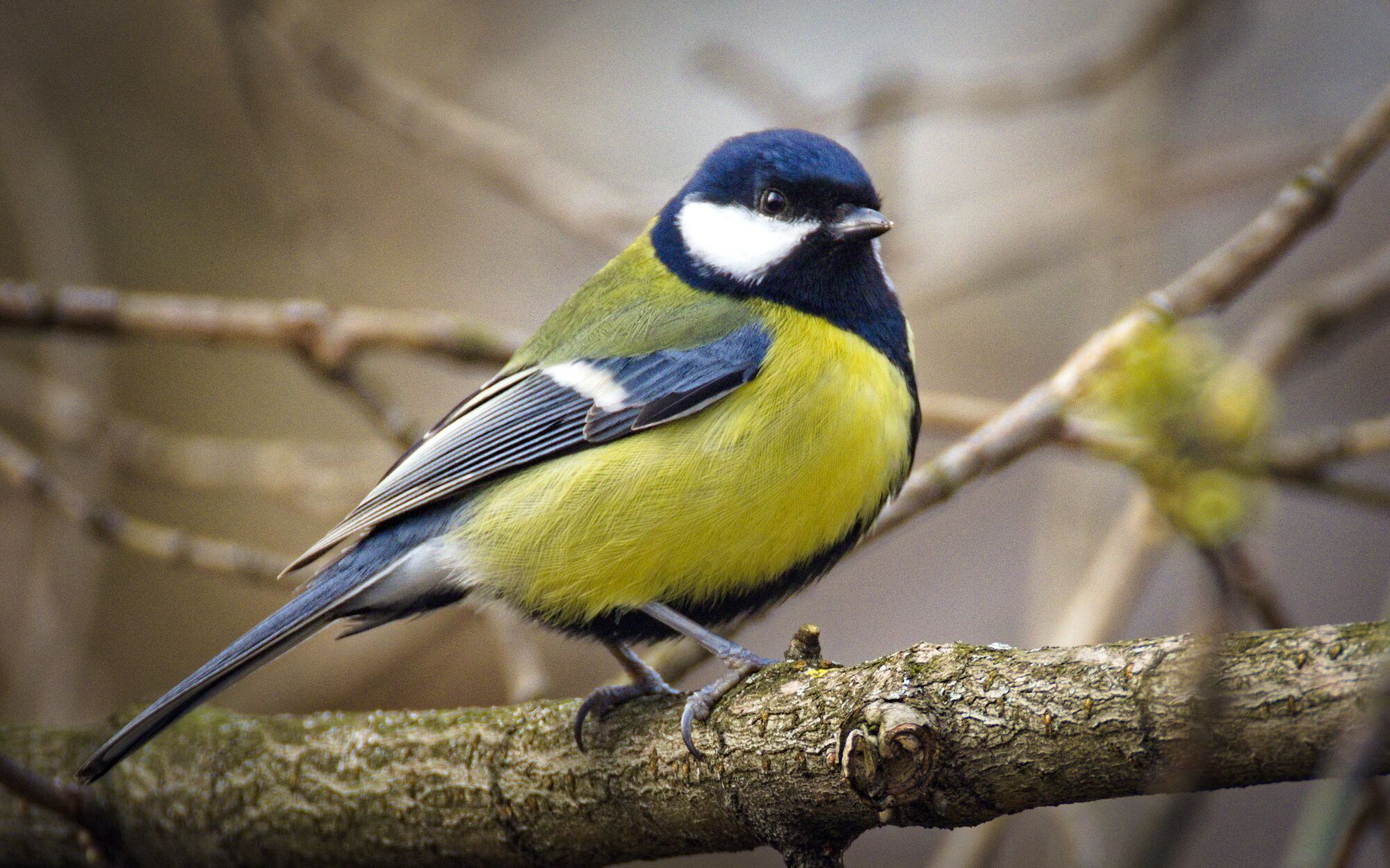
The largest common tit in Europe: a stocky small songbird with a short, strong bill. Glossy black head and throat with large white cheek patches; a black stripe runs from the throat down the centre of the yellow breast and belly.
Plumage & colour
Black head, white cheeks, green back, blue-grey wings and tail, and a yellow belly divided by a black stripe. Males have a broad black belly stripe — its width signals status and attractiveness to females — whereas females have a much thinner stripe.
Behaviour
A hole-nester that readily uses nest boxes, which has made it one of the world’s best-studied wild birds. The female builds a nest of moss, grass, hair and feathers in a tree cavity, wall or nest box. In Britain, clutches are typically 7–9 eggs, incubation takes about 13–14 days and the young fledge after about 18–21 days; usually one brood is raised. They are bold and adaptable foragers: great tits have even been recorded searching out, killing and eating hibernating bats in winter (Estók et al. 2010).
Measurements: Length and wingspan: The Wildlife Trusts (Wildlife Watch species guide; other guides give slightly wider ranges, c. 12.5–15 cm and 22–26 cm). Weight (5th–95th percentile of adults, n = 42,606; mean 18.6 g) and longevity: BTO BirdFacts.
Did you knowGreat tits have been recorded hunting, killing and eating hibernating bats in winter — a remarkable switch for a bird best known for eating caterpillars and seeds (Estók et al. 2010).
Shown at continent level — this species is too widespread for a country list. Consult BirdLife International or eBird for detailed range maps. Occurs as a resident in around 80 countries (BirdLife International). Under the narrower IOC treatment, birds of southern and eastern Asia belong to Cinereous and Japanese Tits.
- Where
- Throughout Europe (absent only from the far north and Iceland) and North Africa (Morocco to Tunisia), east across the Middle East, Central Asia and Siberia to China, Korea and Japan, and — under BirdLife’s broad species concept — south through the Indian subcontinent and South-East Asia to Indonesia.
- Continents
- Europe · Asia · Africa
- Habitat
Mostly open deciduous and mixed forest, woodland edges and clearings, including conifer forest and taiga. Also plantations, hedgerows, orchards, olive groves, parks and gardens — almost any group of trees or bushes. Recorded up to 4,420 m in Asia.
- Movement · resident
- Generally resident, but makes seasonal altitudinal movements and is partially eruptive, with larger movements in some years when food is scarce.
What it eats
In the breeding season mainly insects — above all caterpillars — and spiders. In autumn and winter it adds seeds, nuts (especially beech mast) and berries, and readily visits garden feeders.
Feeding strategy
Forages in the canopy, on branches and on the ground. Nestlings are fed mostly on protein-rich caterpillars, so breeding is timed to the short spring peak in caterpillar abundance. In winter it often feeds on the ground, particularly in years with heavy beech mast.
- InsectCaterpillars (e.g. winter moth)Main nestling food in spring.
- InvertebrateOther insects and spiders
- PlantBeech mast and other seedsImportant in autumn and winter.
- PlantBerriesAutumn and winter.
What eats it
The animals that prey on the Great Tit, grouped by the life stage they attack: its eggs, its chicks, or grown birds.
EggsWho eats its eggs
- BirdGreat Spotted WoodpeckerDocumentedRaids tit broods in nest boxes; predation depends strongly on nest-box design.
ChicksWho kills its chicks
- BirdGreat Spotted WoodpeckerDocumentedTakes nestlings, especially from wooden nest boxes.
- MammalLeast weaselDocumentedRaids nests; predation varies with rodent and tit density (Dunn 1977).
AdultsWho kills grown birds
- BirdEurasian SparrowhawkDocumentedA major predator of adult and fledgling tits.
- MammalLeast weaselDocumentedCan take incubating or brooding adults on the nest.
Predation on great tits is well documented thanks to nest-box studies. Studies by Götmark (2002) and Götmark & Andersson (2005) found that sparrowhawk predation favours early breeding and small broods, and that predation decreases with increasing great tit breeding density.
Its place in nature
Great tits are among the most abundant insect-eating birds of European woodland and farmland. Experiments in Dutch apple orchards showed that great tits attracted by nest boxes reduced caterpillar damage to fruit. They are also prey for sparrowhawks and other predators, and compete with other hole-nesting birds such as flycatchers for nest sites.
- Preys onDocumentedWinter moth and other leaf-eating caterpillars
Nestlings are fed mainly on caterpillars. In a Dutch population, great tit laying dates had not advanced over 23 years despite warmer springs, while selection for early laying intensified — evidence that breeding had become mistimed relative to the caterpillar food peak (Visser et al. 1998).
- Preys onDocumentedOrchard pest caterpillars
In an experimental Dutch apple orchard, plots with great tits had less caterpillar damage (11.2% vs 13.8% of fruit) and higher yields (7.8 vs 4.7 kg per tree) than plots without birds (Mols & Visser 2002); a later study in commercial orchards reported damage reductions of up to about 50% (Mols, Visser & Jones 2007).
- Preyed on byDocumentedEurasian Sparrowhawk
Sparrowhawks are a major predator of great tits; studies link predation risk to breeding timing and density.
- Competes withDocumentedEuropean Pied Flycatcher
The two species compete for nest holes. Great tits can kill prospecting male flycatchers, and this fatal competition increases when flycatchers arrive late relative to tit breeding (Samplonius & Both 2019).
- Preys onDocumentedHibernating pipistrelle bats
Great tits have been recorded searching for, capturing, killing and eating hibernating pipistrelle bats in winter (Estók et al. 2010). This is unusual, opportunistic behaviour.
What if it disappeared?
The Great Tit is one of Europe’s commonest birds and not threatened. Its loss is a thought experiment; because many other insectivores share its diet, effects would probably be modest and uneven.
Press Remove to see which organisms could be affected, how, and how confident scientists are. 4 possible effects are recorded for this species.
Blue tits, other tits and many other woodland insectivores take similar caterpillars and would probably absorb much of the great tit’s role, though not necessarily in orchards or gardens where great tits dominate.
The extent to which great tits regulate caterpillar outbreaks in natural forests, as opposed to experimental orchards, is not well established.
These scenarios summarise published ecology. They are not predictions: ecosystems are complex, other pressures interact, and documented, likely and hypothesised effects are labelled separately.
Conservation
- LCLeast Concern
- NTNear Threatened
- VUVulnerable
- ENEndangered
- CRCritically Endangered
- EWExtinct in the Wild
- EXExtinct
Green-listed in the UK Birds of Conservation Concern. Listed on Appendix II of the Bern Convention.
- Population estimate
- c. 423,000,000–683,000,000 mature individuals (very preliminary global estimate, extrapolated from 127,000,000–205,000,000 in Europe)
- Estimate year: 2018
- Trend
- Stable
- Source
- BirdLife International factsheet (2024 assessment), citing BirdLife International (2021) European Red List of Birds. UK: c. 2.4 million territories in 2016 (APEP4, via BTO).
No reliable historical time series is available for this species, so no population chart is shown. We do not interpolate or estimate missing data.
Threats
- Climate-driven mismatch with caterpillar food
Increased spring temperatures can advance the caterpillar peak faster than great tits advance their breeding, lowering reproductive success in at least some populations (Visser et al. 1998, 2006). The size of the effect varies between populations; UK laying dates have advanced by about nine days since 1968 (BTO).
- Loss of woodland and old trees
BirdLife considers the species moderately dependent on forest habitat, which is declining slowly within its range, though it adapts well to gardens and parks.
What is being done
No conservation measures are currently needed. Great tits benefit from nest boxes, garden feeding and the retention of mature trees, and nest-box schemes in orchards have been promoted as a form of biological pest control.
- Listed on Appendix II of the Bern Convention.
- Monitored by breeding bird surveys and long-term nest-box studies across Europe.
Sources
Conservation status: IUCN Red List (assessed by BirdLife International), assessed 2024. Media credits accompany each image and recording; see Sources & credits.
Taxonomy. BirdLife International (following the HBW–BirdLife checklist) treats Parus major broadly, including the eastern Asian forms often called Japanese Tit and Cinereous Tit; the IUCN status and population below therefore cover that wider species. A genetic study (Päckert et al. 2005) recommended splitting Japanese Tit (P. minor) and Cinereous Tit (P. cinereus), and the IOC World Bird List and some other authorities follow this narrower treatment.
- BirdLife International (2024 assessment). Species factsheet: Great Tit Parus major.
- British Trust for Ornithology. BirdFacts: Great Tit (biometrics, ringing longevity, breeding, UK population).
- Visser, M.E., van Noordwijk, A.J., Tinbergen, J.M. & Lessells, C.M. (1998). Warmer springs lead to mistimed reproduction in great tits (Parus major). Proceedings of the Royal Society B 265: 1867–1870.
- Mols, C.M.M. & Visser, M.E. (2002). Great tits can reduce caterpillar damage in apple orchards. Journal of Applied Ecology 39: 888–899.
- Mols, C.M.M., Visser, M.E. & Jones, P. (2007). Great tits (Parus major) reduce caterpillar damage in commercial apple orchards. PLoS ONE 2: e202.
- Estók, P., Zsebők, S. & Siemers, B.M. (2010). Great tits search for, capture, kill and eat hibernating bats. Biology Letters 6: 59–62.
- Samplonius, J.M. & Both, C. (2019). Climate change may affect fatal competition between two bird species. Current Biology 29: 327–331.
- The Wildlife Trusts. Wildlife Watch: Great tit (length and wingspan).