Huia
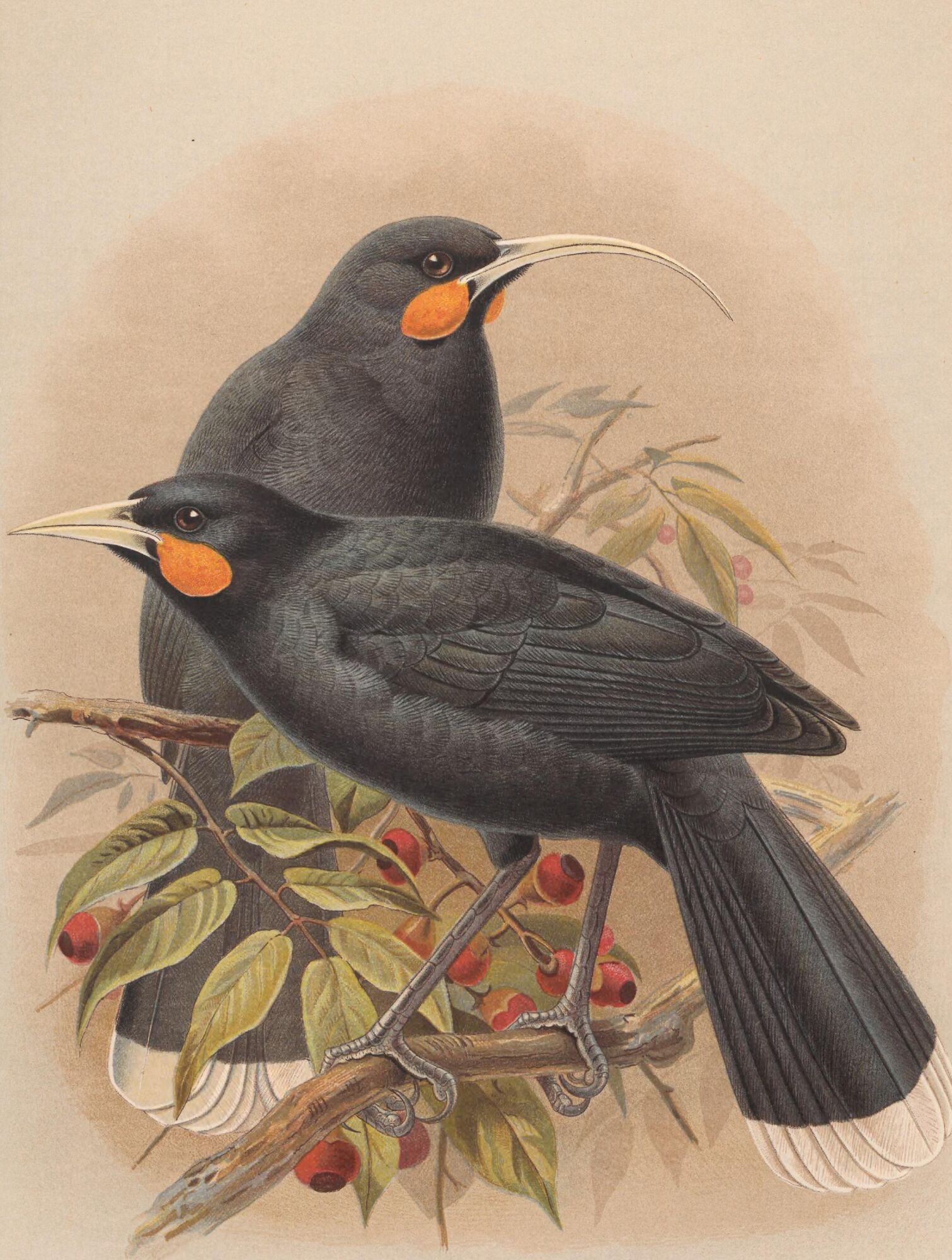
Males and females had completely different bills; lost to feather hunters, collectors and predators.
What it was like
The huia was a glossy black wattlebird of North Island forests, famous because females had a long, curved bill and males a short, stout one. Its white-tipped tail feathers were treasured by Māori and became a fashion item in colonial society. Collecting, hunting, forest loss and introduced predators drove it to extinction in the early 20th century, but exactly when the last bird was seen is uncertain.
Appearance
A magpie-sized forest bird with long legs, a long white-tipped tail and an orange or yellowish fleshy wattle at each side of the bill base. Males were about 45 cm long and females about 47 cm; weight 300–400 g. The female’s bill was long, slender and strongly curved (85–104 mm). The male’s was heavier, straighter and shorter (54–60 mm).
Plumage & colour
Mainly glossy black with a green and bluish-purple sheen in fresh plumage. The long black tail feathers had white tips 2–3 cm deep, forming a white band. The bill was pale ivory. Juveniles were brownish-black with an off-white tail band and white wattles that turned orange with age. Sexes alike except for the bill.
Behaviour
Lived in monogamous pairs and bred from September to February, raising one brood a season. The nest was a large, saucer-shaped cup of woven grass, leaves and stems, placed anywhere from ground level to about 6 m up. The female incubated 2–4 stone-grey, purplish-brown-marked eggs, and young stayed with the family for at least three months. Its flute-like calls carried up to 400 m. Māori named it after its distress call, a whistle rendered as “uia, uia, uia”.
Measurements: New Zealand Birds Online (Szabo 2013)
Did you knowSome museum huia sexed by DNA as females have short, male-like bills. This suggests both sexes looked alike when young and the difference grew with age (Lambert et al. 2009).
Historical range shown at country level (countries of regular occurrence). Historical range. Never recorded from the South Island.
- Where
- North Island of New Zealand only. Bones show it was common throughout the North Island before people arrived. After European settlement it was sparse, mainly in the south and east, with most records from the Ruahine, Tararua and Rimutaka ranges, northern Wairarapa and the hills around Wellington.
- Continents
- Oceania
- Habitat
Native forest. BirdLife International notes it appears to have needed large tracts of primary forest, including dead and decaying trees where it found beetle larvae.
- Movement · resident
- A sedentary forest resident.
What it ate
Mainly insects and larvae living in wood, including huhu beetle grubs, weta, mantises, butterflies and spiders, plus native forest fruits such as hīnau, pigeonwood, Coprosma and kahikatea (New Zealand Birds Online).
Feeding strategy
The sexes fed differently. Males used their short bills like a pick-axe to chip into decaying wood, while females probed their long, curved bills deeper into harder wood. Buller saw males pass food to females but never the reverse, and pairs were seen hunting weta together. Feather isotope analysis shows the sexes had different but overlapping diets and the same position in the food chain (Tomotani et al. 2022).
- InsectHuhu beetle larvaeExtracted from rotting and solid wood.
- InsectWeta
- InvertebrateSpiders
- PlantNative forest fruits (hīnau, pigeonwood, Coprosma, kahikatea)
What hunted it
The animals that preyed on the Huia, grouped by the life stage they attacked.
EggsWho ate its eggs
- MammalIntroduced mammals (e.g. rats, stoats, cats)LikelyNew Zealand Birds Online considers predation by introduced mammals the likely main cause of extinction. Which species mattered most is not documented.
ChicksWho killed its chicks
No predators documented at this stage.
AdultsWho killed grown birds
- PeoplePeopleDocumentedHunted for tail feathers and skins, and collected for museums.
Natural predation on huia before human arrival is not well documented. Nests were recorded from ground level up to about 6 m, so some were within easy reach of introduced ground predators.
Its place in nature
The huia specialised in insects living inside wood, especially huhu beetle larvae, and the two sexes divided this resource between them. It also ate the fruits of several native trees and may have spread their seeds. It was part of the community of animals feeding in decaying wood, but its effect on insect numbers or forest decay was never measured.
- Preys onDocumentedHuhu beetle (larvae)
A main food, extracted from decaying and solid wood.
- Feeds onDocumentedHīnau, pigeonwood, Coprosma and kahikatea
Their fruits were eaten (New Zealand Birds Online). Whether the huia dispersed their seeds effectively is not known.
- Preyed on byDocumentedMāori
Huia tail feathers were taonga (treasures), worn as a mark of status. They were also hunted for skins, and in one month in 1863 eleven Māori hunters took 646 skins (recorded by Buller).
How it disappeared
- Extinct
- Last “generally accepted” record 1907 (now questioned); unconfirmed reports into the 1920s
- Last confirmed record
- Traditionally: two males and a female seen by W.W. Smith, 28 December 1907, Tararua Range (Myers 1923). Galbreath (2017) showed this date is unreliable: Smith probably saw a pair in the Tararua Range in 1905–1907. Credible but unconfirmed reports continue to the mid-1920s.
- Where
- North Island, New Zealand
For Māori the huia was a treasured bird. Its white-tipped tail feathers were worn as a mark of status. After European settlement, demand grew: collectors and museums bought mounted specimens and tail feathers, and thousands were exported.
In 1901 the visiting Duke of York wore a huia feather, and a fashion for them followed in colonial society. Laws to protect the bird were passed in the 1890s but did little to stop hunters when a single feather could fetch a week’s wages. At the same time, North Island forests were being cleared and introduced mammals were spreading.
The record usually quoted as the last sighting is from 1907, but research by Ross Galbreath shows it rests on a shaky, second-hand account. Reports of huia continued into the 1920s. None has been confirmed, and the species is now considered extinct.
The human role
Entirely human-caused, although experts weigh the causes differently. BirdLife International emphasises habitat loss, while New Zealand Birds Online emphasises introduced predators. Both agree that hunting and collecting played a part.
About the date. Most sources, including BirdLife International (citing Myers 1923), give 1907 as the last confirmed record. Myers reported “two males and a female” seen by W.W. Smith on 28 December 1907. Galbreath (2017) traced this record and found it to be second-hand and published 15 years later. It conflicts with Smith’s own letters and cannot be squared with his whereabouts on that date. Galbreath concludes that Smith probably saw a pair of huia somewhere in the Tararua Range sometime in 1905–1907, and that the record should be treated as unconfirmed. New Zealand Birds Online notes that a few huia probably survived into the 1920s.
What was lost
New Zealand lost a wood-foraging insect specialist with one of the most extreme differences in bill shape between males and females known in any bird. Its effects on forest insects and fruit dispersal are unknown. Its loss is also cultural: the huia remains a taonga and a symbol in Māori tradition.
Historical population
Never counted. Bones show it was once common throughout the North Island; after European settlement it was sparse. A genetic study suggests a moderately large population with high genetic diversity (Lambert et al. 2009).
- Wood-boring insect larvae
Losing a specialist predator of huhu larvae and other wood-dwelling insects may have reduced predation on them in North Island forests. No data exist to test this.
- Fruiting forest trees
Huia ate fruit from several native trees. Other fruit-eating birds survive, so any loss of seed dispersal was probably small, but it has not been studied.
Uncertainty. Population size, territory size and the huia’s effect on insects and forest were never recorded. Lambert et al. (2009) used genetic data to estimate that the population was moderately large and showed high genetic diversity, but this cannot reveal its ecological role.
Legacy
Legal protection in the 1890s came too late and was poorly enforced, and official efforts to catch birds for transfer to a safe refuge were, in Galbreath’s (2017) word, “desultory”. The huia remains a symbol of loss in New Zealand and a taonga for Māori. Its story is also a warning about how fashion and collecting can push a rare species over the edge.
Sources
Conservation status: IUCN Red List (assessed by BirdLife International), assessed 2024. Media credits accompany each image and recording; see Sources & credits.
Taxonomy. One of New Zealand’s endemic wattlebirds, with the kōkako and tīeke (saddleback). Genetic dating suggests the huia and saddleback lineages split about 5 million years ago, so the huia’s extreme bill dimorphism evolved within that time (Gibb & Shepherd 2022).
- BirdLife International (2024). Species factsheet: Huia Heteralocha acutirostris.
- Szabo, M.J. (2013). Huia. In Miskelly, C.M. (ed.) New Zealand Birds Online.
- Galbreath, R. (2017). The 1907 ‘last generally accepted record’ of huia (Heteralocha acutirostris) is unreliable. Notornis 64: 239–242.
- Lambert, D.M. et al. (2009). The molecular ecology of the extinct New Zealand Huia. PLoS ONE 4: e8019.
- Tomotani, B.M. et al. (2022). Extreme bill dimorphism leads to different but overlapping isotopic niches and similar trophic positions in sexes of the charismatic extinct huia. Oecologia 198: 67–77.
- Gibb, G.C. & Shepherd, L.D. (2022). Recent evolution of extreme sexual dimorphism in the huia. Molecular Phylogenetics and Evolution 175: 107575.