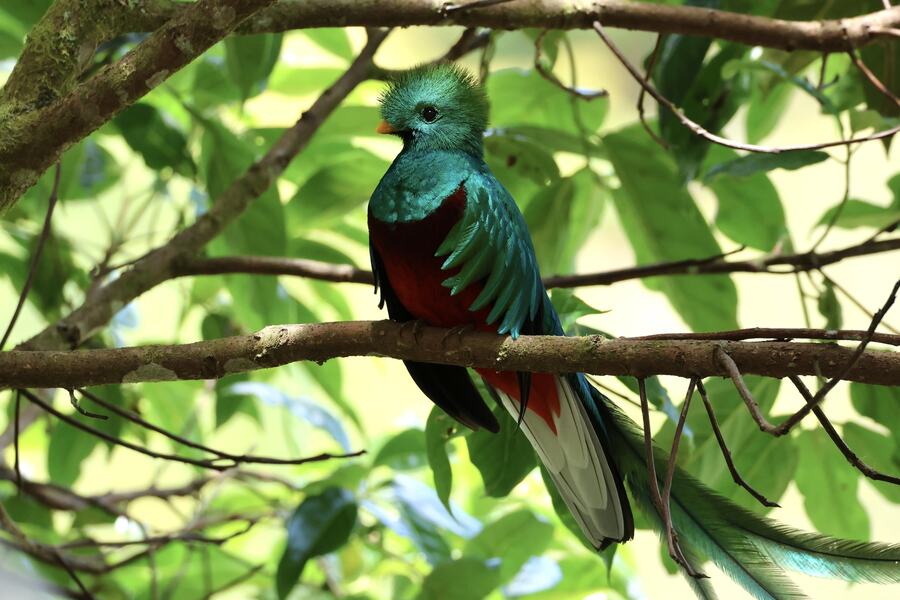
Red-billed Oxpecker
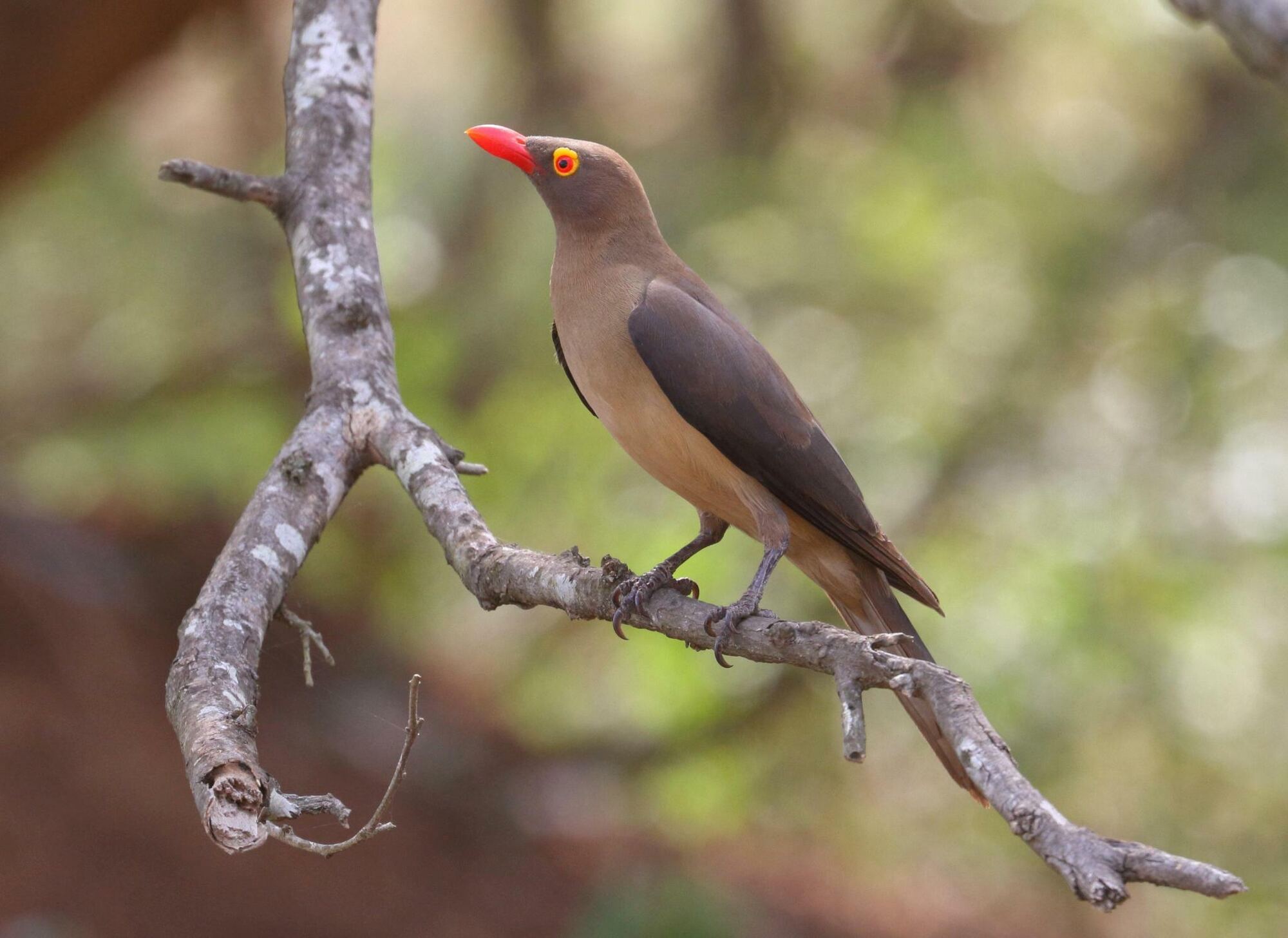
Africa’s “tickbird” — but is it a helpful cleaner or a blood-sipping freeloader?
Meet the bird
The Red-billed Oxpecker is a starling-like bird of African savannas that spends most of its life clinging to large mammals — buffalo, giraffe, impala, rhinos and cattle — feeding on ticks and other parasites, and also on blood, wound tissue and ear wax. It is a textbook example of mutualism, yet experiments with cattle showed little tick control and slower wound healing, so the relationship is better described as variable, ranging from mutualism to parasitism.
Appearance
A slim bird of about 20 cm with strong feet for clinging to the hides of large mammals and a bright red bill. Usually seen in small groups clambering over large mammals. Flight is strong and direct; the call is a hissing, crackling “trik-quisss”.
Plumage & colour
Adults are mainly brown with a red bill. Juveniles are darker brown than adults, and their bills start dark olive before gradually taking on the adult red colour.
Behaviour
Spends much of the day in small groups riding on large mammals. Nests in tree holes lined with hair plucked from host animals, including livestock; clutches are typically two to five eggs (average three). Breeding pairs are often assisted by helpers that feed the young. Outside the breeding season it may form larger, noisy flocks.
Measurements: Length: BirdForum Opus species account (secondary source; c. 20 cm). No authoritative wingspan, weight or longevity figures were found, so these are left empty.
Did you knowIn field trials, black rhinos carrying oxpeckers detected approaching people every time, compared with 23% of the time without the birds’ alarm calls.
Range shown at country level (countries of regular occurrence). A vagrant record from Yemen is not shown. Within the range, distribution is patchy and follows the availability of large host mammals.
- Where
- Savannas of eastern and southern Africa, from Eritrea, Ethiopia and Somalia south through East Africa to Angola, Namibia, Botswana, Zimbabwe, Mozambique and northern and eastern South Africa.
- Continents
- Africa
- Habitat
Open savanna and wooded grassland wherever large wild or domestic mammals are present, including game reserves and cattle ranches. Needs trees with holes for nesting.
- Movement · resident
- Not migratory. Birds move locally with their host animals.
What it eats
Ticks and other ectoparasites from large mammals, plus blood, wound tissue, dead skin and ear wax.
Feeding strategy
Uses a scissoring action of the bill to comb through hair, removing ticks and other parasites. It also pecks at sores and wounds, feeding on blood and tissue and keeping wounds open. In one Zimbabwe study, oxpeckers on cattle spent less than 15% of their foraging time eating adult ticks; the rest went to wounds, ear wax and combing through hair.
- InvertebrateTicksClassic food, but the proportion of the diet varies.
- MammalBlood and wound tissue of host mammalsDocumented, especially on cattle.
- OtherEar wax and dead skin
What eats it
The animals that prey on the Red-billed Oxpecker, grouped by the life stage they attack: its eggs, its chicks, or grown birds.
EggsWho eats its eggs
No predators documented at this stage.
ChicksWho kills its chicks
No predators documented at this stage.
AdultsWho kills grown birds
No predators documented at this stage.
Predators of Red-billed Oxpeckers are not well documented. Their habit of staying on large mammals and nesting in tree holes may reduce exposure to some predators, but this has not been studied.
Its place in nature
Oxpeckers are among the most famous animal partnerships in Africa, but the partnership is more complicated than it looks. They do remove ticks, yet an experiment excluding them from cattle in Zimbabwe found no consistent change in tick loads and faster wound healing without the birds (Weeks 2000). On the other hand, their loud alarm calls warn hosts of danger: black rhinos accompanied by oxpeckers detected approaching people far more often and at greater distances (Plotz & Linklater 2020). Whether a host gains or loses overall probably depends on the host species, its tick burden and its wounds.
- Preys onDocumentedTicks
Ticks are an important food, taken from a wide range of wild and domestic hosts.
- Parasitic relationship withDocumentedDomestic cattle
Weeks (2000) chased oxpeckers away from half of a cattle herd for a month in three trials: tick loads did not consistently change, but wounds healed faster without the birds. On cattle, the relationship looked closer to parasitism than mutualism.
- Mutualism withDocumentedBlack rhinoceros
In Hluhluwe-iMfolozi Park, South Africa, oxpecker alarm calls raised the rate at which rhinos detected approaching researchers from 23% to 100%, and the detection distance from about 27 m to 61 m (Plotz & Linklater 2020). Whether the birds call for the rhino’s benefit or their own is unknown.
- Mutualism withHypothesisedWild ungulates (buffalo, giraffe, impala)
The traditional view is that wild hosts benefit from tick removal. Oxpecker diets on wild hosts may differ from those on cattle, and the net benefit (or cost) to wild hosts has not been tested experimentally.
What if it disappeared?
Oxpeckers are still widespread, though they have declined where large game and untreated cattle have disappeared. Their loss would test the competing views of what they do for their hosts.
Press Remove to see which organisms could be affected, how, and how confident scientists are. 3 possible effects are recorded for this species.
The Yellow-billed Oxpecker overlaps in range and habits in parts of eastern and southern Africa and could partly fill the role. Other birds such as cattle egrets and some starlings feed around large mammals but do not specialise on their skin and parasites.
Most experimental evidence comes from one study on domestic cattle. How oxpeckers affect tick-borne disease, wild ungulate health and anti-predator vigilance across hosts has not been measured.
These scenarios summarise published ecology. They are not predictions: ecosystems are complex, other pressures interact, and documented, likely and hypothesised effects are labelled separately.
Conservation
- LCLeast Concern
- NTNear Threatened
- VUVulnerable
- ENEndangered
- CRCritically Endangered
- EWExtinct in the Wild
- EXExtinct
- Population estimate
- No reliable global estimate
- Trend
- Decreasing
- Source
- BirdLife International factsheet (2018 assessment): the global population has not been quantified; the species is described as locally common (Fry & Keith 2000) and is suspected to be declining owing to fewer large game hosts and the dipping of domestic cattle (Feare & Craig 1998).
No reliable historical time series is available for this species, so no population chart is shown. We do not interpolate or estimate missing data.
Threats
- Loss of large game hosts
Declines in large wild mammals reduce the hosts on which oxpeckers depend for food.
- Cattle dipping
Treatment of cattle with acaricide dips to kill ticks removes food and is suspected to have contributed to declines (Feare & Craig 1998, cited by BirdLife).
What is being done
No species-specific conservation measures are listed by BirdLife. Oxpeckers persist best in protected areas and rangelands with large mammal herds; their decline is linked to the loss of game and to tick-control practices on cattle.
- Present in many protected areas with large-mammal populations in eastern and southern Africa.
Sources
Conservation status: IUCN Red List (assessed by BirdLife International), assessed 2018. Media credits accompany each image and recording; see Sources & credits.
Taxonomy. The specific name is spelled erythrorynchus by BirdLife International (del Hoyo & Collar 2016); it was previously listed as erythrorhynchus, a spelling still used in many sources. BirdLife places the oxpeckers in their own family, Buphagidae.
- BirdLife International (2018 assessment). Species factsheet: Red-billed Oxpecker Buphagus erythrorynchus.
- Weeks, P. (2000). Red-billed oxpeckers: vampires or tickbirds? Behavioral Ecology 11: 154–160.
- Milius, S. (2000). Do oxpeckers help or mostly just freeload? Science News, 29 April 2000.
- Plotz, R.D. & Linklater, W.L. (2020). Oxpeckers help rhinos evade humans. Current Biology 30: 1965–1969.
- Wikipedia. Red-billed oxpecker (description, nesting and clutch size).
- BirdForum Opus. Red-billed Oxpecker (size, helpers at the nest).