Eurasian Hoopoe
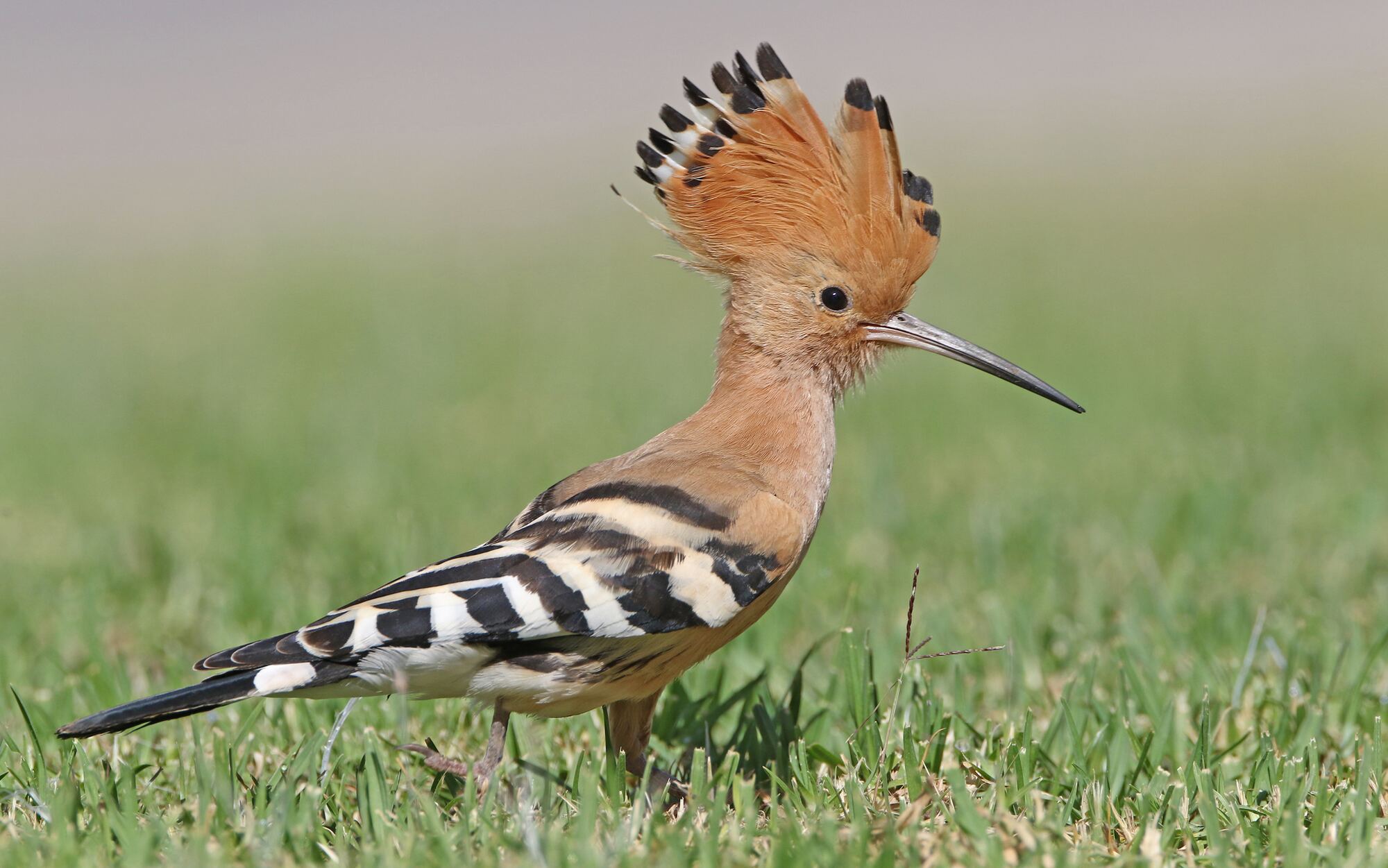
A crested, zebra-winged insect hunter whose nestlings defend themselves with stench and hissing.
Meet the bird
The hoopoe is an unmistakable pinkish-buff bird with a long, down-curved bill, a fan-like crest and bold black-and-white wings. It feeds mainly on large insects and their larvae probed from the ground in open, warm country across Europe, Asia and Africa. Its nesting females and chicks produce a foul-smelling preen-gland secretion that hosts antibiotic-producing bacteria — one of the best-studied bird–microbe partnerships.
Appearance
A medium-sized bird (25–32 cm including the bill) with a long, thin, slightly down-curved bill, broad rounded wings and a large erectile crest that can be fanned out. The bold black-and-white barring of the wings and tail is striking in flight.
Plumage & colour
Head, crest, breast and mantle cinnamon to pinkish-buff; wings and tail strongly barred black and white. Sexes are similar. Several subspecies are recognised.
Behaviour
Monogamous, solitary and territorial when breeding, though extra-pair paternity has been found in south-east Spain. Nests in a cavity — tree holes, walls, old buildings, rock crevices, even abandoned vehicles and nest boxes — and may reuse a site for several seasons. Clutches are typically seven to eight eggs in Europe; the young fledge after about 26–29 days. During breeding, females and nestlings produce a strong-smelling preen-gland secretion rich in Enterococcus bacteria, which females smear onto their eggs. Nestlings can also hiss and squirt faeces at intruders.
Measurements: Krištín, A. (2001), Family Upupidae, Handbook of the Birds of the World Vol. 6, as summarised on Wikipedia. No reliable ringing-based longevity record was found.
Did you knowFemale hoopoes paint their eggs with a bacteria-rich preen secretion; tiny crypts in the eggshell hold the secretion, and the bacteria appear to protect the embryos from infection.
Shown at continent level — this species is too widespread for a country list. Consult BirdLife International or eBird for detailed range maps. Occurs in well over 100 countries (BirdLife International). Scarce migrant or vagrant north of its breeding range, e.g. in Britain.
- Where
- Breeds across southern, central and eastern Europe, North Africa, the Middle East and Central Asia to Mongolia, China and Korea, and south through the Indian subcontinent and mainland South-East Asia. Resident populations (including the African Hoopoe) occur widely in sub-Saharan Africa south to South Africa. European breeders winter mainly in the Sahel belt south of the Sahara.
- Continents
- Europe · Asia · Africa
- Habitat
Open, warm country with short or sparse ground vegetation for foraging and trees, walls or banks for nest holes: pastures, parkland, orchards, olive groves, vineyards and sandy heathland in Europe; steppe and broken ground in Asia; dry wooded savanna in Africa. Often found around villages and traditionally farmed land. Recorded up to 3,650 m.
- Movement · partial
- Northern populations are fully migratory, most European and north Asian birds wintering in the tropics; European breeders mainly winter in the Sahel. Migration takes place predominantly at night. Southern and African populations are partially migratory or sedentary.
What it eats
Almost entirely animal food, mainly large insects and their larvae and pupae; occasionally small reptiles, frogs, seeds or berries.
Feeding strategy
Forages mostly on the ground, walking over short vegetation or bare soil and probing with its long bill to extract larvae and pupae. Prey ranges from about 10 to 150 mm, with a preferred size of around 20–30 mm. Food quality and accessibility have been shown to affect breeding success.
- InsectLarge insect larvae and pupae from the soilCore of the diet.
- InsectPine processionary moth pupaeDocumented prey in Mediterranean pine forests.
- InvertebrateOther invertebrates
- ReptileSmall reptiles and frogsOccasional.
What eats it
The animals that prey on the Eurasian Hoopoe, grouped by the life stage they attack: its eggs, its chicks, or grown birds.
EggsWho eats its eggs
No predators documented at this stage.
ChicksWho kills its chicks
No predators documented at this stage.
AdultsWho kills grown birds
No predators documented at this stage.
Which predators take hoopoes, and how often, is not well documented. What is documented is the nest defence: from about six days old, nestlings hiss like a snake and squirt faeces at intruders, and the strong-smelling preen secretion of females and chicks may also deter predators — although its best-supported role is antimicrobial rather than anti-predator.
Its place in nature
The hoopoe is a specialist predator of large soil insects, extracting larvae and pupae that few other birds can reach. In Mediterranean pine forests it eats the buried pupae of the pine processionary moth, a damaging forest pest, though its overall effect on moth outbreaks has not been quantified. It is also host to a specialised community of symbiotic bacteria in its preen gland that produce antimicrobial substances and appear to protect its eggs from infection.
- Mutualism withDocumentedEnterococcus bacteria (e.g. Enterococcus faecalis)
Bacteria living in the preen (uropygial) gland of breeding females and nestlings produce antimicrobial substances. Females smear the secretion into tiny crypts on the eggshell; experiments showed that blocking access to the gland reduced bacteria on the eggs, and hatching success was linked to Enterococcus density in the secretion.
- Preys onDocumentedPine processionary moth
Hoopoes dig out and eat the pupae of this pest moth from the soil beneath pines (Battisti et al. 2000). The extent to which this suppresses outbreaks is not known.
- Preys onDocumentedLarge soil-dwelling insects
Larvae and pupae of large insects probed from soil and short turf form the bulk of the diet.
- Nests in / depends onDocumentedCavities in old trees, walls and buildings
A secondary cavity nester that cannot excavate its own hole. The availability of suitable nest cavities has been shown to affect reproduction in agricultural landscapes (Arlettaz et al. 2000, cited by BirdLife).
What if it disappeared?
The hoopoe is widespread and not threatened globally. Its disappearance is a thought experiment; most of its ecological effects are not quantified, so the consequences below are uncertain.
Press Remove to see which organisms could be affected, how, and how confident scientists are. 3 possible effects are recorded for this species.
Other ground-feeding insectivores such as starlings and thrushes take some of the same prey, but few probe so deeply into soil. Partial compensation is likely; full compensation is unknown.
There are no studies measuring how hoopoe numbers affect insect populations or crop and forest damage, so all effects of its loss are inferred.
These scenarios summarise published ecology. They are not predictions: ecosystems are complex, other pressures interact, and documented, likely and hypothesised effects are labelled separately.
Conservation
- LCLeast Concern
- NTNear Threatened
- VUVulnerable
- ENEndangered
- CRCritically Endangered
- EWExtinct in the Wild
- EXExtinct
Also assessed as Least Concern for Europe and the EU27+UK (2021) and the Arabian Peninsula (2012). Chosen as Israel’s national bird in 2008.
- Population estimate
- c. 5,000,000–10,000,000 individuals globally (estimated; data quality poor). Europe: 1,300,000–2,760,000 pairs (2,600,000–5,530,000 mature individuals).
- Estimate year: 2015
- Trend
- Decreasing
- Source
- BirdLife International factsheet (2020 assessment), citing Krištín & Kirwan (2015) for the global figure and BirdLife International (2015) for Europe. The factsheet gives 2009 as the year of the underlying global estimate.
No reliable historical time series is available for this species, so no population chart is shown. We do not interpolate or estimate missing data.
Threats
- Agricultural intensification
Loss of short-grazed pasture, orchards and traditional farmland reduces access to soil insects, while removal of old trees and buildings reduces nest cavities.
- Hunting
Hunted in the Mediterranean region, Kuwait and parts of South-East Asia; hunting and disturbance may have caused recent declines in the northern Malay Peninsula.
What is being done
No species-specific international action is in place. BirdLife recommends maintaining large areas of suitable habitat through landscape-scale management, providing nest sites, and introducing and enforcing hunting controls.
- Listed on Appendix II of the Bern Convention.
- Monitored by systematic breeding bird surveys in some European countries.
- Readily uses nest boxes where natural cavities are scarce.
Sources
Conservation status: IUCN Red List (assessed by BirdLife International), assessed 2020. Media credits accompany each image and recording; see Sources & credits.
Taxonomy. Treatments differ. BirdLife International (and therefore the IUCN Red List) includes the sub-Saharan African Hoopoe (africana) within Upupa epops and treats the Madagascar Hoopoe (Upupa marginata) as a separate species. Some authorities have also split the African Hoopoe as a full species, Upupa africana. This profile follows the BirdLife species concept, so its status, population and range include African birds. Hoopoes are placed with the hornbills in the order Bucerotiformes.
- BirdLife International (2020 assessment). Species factsheet: Common Hoopoe Upupa epops.
- Martín-Platero, A.M. et al. (2006). Characterization of antimicrobial substances produced by Enterococcus faecalis MRR 10-3, isolated from the uropygial gland of the hoopoe (Upupa epops). Applied and Environmental Microbiology 72: 4245–4249.
- Martín-Vivaldi, M. et al. (2014). Special structures of hoopoe eggshells enhance the adhesion of symbiont-carrying uropygial secretion that increase hatching success. Journal of Animal Ecology 83: 1289–1301.
- Battisti, A., Bernardi, M. & Ghiraldo, C. (2000). Predation by the hoopoe (Upupa epops) on pupae of Thaumetopoea pityocampa and the likely influence on other natural enemies. BioControl 45: 311–323.
- Bächler, E. et al. (2010). Year-round tracking of small trans-Saharan migrants using light-level geolocators. PLoS ONE 5: e9566.
- Wikipedia. Common hoopoe (summary of HBW measurements, breeding and nest-defence behaviour).