Paradise Parrot
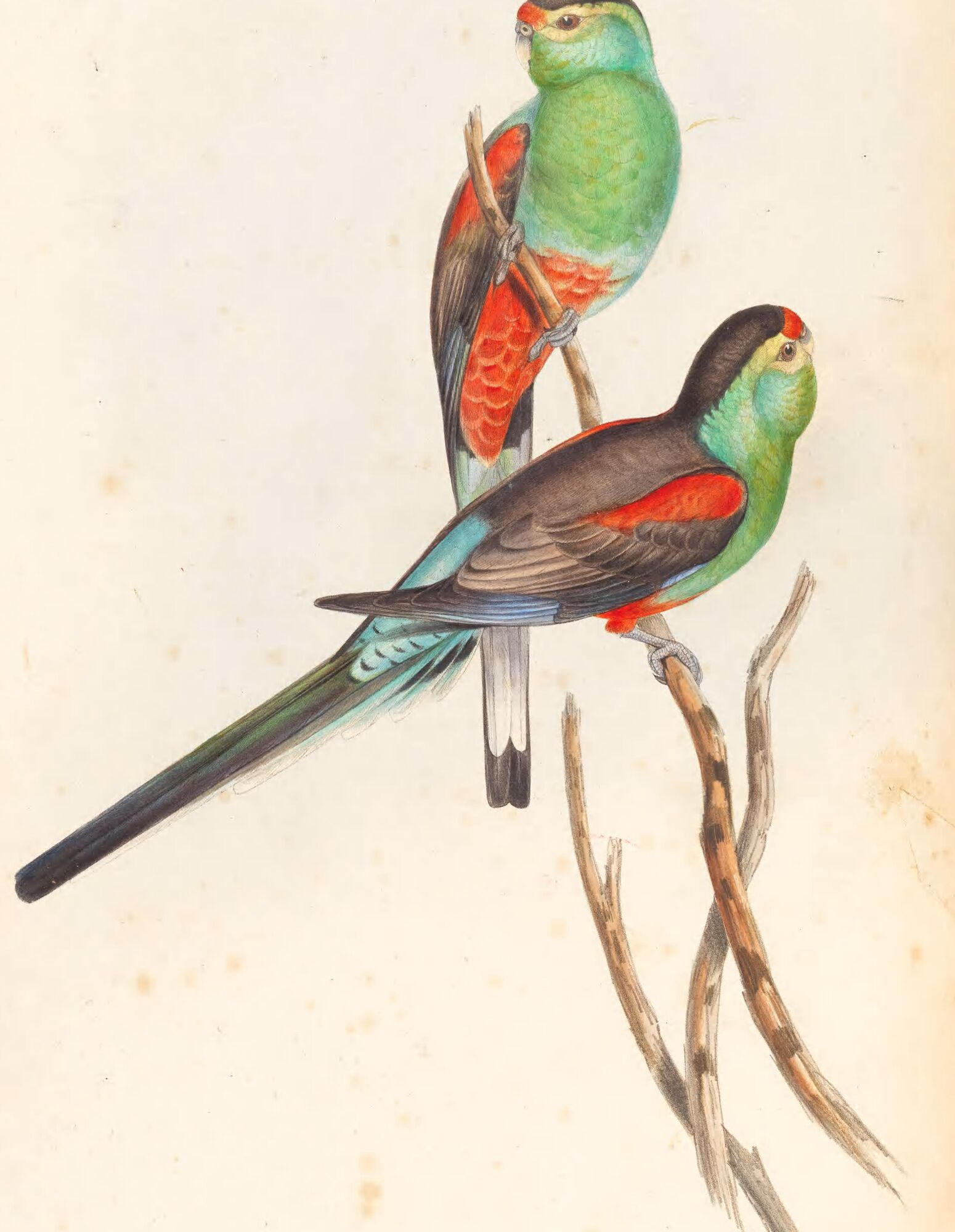
A jewel-coloured grass parrot that nested in termite mounds and was last seen with certainty in 1927.
What it was like
The Paradise Parrot was a strikingly coloured, ground-feeding parrot of the grassy woodlands of south-eastern Queensland. It fed on native grass seeds and dug its nests into termite mounds. Drought, overgrazing by livestock, changed fire patterns, prickly pear, trapping and predators all played a part in its decline. It has not been recorded with certainty since 1927.
Appearance
A slender, long-tailed parrot about 27 cm long. Its weight was never recorded; the World Parrot Trust suggests it was probably similar to related species (50–70 g), but this is a guess by analogy.
Plumage & colour
Males had a red forehead, dark crown, red-brown upperparts, a green or blue-green face and rump, emerald-green underparts, a red belly and undertail, and a bronze-green tail tipped blue-white. Females were duller, with a yellowish-tan face and breast, pale blue belly with a red centre, and dull red wing coverts.
Behaviour
Fed on the ground. It nested in a chamber dug into a termite mound on the ground, laying 3–5 eggs (World Parrot Trust). Only four or five photographs of wild Paradise Parrots were ever taken, all by Cyril Jerrard in the 1920s.
Measurements: World Parrot Trust, Parrot Encyclopedia
Did you knowOnly four or five photographs of wild Paradise Parrots were ever taken, all by one grazier, Cyril Jerrard, in the 1920s.
Historical range shown at country level (countries of regular occurrence). Historical range. Some sources (e.g. World Parrot Trust) extend it to north-eastern New South Wales; BirdLife does not accept this.
- Where
- Eastern Australia. BirdLife International states that it was reported with certainty only from south-eastern Queensland. Claims from northern Queensland are probably mistaken, and there are no confirmed records from New South Wales, though it is often said to have occurred there. Its last stronghold was the Gayndah district of the Burnett region.
- Continents
- Oceania
- Habitat
A specialist of open savanna woodland and shrubby grassland with eucalypts and scattered termite mounds (BirdLife International; World Parrot Trust).
- Movement · resident
- Probably resident; movements are not documented.
What it ate
Native grass seeds, taken on the ground (BirdLife International; World Parrot Trust).
Feeding strategy
Depended on seeds of native grasses. Drought and heavy grazing by livestock reduced this food supply, and BirdLife considers this the factor that probably sealed its fate.
- PlantNative grass seedsMain food.
What hunted it
The animals that preyed on the Paradise Parrot, grouped by the life stage they attacked.
EggsWho ate its eggs
- MammalFeral catsLikelyNamed by Chisholm (1922) and listed by BirdLife among contributing threats.
- OtherNative nest predatorsLikelyBirdLife notes nest predation by both introduced and native species (Chisholm 1922). Which native species is not specified.
ChicksWho killed its chicks
No predators documented at this stage.
AdultsWho killed grown birds
- PeoplePeople (trapping)DocumentedTrapped for the aviary trade; eggs were also collected.
Predation on adults is poorly documented. Nest predation was reported by contemporary observers but never measured.
Its place in nature
The Paradise Parrot was one of many seed-eating birds of eastern Australia’s grassy woodlands. Its tie to termite mounds as nest sites linked it to the termites that build them. Its wider ecological role, such as its effect on grass seed supplies or as prey, was never studied.
- Nests in / depends onDocumentedMound-building termites
It nested in chambers dug into termite mounds on the ground.
- Feeds onDocumentedNative grasses
Its main food was native grass seed.
- Competes withHypothesisedPrickly pear (Opuntia stricta)
An introduced cactus that spread over vast areas of Queensland. BirdLife lists its spread (Joseph 1988) as a contributing threat.
How it disappeared
- Extinct
- Last confirmed sighting 1927; later reports unconfirmed
- Last confirmed record
- 1927: last confirmed observations by Cyril Jerrard in the Gayndah district, Burnett region, Queensland. Credible but unconfirmed reports into the 1930s and early 1940s.
- Where
- South-eastern Queensland, Australia
In the 19th century the Paradise Parrot was locally common in south-eastern Queensland, though generally scarce. After the severe drought of 1902 it was feared extinct.
It was found again, and on 11 December 1921 the grazier Cyril Jerrard found a pair on his property near Gayndah. In March 1922 he took the first photograph of a wild Paradise Parrot, a male at its termite-mound nest. The naturalist Alec Chisholm publicised the rediscovery and pointed to burning, cats and trapping as threats.
Jerrard continued to see the birds occasionally through the 1920s, but numbers stayed tiny. His last confirmed sighting was in 1927. Reports continued for years afterwards, some credible, but none was ever confirmed.
The human role
Mostly human-caused, combined with drought (shown here as “other”). Overgrazing by livestock, altered fire regimes, ringbarking and the spread of prickly pear degraded its habitat and food supply. Trapping, egg collecting and introduced cats added to the losses.
About the date. BirdLife International gives 1927 as the last confirmed observation. A historical study gives grazier Cyril Jerrard’s last sighting as 13 November 1927, with a further report from neighbours in 1929. McGregor (2021) and BirdLife note credible reports into the 1930s and early 1940s. A claim of five birds seen in 1990 (Kiernan 1993) was not accepted. The species was listed as Extinct by the IUCN from 1994.
What was lost
Australia lost a grassy-woodland seed-eater with a specialised dependence on termite mounds for nesting. Its ecological role was never studied. Its disappearance is a marker of how much the grassy woodlands of Queensland changed under pastoralism.
Historical population
Never estimated. Locally common in the 19th century, then rapidly declining.
- Native grass seeds
It removed one of many seed-eaters from grassy woodland. Any effect on grasses is unknown and likely small compared with the effects of livestock grazing.
Uncertainty. Almost nothing was measured while it lived. Even its true range is debated. The losses it reveals, of native grasses, termite-mound habitats and traditional fire regimes, are better documented than its own role.
Legacy
No effective protection reached the Paradise Parrot. Later reports were investigated but none was confirmed, and the species remains on CITES Appendix I. Historians and ecologists now use its story to show how pastoralism, the loss of Aboriginal fire management and introduced species changed Queensland’s grassy woodlands (McGregor 2021).
Sources
Conservation status: IUCN Red List (assessed by BirdLife International), assessed 2023. Media credits accompany each image and recording; see Sources & credits.
Taxonomy. Formerly placed in the genus Psephotus (BirdLife International). It shared the habit of nesting in termite mounds with the endangered Golden-shouldered Parrot.
- BirdLife International (2023). Species factsheet: Paradise Parrot Psephotellus pulcherrimus.
- World Parrot Trust. Parrot Encyclopedia: Paradise Parrot.
- McGregor, R. (2021). The tragedy of the Paradise Parrot. Arcadia (Rachel Carson Center) no. 27.
- Alec Chisholm and the extinction of the Paradise Parrot (2021). Historical Records of Australian Science 32(2).