Carolina Parakeet
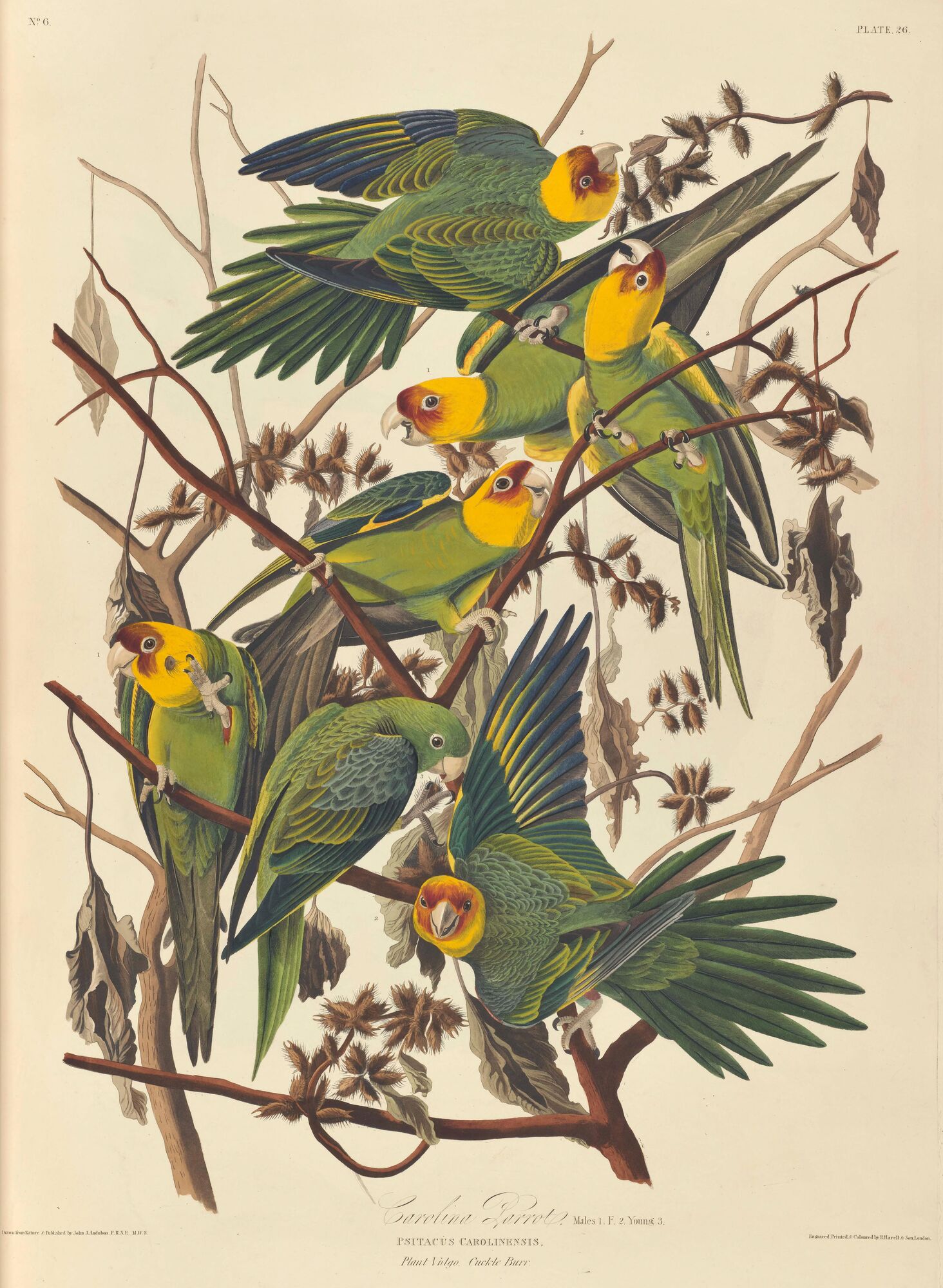
North America’s own parrot: a flock bird that ate toxic cockleburs and vanished in the early 20th century.
What it was like
The Carolina Parakeet was a green, yellow and orange parrot that lived in noisy flocks along the river forests of the eastern and central United States. It was shot as a crop pest and for food and feathers, caught for the cage-bird trade, and lost much of its bottomland forest. The last captive bird died at Cincinnati Zoo in 1918, and exactly when the last wild birds died is still debated.
Appearance
A slender, long-tailed parakeet about 12.5 inches (c. 32 cm) long, with a wingspan of roughly 22 inches (c. 56 cm) (NCpedia).
Plumage & colour
Mostly green, with a bright yellow and orange head (NCpedia).
Behaviour
Highly social, living and roosting in flocks. Flocks reportedly gathered around dead or wounded flock-mates, which made it easy for hunters to shoot many birds at once (NCpedia).
Measurements: NCpedia (Encyclopedia of North Carolina), converted from inches; weight not reliably documented
Did you knowCarolina Parakeets ate cockleburs, which are poisonous to most animals, and their genome shows changes that may explain how they coped with the toxin.
Historical range shown at country level (countries of regular occurrence). Historical range.
- Where
- Eastern United States. The eastern subspecies ranged from Florida to Virginia; the western subspecies lived in the Mississippi–Missouri river basin. Analysis of all known records (Burgio et al. 2017) suggests the range was much smaller than often shown, and that birds avoided higher ground in the Appalachian and Ozark Mountains.
- Continents
- North America
- Habitat
Typically cypress and sycamore trees along rivers and in swamps (BirdLife International). Bald cypress was both an important food and a nesting tree. Birds roosted together in tree cavities all year, which may have helped them survive cold weather (Burgio et al. 2017).
- Movement · partial
- Modelling of historical records suggests the western subspecies may have moved between breeding and winter areas, while the eastern subspecies apparently did not (Burgio et al. 2017).
What it ate
Mainly seeds, including those of cockleburs and thistles, plus beechnuts, chinquapins, birch buds and cypress, and fruit from orchards (NCpedia; Burgio et al. 2017).
Feeding strategy
It had a strong taste for cockleburs, which contain a powerful toxin, carboxyatractyloside. Gelabert et al. (2020) found two genetic changes in proteins that interact with this toxin, which may explain how the parakeet tolerated it.
- PlantCocklebur seeds (Xanthium)A favourite food, toxic to most animals.
- PlantThistle seeds
- PlantBald cypress seeds
- PlantBeechnuts and chinquapins
- PlantOrchard fruitBrought it into conflict with farmers.
What hunted it
The animals that preyed on the Carolina Parakeet, grouped by the life stage they attacked.
EggsWho ate its eggs
No predators documented at this stage.
ChicksWho killed its chicks
No predators documented at this stage.
AdultsWho killed grown birds
- PeoplePeopleDocumentedShot as crop pests and for food and feathers, and trapped for the cage-bird trade.
Natural predation is poorly documented. Gelabert et al. (2020), citing earlier accounts, note that its cocklebur diet made the birds notoriously toxic to most predators.
Its place in nature
The parakeet was a seed-eater of floodplain forests and open ground, and one of very few animals able to eat toxic cockleburs. Whether it dispersed any seeds, rather than simply destroying them, has never been studied. Its feathers also carried at least one quill mite now known only from museum skins.
- Feeds onDocumentedCocklebur (Xanthium)
A favourite food. The parakeet tolerated the plant’s toxin, possibly thanks to specific genetic adaptations (Gelabert et al. 2020).
- Nests in / depends onDocumentedBald cypress
Both a food source and a nesting tree (Burgio et al. 2017).
- Host toDocumentedQuill mite Peristerophila conuropsis
A parasitic mite described in 2024 from a museum skin of the parakeet. Its describers consider it highly probable that it went extinct with its host (Skoracki et al. 2024).
- Competes withHypothesisedIntroduced honeybees
BirdLife International lists competition with introduced honeybees as a possible contributing factor (McKinley 1960).
How it disappeared
- Extinct
- Last captive bird died 21 February 1918; last accepted wild records 1904–1910, with later claims debated
- Last confirmed record
- Captive: Incas, died 21 February 1918, Cincinnati Zoo. Wild: last specimens 1904 (Lake Okeechobee, Florida); last accepted wild record 1910 (BirdLife); unconfirmed reports into the 1930s.
- Where
- Eastern and central United States
At the start of the 19th century Carolina Parakeets were still common in the river forests of the south-east and the Mississippi valley. By 1832 Audubon noticed they were declining as settlers moved inland.
Farmers shot flocks that raided orchards and crops, and hunters took them for food, for hat feathers and for cages. When one bird fell, the rest of the flock often circled back, and many more could be shot. At the same time the great bottomland forests where they nested were cleared.
The last specimens were collected in Florida in 1904. The last captive bird, Incas, died at Cincinnati Zoo in February 1918. Reports of wild flocks continued for years afterwards, and modern analyses suggest small numbers may have survived in the east into the 1930s or 1940s. None of these later reports was ever confirmed.
The human role
Human-caused. BirdLife International names persecution (for food, crop protection, aviculture and feathers) and deforestation as the main causes. Its flocking habits and possibly competition with introduced honeybees made things worse. Disease has been suggested but is unproven.
About the date. The last captive bird died at Cincinnati Zoo on 21 February 1918. BirdLife International gives 1910 as the last wild record, of the western subspecies. The last specimens were collected near Lake Okeechobee, Florida, in 1904, and rumours of survival persisted into the 1930s. A Bayesian analysis of sighting records (Burgio et al., 2019 preprint, not peer-reviewed at posting) estimated that the western subspecies died out around 1914 and the eastern subspecies in the late 1930s or mid-1940s. This would mean wild birds outlived the last captive bird. These dates remain debated.
What was lost
The eastern United States lost its only native parrot, a specialist eater of toxic cockleburs, and at least one parasite that lived only on it. Its wider ecological role is unknown.
Historical population
Never counted. Described as common in the early 19th century and declining from the 1830s (BirdLife International).
- Its own parasites
The quill mite Peristerophila conuropsis, found in a museum skin, is thought very probably to have died out with its only known host (Skoracki et al. 2024).
- Cockleburs and other seed plants
Flocks ate large amounts of cocklebur and other seeds, so their disappearance removed a seed predator. Whether this changed the abundance of any plant is unknown.
Uncertainty. The parakeet’s numbers, exact range and ecological effects were never measured. Most of what is known comes from scattered historical observations, many of uncertain reliability.
Legacy
No effective protection came in time. Work on the Carolina Parakeet is now about learning lessons: researchers have gathered every known record into a public dataset of 861 sightings from 1564 to 1944 (Burgio et al. 2018), sequenced its genome, and used it to study how a widespread parrot can disappear. These lessons matter because parrots are the most threatened group of birds.
Sources
Conservation status: IUCN Red List (assessed by BirdLife International), assessed 2021. Media credits accompany each image and recording; see Sources & credits.
Taxonomy. The only parrot native to the eastern United States. Two subspecies were recognised: C. c. carolinensis in the east (Florida to Virginia) and C. c. ludovicianus in the Mississippi–Missouri drainage. Its genome has been compared with that of the Sun Parakeet (Aratinga solstitialis), a close living relative (Gelabert et al. 2020).
- BirdLife International (2021). Species factsheet: Carolina Parakeet Conuropsis carolinensis.
- Dough, W. & Powell, W.S. Carolina Parakeet. NCpedia (from the Encyclopedia of North Carolina, 2006).
- Burgio, K.R., Carlson, C.J. & Tingley, M.W. (2017). Lazarus ecology: recovering the distribution and migratory patterns of the extinct Carolina parakeet. Ecology and Evolution 7: 5467–5475.
- Burgio, K.R., Carlson, C.J. & Bond, A.L. (2018). Georeferenced sighting and specimen occurrence data of the extinct Carolina Parakeet from 1564–1944. Biodiversity Data Journal 6: e25280.
- Burgio, K.R. et al. (2019). The two extinctions of the Carolina parakeet. bioRxiv preprint 801142.
- Gelabert, P. et al. (2020). Evolutionary history, genomic adaptation to toxic diet, and extinction of the Carolina parakeet. Current Biology 30: 108–114.
- Skoracki, M. et al. (2024). Lost companions: a new quill mite species and its possible coextinction with the Carolina parakeet. Parasitology 151: 463–467.