Spix’s Macaw
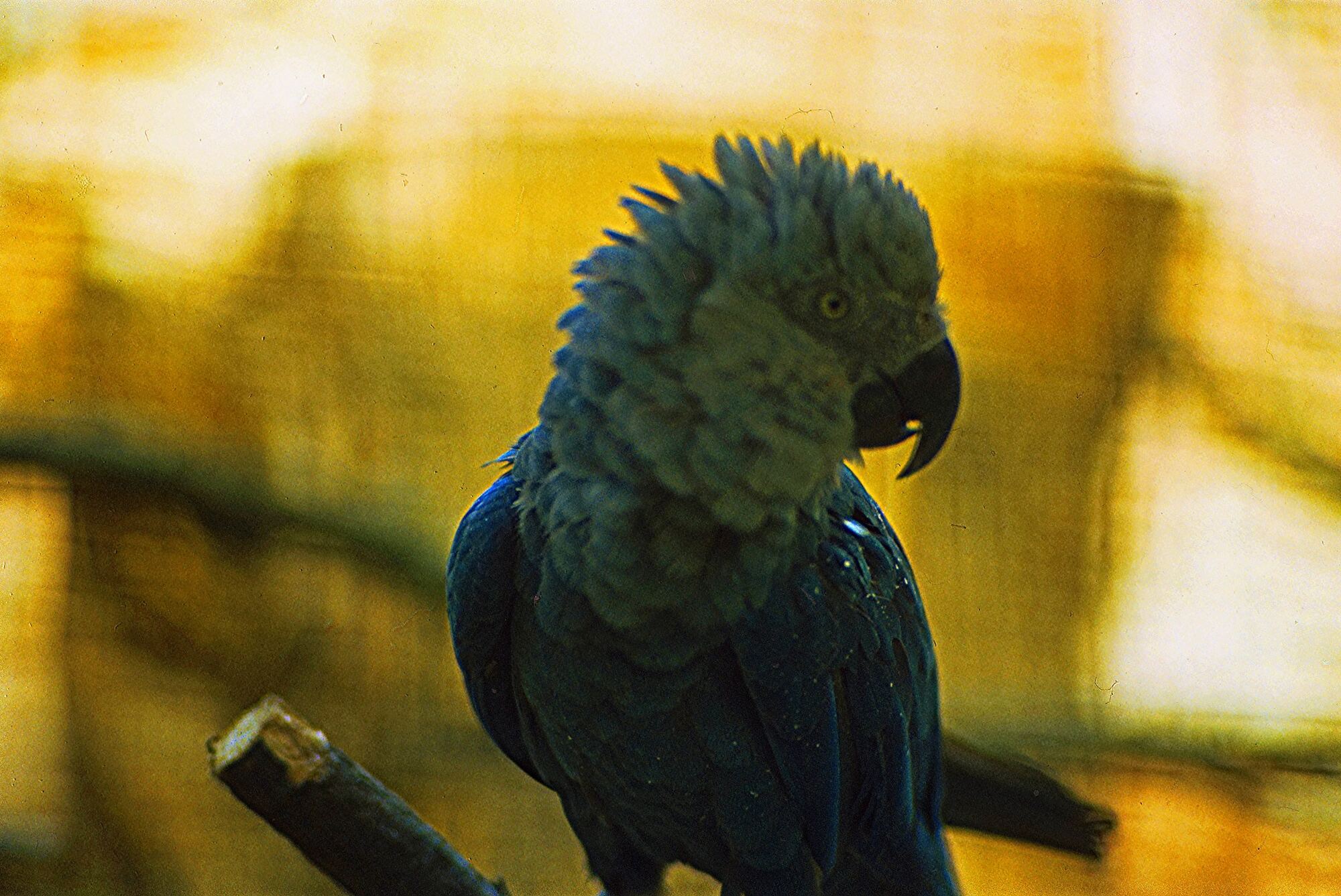
The little blue macaw that vanished from the wild in 2000 and has been flying again in Bahia since 2022.
Meet the bird
Spix’s Macaw is a small, blue macaw from the dry caatinga of north-eastern Brazil, where it depended on riverside woodland of caraibeira trees. Trapping for the illegal bird trade and habitat loss wiped out the wild population, and the last known wild bird, a male, disappeared at the end of 2000. The species survived only in captivity until captive-bred birds were released in Curaçá, Bahia, in 2022. That reintroduction has had first successes but is now uncertain.
Appearance
A slender, long-tailed macaw, small for a macaw (about 56 cm including the long tail), with soft blue plumage.
Plumage & colour
Soft blue overall, with darker blue back, wings and tail and a greyish head. Juveniles look like adults but have a white eye-ring, dark brown eyes and a partly horn-coloured bill.
Behaviour
Little is known about wild behaviour because the species was rare when it was rediscovered. Pairs nested in cavities of large caraibeira trees during the austral summer (about November to March), laying two or three eggs in the wild and up to five in captivity. The last wild male paired with a female Blue-winged Macaw; their eggs were infertile, and DNA analysis of one early embryo showed it to be a hybrid.
Measurements: World Parrot Trust, Parrot Encyclopedia (length 56 cm, weight 360 g)
Did you knowFor about ten years the last known wild Spix’s Macaw, a male, lived paired with a female of a different species, the Blue-winged Macaw.
Range shown at country level (countries of regular occurrence). BirdLife lists the species as extinct in Brazil’s wild. The released birds live in a small area of Curaçá; most of the world population is in captivity in Brazil and elsewhere.
- Where
- Endemic to Brazil. The last wild population was found in 1985–86 near the São Francisco river in northern Bahia, around Curaçá. Captive-bred birds have been released in the same area since 2022, around the Spix’s Macaw protected areas created in 2018 in Curaçá and Juazeiro.
- Continents
- South America
- Habitat
Caatinga, the dry thorn scrub and forest of north-eastern Brazil. The species apparently needed gallery (riverside) woodland dominated by caraibeira trees along seasonal creeks for nesting, while feeding mainly on the seeds of two typical caatinga plants of the spurge family.
- Movement · nomadic
- Not migratory. BirdLife classes it as nomadic, moving around the caatinga according to food, but little was recorded about its movements before the wild population disappeared.
What it eats
Mainly the seeds of two caatinga plants of the spurge family (Euphorbiaceae): favela (Cnidoscolus phyllacanthus) and pinhão (Jatropha pohliana).
Feeding strategy
Wild feeding behaviour was poorly documented before the species disappeared from the wild, and the diet of the released birds is not described in the sources consulted.
- PlantSeeds of favela (Cnidoscolus phyllacanthus)Euphorbiaceae; a main food.
- PlantSeeds of pinhão (Jatropha pohliana)Euphorbiaceae; a main food.
What eats it
The animals that prey on the Spix’s Macaw, grouped by the life stage they attack: its eggs, its chicks, or grown birds.
EggsWho eats its eggs
No predators documented at this stage.
ChicksWho kills its chicks
No predators documented at this stage.
AdultsWho kills grown birds
No predators documented at this stage.
Natural predators of Spix’s Macaw are not documented in the sources consulted. People were the main cause of its decline, through trapping for the illegal pet trade. One female released in 1995 disappeared after seven weeks and is thought to have collided with a power line. Causes of losses among the birds released since 2022 are not detailed in the sources consulted.
Its place in nature
As a seed-eater, Spix’s Macaw probably destroyed most of the seeds it ate rather than dispersing them, but its ecological role was never studied while wild birds existed. Its close dependence on caraibeira gallery woodland makes it a symbol of one of the caatinga’s most threatened habitats.
- Nests in / depends onDocumentedCaraibeira (Tabebuia aurea)
The macaw nested in cavities of these large riverside trees. Centuries of clearance of this gallery woodland along the São Francisco valley removed most nest sites. BirdLife uses the synonym Tabebuia caraiba.
- Feeds onDocumentedFavela (Cnidoscolus phyllacanthus)
A spiny caatinga shrub of the spurge family whose seeds were one of the two main foods.
- Feeds onDocumentedPinhão (Jatropha pohliana)
The other main food plant, also of the spurge family.
- Competes withHypothesisedAfricanized honey bees
Introduced aggressive African bees colonised the range in the 20th century and may have contributed to the decline, plausibly by occupying tree cavities, though this has not been demonstrated.
- Parasitic relationship withDocumentedPsittacine beak and feather disease virus (circovirus)
In November 2025, all 11 free-flying macaws recaptured in Curaçá tested positive for this incurable parrot virus, after a first case was detected in one bird in May 2025.
What if it disappeared?
Spix’s Macaw has been effectively absent from the caatinga since 2000, and in very low numbers for decades before that. Whatever ecological effects its loss had have already happened and were never measured.
Press Remove to see which organisms could be affected, how, and how confident scientists are. 3 possible effects are recorded for this species.
Other seed-eating parrots of the region, such as the Blue-winged Macaw that shared the last wild male’s range, eat seeds in the same habitat, so any ecological gap is likely to be small.
Wild Spix’s Macaws were barely studied, so their diet, movements and interactions are largely unknown. Whether released birds can establish a self-sustaining population, and what the 2025 circovirus outbreak means for them, is not yet known.
These scenarios summarise published ecology. They are not predictions: ecosystems are complex, other pressures interact, and documented, likely and hypothesised effects are labelled separately.
Conservation
- LCLeast Concern
- NTNear Threatened
- VUVulnerable
- ENEndangered
- CRCritically Endangered
- EWExtinct in the Wild
- EXExtinct
Critically Endangered in IUCN assessments up to 2018, then Extinct in the Wild from 2019. Brazil’s national list (2014) gives Critically Endangered (Possibly Extinct in the Wild). No IUCN reassessment after the 2022 releases was found: the released birds have not formed a self-sustaining wild population, and in November 2025 those recaptured tested positive for circovirus.
- Population estimate
- No mature individuals in the wild at the 2019 IUCN assessment. Over 360 birds in captivity (World Parrot Trust). Small numbers of captive-bred birds have flown free in Curaçá, Bahia, since 2022: 11 were free-flying in July 2024, and 11 were recaptured in November 2025 after testing positive for circovirus.
- Estimate year: 2019
- Trend
- Unknown
- Source
- BirdLife International factsheet (2019 assessment); World Parrot Trust; Mongabay (2024); Agência Gov (2025)
No reliable historical time series is available for this species, so no population chart is shown. We do not interpolate or estimate missing data.
Threats
- Trapping for the illegal bird trade
In recent decades, trapping for the live-bird trade pushed the species to extinction in the wild; the last three birds found in 1985–86 were captured for trade in 1987 and 1988.
- Loss of caraibeira gallery woodland
More than three centuries of settlement and exploitation along the São Francisco valley destroyed most of the riverside woodland the species needed, and grazing by goats and cattle continues to degrade the caatinga.
- Disease
Psittacine circovirus, which causes beak and feather disease, was first detected in one bird in May 2025, and all 11 free-flying birds recaptured that November tested positive. ICMBio found that biosecurity protocols were not being followed and fined the facility.
- Other historical pressures
The spread of Africanized bees and the building of the Sobradinho hydroelectric dam may have contributed to the decline in the 1970s and 1980s.
What is being done
Brazil’s Chico Mendes Institute for Biodiversity Conservation (ICMBio) leads the species’ recovery under a national action plan, working with captive-breeding holders in Brazil and abroad. Captive-bred birds were released in Curaçá, Bahia, in 2022, after protected areas were created and habitat was restored there.
- Protected under Brazilian law; CITES Appendix I.
- Captive breeding, historically led by Al-Wabra Wildlife Preservation (Qatar) and later by ACTP (Germany), São Paulo Zoo and others.
- Spix’s Macaw Wildlife Refuge and Environmental Protection Area designated in Curaçá and Juazeiro, Bahia, in 2018.
- Habitat restoration, including work with farmers to reduce goat grazing in the caatinga.
- Release of 20 captive-bred birds in 2022, the first eight on 13 June 2022.
A conservation story
Spix’s Macaw was known for more than 150 years only from a handful of traded birds and the specimen collected by Johann Baptist von Spix. When its last wild population was finally traced in 1985–86, only three birds were left, and trappers took them in 1987 and 1988. In 1990 a single male was found, paired with a female Blue-winged Macaw. A captive female released in 1995 to join him disappeared after seven weeks, and the male was last seen at the end of 2000. In 2019 the IUCN declared the species Extinct in the Wild.
The species survived because of captive flocks. The official captive population grew from 60 declared birds in 2000 to more than 100 by 2015. In 2020, 52 birds were brought from ACTP in Germany to a new breeding and release centre in Curaçá. In June 2022, ICMBio and ACTP released eight Spix’s Macaws into the caatinga, and 20 had been released by the end of the year. Wild breeding followed quickly: in 2023 a pair hatched two chicks, the first wild nesting since 1986, although they died before fledging, and in May 2024 two wild-hatched chicks took their first flights.
The future is uncertain. About 58% of released birds survived their first year, and only 11 were flying free by mid-2024. ICMBio did not renew its cooperation agreement with ACTP in 2024. Then, in 2025, psittacine circovirus was detected, inspectors found that biosecurity rules were not being followed at the Curaçá breeding facility, and all 11 free-flying birds recaptured in November tested positive. Bringing Spix’s Macaw back will need disease-free birds, secure habitat and continued protection from trappers.
Sources
Conservation status: IUCN Red List (assessed by BirdLife International), assessed 2019. Media credits accompany each image and recording; see Sources & credits.
Taxonomy. The only species in the genus Cyanopsitta.
- BirdLife International (2019 assessment). Species factsheet: Spix’s Macaw Cyanopsitta spixii.
- World Parrot Trust. Parrot Encyclopedia: Spix’s Macaw.
- Pesquisa FAPESP (July 2022). From captivity to the skies.
- BirdGuides (November 2023). Spix’s Macaw breeds in wild for first time in 37 years.
- Araujo, B. (15 July 2024). For ‘extinct’ Spix’s macaw, successful comeback is overshadowed by uncertainty. Mongabay.
- Agência Gov (26 November 2025). Ararinhas-azuis que estavam em vida livre testam positivo para circovírus.