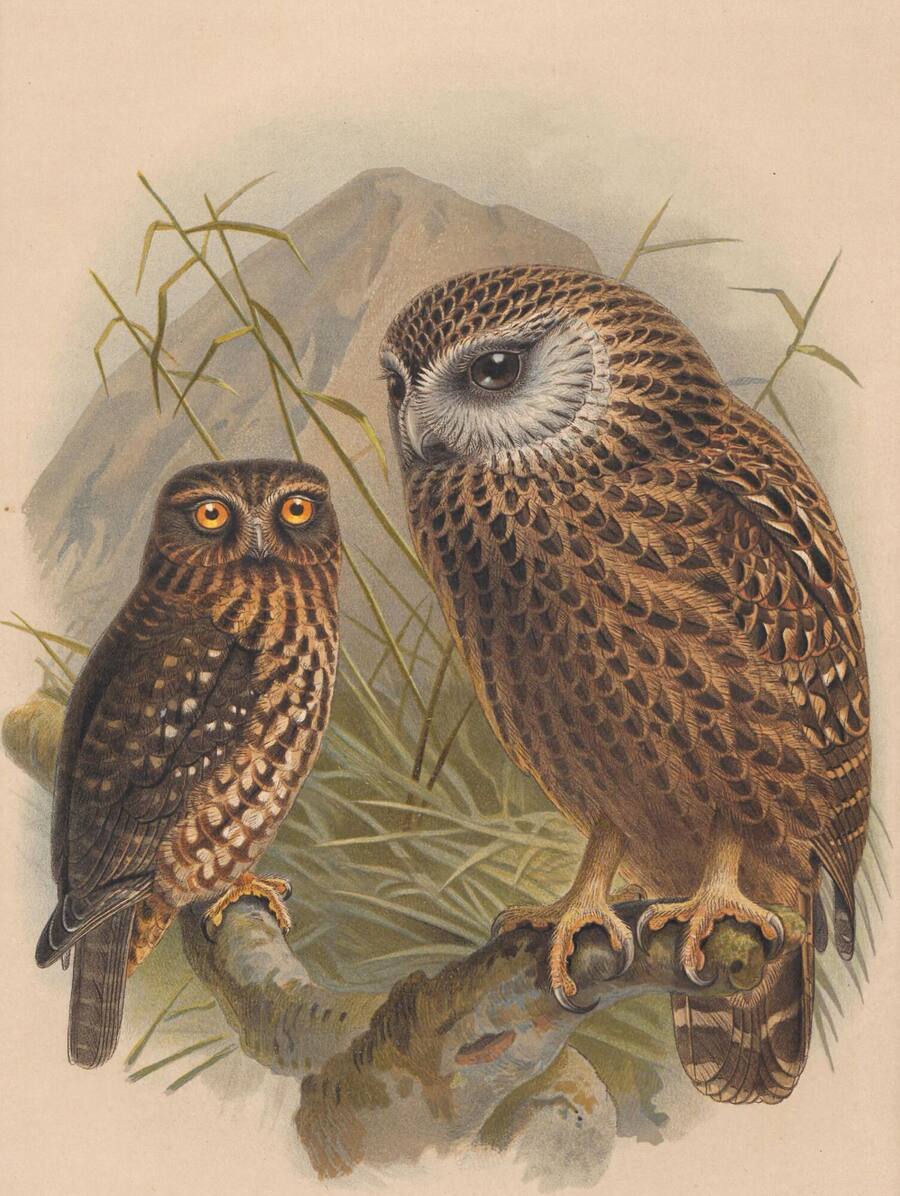
Kākāpō
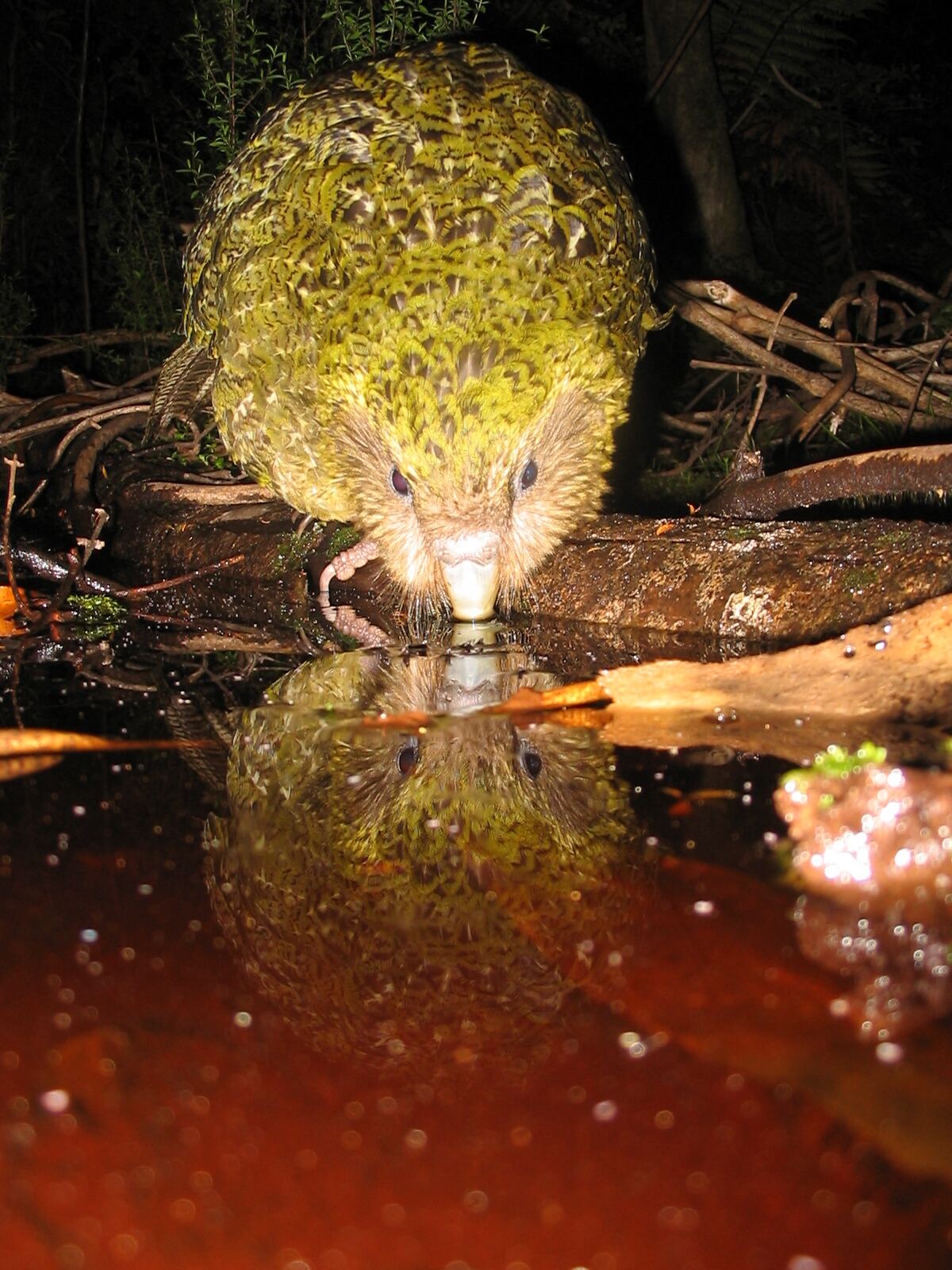
A flightless, night-active, moss-green parrot whose every individual is known by name.
Meet the bird
The kākāpō is a large, flightless, nocturnal parrot found only in New Zealand. It once lived across the North, South and Stewart Islands, but introduced predators reduced it to a few dozen birds, and it now survives only on predator-free islands under one of the most intensive recovery programmes for any bird. It breeds only in years when rimu and some other podocarp trees fruit heavily.
Appearance
A heavy, round-bodied parrot with a pale, owl-like facial disc, a grey bill and short wings that cannot support flight. Kākāpō walk and climb, and can only make a controlled plummet when they leap from a height. Males "boom" and "ching" to attract mates; both sexes give a loud "skraak" call.
Plumage & colour
Moss-green upperparts finely mottled with yellow and black, more yellow below. Bill, legs and feet are grey. Males are considerably heavier than females.
Behaviour
Kākāpō are solitary and nocturnal. They are lek breeders: in breeding years, males gather at traditional sites and call each night for about three months from "track-and-bowl" systems they dig into the ground, producing deep booms that carry over long distances. Females visit to mate and then raise the chicks entirely alone, leaving eggs and chicks unattended for hours at night while they feed. Breeding happens only when rimu (or, on some islands, pink pine) fruits abundantly, which on southern islands is once every two to four years. Clutches contain one to four eggs, and incubation averages about 29 days.
Measurements: New Zealand Birds Online (Elliott 2013, updated 2025): length 58–64 cm; males 2–4 kg, females 1–2.5 kg
Did you knowMale kākāpō dig "track-and-bowl" systems into the ground and boom from them at night, and the calls carry over long distances.
Range shown at country level (countries of regular occurrence). The current range is a set of managed islands; the species is considered extinct in its natural mainland range.
- Where
- Endemic to New Zealand. Formerly widespread across the North, South and Stewart Islands; the last North Island record was in 1927 and the last Fiordland birds disappeared in the late 1980s. Today all birds live on predator-free islands. In 2026 DOC listed three breeding populations, on Whenua Hou/Codfish Island, Pukenui/Anchor Island and Te Kāhaku/Chalky Island; birds from Hauturu-o-Toi/Little Barrier Island and Pearl Island were moved to southern islands in 2024–25.
- Continents
- Oceania
- Habitat
Before people arrived, kākāpō occupied a wide range of vegetation types, especially beech and podocarp–broadleaf forest with moderate to high rainfall. On today’s refuge islands they use forest, scrub and open areas, foraging on the ground and climbing trees. Breeding depends on the presence of podocarps such as rimu that fruit heavily in some years.
- Movement · resident
- Sedentary. Individuals keep the same home range for many years; any movement between islands is the result of managed transfers.
What it eats
Entirely vegetarian. Kākāpō eat leaves, buds, flowers, fern fronds, bark, roots, bulbs, fruit and seeds, and the diet changes through the seasons.
Feeding strategy
Birds forage on the ground and climb into trees and shrubs at night. In mast years, females feed chicks largely on ripening rimu fruit. Island birds are also given supplementary food, which has increased breeding success; research has shown that the amount of supplementary food affects the sex ratio of chicks.
- PlantRimu fruit (Dacrydium cupressinum)Abundant rimu fruit is the only known breeding trigger.
- PlantPink pine fruit (Halocarpus biformis)Associated with breeding on some islands.
- PlantLeaves, buds, fern fronds, bark, roots and bulbs
What eats it
The animals that prey on the Kākāpō, grouped by the life stage they attack: its eggs, its chicks, or grown birds.
EggsWho eats its eggs
- MammalRats, including kiore (Pacific rat)DocumentedIntroduced rats can kill eggs; kiore were removed from Whenua Hou and Hauturu as part of the recovery.
ChicksWho kills its chicks
- MammalRats, including kiore (Pacific rat)DocumentedChicks left alone at night are vulnerable.
AdultsWho kills grown birds
- MammalFeral catDocumentedOn Stewart Island, over 50% of monitored adults were killed each year by cats (Clout & Merton 1998).
- MammalStoatDocumentedIntroduced stoats contributed to the decline.
The kākāpō evolved without land mammals. Its defence of freezing and relying on camouflage works against predators that hunt by sight but not against mammals that hunt by smell. All islands where kākāpō now live have been cleared of introduced predators.
Its place in nature
As a large plant-eating bird that was once widespread, the kākāpō must have browsed a great deal of New Zealand’s vegetation and eaten large quantities of fruit and seed. Its exact ecological role before people arrived is not well documented, because the birds disappeared from most of the country long before modern ecological study. What is clear is the tight link with mast-fruiting podocarps such as rimu: their irregular, heavy fruiting sets the rhythm of kākāpō breeding.
- Feeds onDocumentedRimu
Kākāpō on southern islands breed only when rimu fruits heavily, and chicks are raised mainly on rimu fruit. Large rimu masts in 2016, 2019 and 2022 drove a doubling of the population between 2016 and 2023.
- Feeds onDocumentedPink pine
On Codfish, Stewart and Pearl Islands, nesting has only occurred when rimu or pink pine fruit was abundant (Harper et al. 2006).
- Preyed on byDocumentedFeral cat
Cats killed a large share of the last Stewart Island population each year before the survivors were moved to predator-free islands.
- Preyed on byDocumentedStoat
An introduced mustelid that kills adult kākāpō; it contributed to the species’ disappearance from the mainland.
- Preyed on byDocumentedKiore (Pacific rat)
Rats threaten eggs and chicks; kiore had to be eradicated from refuge islands.
What if it disappeared?
For much of New Zealand, the kākāpō has already disappeared: it has been gone from the North Island for about a century and from Fiordland since the late 1980s. Its loss from mainland ecosystems is therefore largely a past event, and its effects were never measured.
Press Remove to see which organisms could be affected, how, and how confident scientists are. 3 possible effects are recorded for this species.
No other living bird combines the kākāpō’s size, flightlessness and plant diet in New Zealand forests, so there is no known species that could take over its role. Whether any species took over its role after it vanished from the mainland is not known.
Most of what is known comes from a small number of birds on managed islands with supplementary feeding. The species’ pre-human abundance and its ecological effects are reconstructed from fossils and history, not from measurements.
These scenarios summarise published ecology. They are not predictions: ecosystems are complex, other pressures interact, and documented, likely and hypothesised effects are labelled separately.
Conservation
- LCLeast Concern
- NTNear Threatened
- VUVulnerable
- ENEndangered
- CRCritically Endangered
- EWExtinct in the Wild
- EXExtinct
Classified as Nationally Critical under the New Zealand Threat Classification System. BirdLife’s assessment history lists the species as Extinct in the Wild in 1994 and 1996 and as Critically Endangered since 2000. The 2018 assessment predates the 2019, 2022 and 2026 breeding booms.
- Population estimate
- 325 individuals (every known bird; DOC, 1 September 2026). The 2018 IUCN assessment used 116 mature individuals (2017).
- Estimate year: 2026
- Trend
- Increasing
- Source
- Department of Conservation media release (1 September 2026); BirdLife International factsheet for the IUCN figure
Threats
- Introduced mammalian predators
Cats, stoats and rats caused the collapse of wild populations. They are absent from the current refuge islands, but any reinvasion would be a serious threat.
- Infertility and low genetic diversity
Abnormally low egg fertility and very low natural reproduction are major concerns. All living birds descend from a small number of founders, almost all from Stewart Island.
- Disease
In 2004 three juveniles died of erysipelas, a bacterial infection not previously recorded in the species. Since 2002 at least 15 birds on Whenua Hou have been diagnosed with cloacitis. In 2024–25 DOC ran a vaccination trial against highly pathogenic avian influenza.
- Infrequent breeding and limited habitat
Kākāpō breed only in mast years, and DOC counts just 13 breeding seasons since 1995. The population is confined to a few islands, which limits room for growth.
What is being done
The Kākāpō Recovery Programme is run by New Zealand’s Department of Conservation in partnership with Ngāi Tahu and has been supported by Meridian Energy since 2016. Every bird carries a transmitter and is monitored throughout its life.
- Between 1980 and 1992, 61 surviving Stewart Island birds were moved to predator-free offshore islands.
- Introduced predators (stoats, possums, rats, cats) have been eradicated from every island the birds now use.
- All birds are radio-tagged and tracked year-round; nests are watched with infrared cameras and sensors during breeding seasons.
- Supplementary feeding, hand-rearing and artificial insemination (three chicks in 2009).
- Genome sequencing of the population (82 birds sequenced by 2017) to manage genetic diversity.
A conservation story
By 1976 the only kākāpō known were 18 males in Fiordland. The discovery of about 150 birds on Stewart Island in 1977 gave hope, but cats were killing many of them, so between 1980 and 1992 the 61 survivors were moved to offshore islands cleared of predators. When the dedicated recovery programme was formed in 1995, the species numbered 51 birds, including only 20 females.
Intensive management followed. Every bird is radio-tagged, nests are monitored around the clock, chicks at risk are hand-reared, and supplementary food is given to breeding females. The population grew slowly, but rose sharply after large rimu masts in 2016, 2019 and 2022, doubling between 2016 and 2023. The 2026 season, the first in four years, was a record: 90 chicks were added to the official count on 1 September 2026, taking the population to 325, the highest of the modern recovery era.
Big challenges remain. Kākāpō breed only every two to four years, and many eggs are infertile. Disease is a growing concern: erysipelas has killed birds, cloacitis has affected others, and avian influenza is now a risk being prepared for. Most of all, the species needs more predator-free habitat large enough for a population that no longer depends on intensive management.
Sources
Conservation status: IUCN Red List (assessed by BirdLife International), assessed 2018. Media credits accompany each image and recording; see Sources & credits.
Taxonomy. The only species in the genus Strigops.
- Department of Conservation (2025). Kākāpō population 2024–2025 (annual reporting, indicator 1.4.2).
- Department of Conservation (1 September 2026). Kākāpō population reaches new milestone (media release).
- Department of Conservation (6 January 2026). Kākāpō breeding season officially underway (media release).
- Elliott, G.P. (2013, updated 2025). Kākāpō. In Miskelly, C.M. (ed.) New Zealand Birds Online.
- BirdLife International (2018 assessment). Species factsheet: Kakapo Strigops habroptilus.
- Department of Conservation. Kākāpō Recovery.