South Island Giant Moa
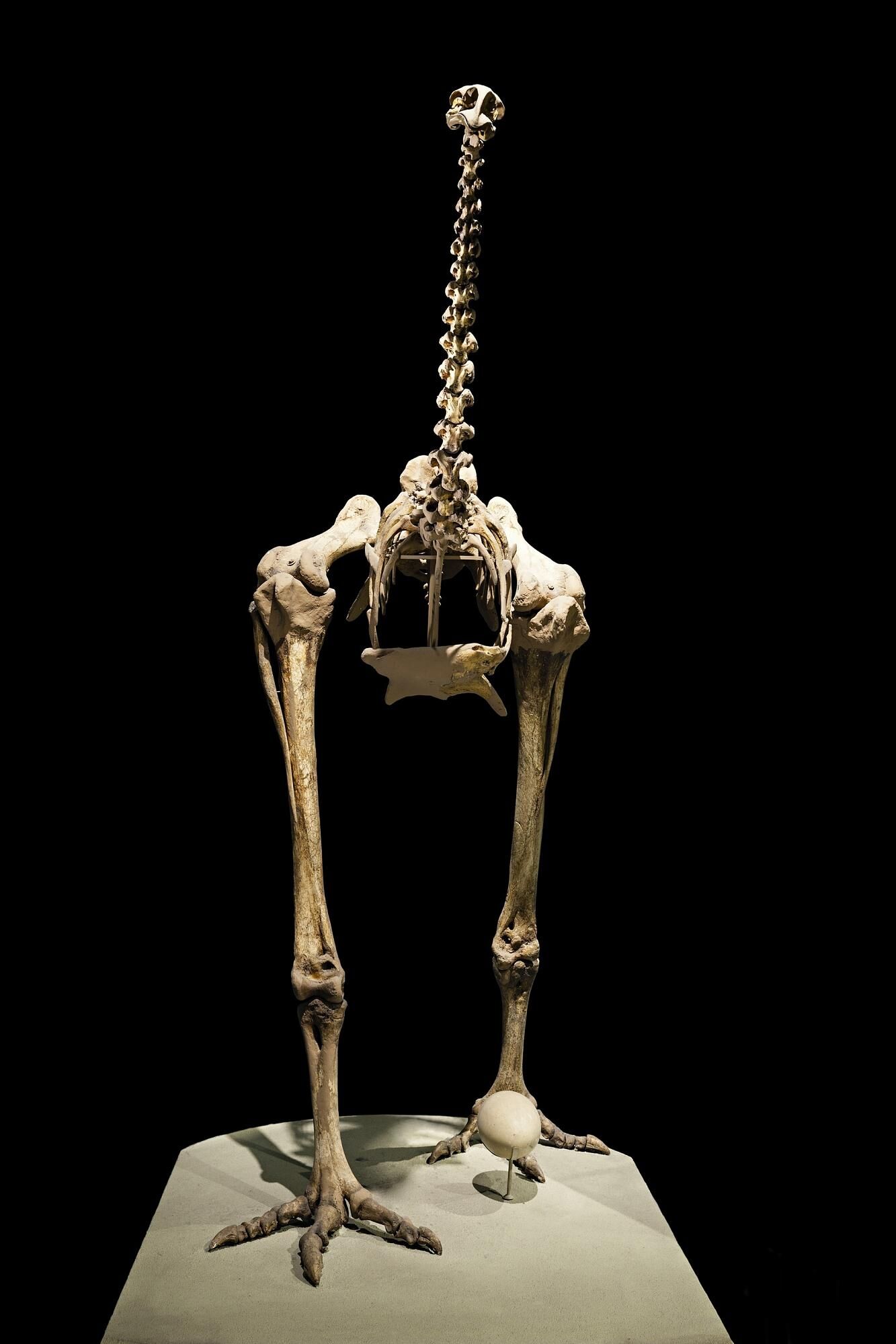
A wingless giant whose females stood 2 m tall at the back, hunted out within two centuries of human arrival.
What it was like
The South Island Giant Moa was an enormous, wingless plant-eater of New Zealand’s South Island. Females could stand up to 2 m at the back and weigh about 250 kg, far more than the males. It and all other moa vanished within roughly 150–200 years of Polynesian settlement, one of the fastest human-caused megafauna extinctions known.
Appearance
A huge, completely wingless bird with a long neck, small head and massive legs. Adult females stood up to about 2 m high at the back and could reach foliage up to 3.6 m above the ground. Females were about 150% the height and 280% the weight of males. This is one of the most extreme cases of reversed sexual size dimorphism known in birds.
Plumage & colour
Not well documented in the sources used here.
Behaviour
Probably nested in rock shelters, as isolated pairs rather than colonies. One or two eggs were probably laid per season, and the male probably incubated them (New Zealand Birds Online). These details are inferred from remains and are not certain.
Measurements: New Zealand Birds Online (Szabo 2013, updated 2022): males 34–85 kg, females 76–249 kg; Bunce et al. (2003)
Did you knowFor decades scientists thought the big and small giant moa were different species. DNA showed that the giants were females, which could weigh about 2.8 times as much as males.
Historical range shown at country level (countries of regular occurrence). Prehistoric range, reconstructed from bones.
- Where
- South Island of New Zealand, with records from Stewart Island and D’Urville Island. Bones from caves, dunes, swamps and middens show it was widespread in the eastern South Island.
- Continents
- Oceania
- Habitat
A wide range of vegetated habitats, from coastal dunes and inland shrublands to forests, subalpine herbfields and grasslands (New Zealand Birds Online). Coprolite evidence suggests that the large females fed more in forest and the smaller males more in open valley-floor herbfields (Wood et al. 2013).
- Movement · resident
- A flightless resident. Some seasonal movement between habitats is possible but undocumented.
What it ate
A browser and grazer. It ate twigs, leaves, flowers, berries and seeds from the smaller branches of trees and shrubs, as well as herbs and vines (New Zealand Birds Online).
Feeding strategy
Gizzard contents from Pyramid Valley swamp are dominated by forest trees and shrubs. Coprolites (fossil droppings) from the Dart River valley contain southern beech (Nothofagus) DNA, which suggests the large females ate low-quality, fibrous plant material (Wood et al. 2013). Coprolite DNA studies show that moa in general also ate ferns, mosses and fungi (Boast et al. 2018).
- PlantTwigs and leaves of trees and shrubsIncluding southern beech, from coprolite DNA.
- PlantFlowers, berries and seeds
- PlantHerbs and vines
- FungusEctomycorrhizal fungiShown for moa generally (Boast et al. 2018).
What hunted it
The animals that preyed on the South Island Giant Moa, grouped by the life stage they attacked.
EggsWho ate its eggs
No predators documented at this stage.
ChicksWho killed its chicks
- MammalKurī (Polynesian dog)LikelyIntroduced by people. New Zealand Birds Online mentions predation of chicks.
AdultsWho killed grown birds
- BirdHaast’s eagle (Aquila moorei)LikelyThe largest eagle known. A morphological study suggests it specialised in moa up to the size of adult South Island giant moa.
- PeoplePeopleDocumentedHunted intensively after Polynesian settlement in the 13th century.
Before people arrived, Haast’s eagle was the South Island’s main predator. No native predators of moa eggs or chicks are documented.
Its place in nature
Moa were New Zealand’s largest plant-eaters. Coprolite studies suggest moa species divided up the vegetation. Giant moa were “tall browsers” that fed high in shrubs and short forest; females, at least, used forest. As the main prey of Haast’s eagle, and as eaters of fruit, seeds and fungi, they linked many parts of the ecosystem. Wood et al. (2013) concluded that no living herbivore could replace the full range of moa feeding ecology.
- Preyed on byLikelyHaast’s eagle
The eagle’s size and build suggest it hunted moa up to the size of adult giant moa. It died out at about the same time as the moa, probably because its prey was hunted out.
- Feeds onDocumentedSouthern beech and other forest trees and shrubs
Shown by gizzard contents and coprolite DNA (Wood et al. 2013).
- Feeds onHypothesisedDivaricating shrubs
Many New Zealand shrubs have a tangled, wiry “divaricate” growth form, and some trees change leaf shape as they grow (heteroblasty). Whether these evolved as defences against moa browsing has long been debated. Other explanations, such as adaptations to frost, water loss or light conditions, have also been proposed (see the studies reviewed by Wood et al. 2013).
- Disperses seeds ofHypothesisedEctomycorrhizal fungi
Coprolite DNA shows moa ate these forest-forming fungi, suggesting they helped spread fungal spores (Boast et al. 2018). Whether giant moa in particular did so is not known.
How it disappeared
- Extinct
- c. 1420–1470 CE (most likely c. 1440–1445), estimated
- Where
- South Island, New Zealand
Polynesian voyagers settled New Zealand in the 13th century. The largest animals they found were birds. Nine species of moa, from about 20 kg to over 200 kg, were hunted for food.
Hunting was intense and fast. Studies of dated bones and archaeological sites suggest moa were hunted to scarcity within about 150 years. Small surviving populations probably lasted only another 50 years or so in remote mountains.
By around the middle of the 15th century the moa were gone. Haast’s eagle, which had preyed on them, disappeared at about the same time.
The human role
Moa are considered the only late Quaternary megafauna whose extinction was clearly caused by people (Holdaway et al. 2014). Genetic data show no decline before settlement (Allentoft et al. 2014). A small human population, probably fewer than 2,000 people, wiped out viable moa populations through hunting and habitat removal.
About the date. Perry et al. (2014) analysed 111 high-quality radiocarbon dates from moa remains, selected from 653. They estimated that moa populations had collapsed within about 150 years of settlement, and that the last birds were gone about 200 years after settlement, between about 1420 and 1470 CE (most likely 1440–1445). Extinction appears to have happened at about the same time at sites hundreds of kilometres apart. These are model estimates, not observed last records. Wood et al. (2013) give “∼1450 AD” for moa extinction.
What was lost
New Zealand lost its largest herbivores, the main prey of Haast’s eagle, consumers and probable dispersers of seeds and fungi, and a set of parasites that lived only in moa. Effects on forest structure are likely but cannot be measured directly. Whether the divaricate shape of many native shrubs is a legacy of moa browsing remains debated.
Historical population
Unknown. Genetic studies show moa populations were large and stable for at least 4,000 years before people arrived (Allentoft et al. 2014).
- Haast’s eagle
Haast’s eagle died out at about the same time as the moa. New Zealand Birds Online considers overhunting of its moa prey by people the probable main cause.
- Forest understorey and canopy openness
Wood et al. (2013) suggest that losing the “tall browser” guild, including giant moa, may have changed forest understoreys and canopy openness in short forest. A related hypothesis is that reduced browsing let broadleaf shrubs thrive and reduced podocarp regeneration.
- Moa-specific parasites
Coprolite DNA reveals parasites found only in moa. Boast et al. (2018) present data supporting the hypothesis that several of these parasites went extinct along with their hosts.
- Seeds and fungal spores
Moa ate berries, seeds and fungi, and intact seeds are found in moa coprolites. Their loss probably reduced the dispersal of some plants and ectomycorrhizal fungi, but the size of this effect is unknown.
- Divaricating plants
If the wiry, divaricate shape of many New Zealand shrubs evolved against moa browsing, these plants now carry defences against a browser that no longer exists. This explanation is debated, and climate-based explanations have also been proposed.
Uncertainty. Moa were never studied alive. Effects on vegetation are hard to separate from those of forest burning by early settlers and of introduced mammals, which arrived later.
Legacy
Moa disappeared centuries before any conservation movement existed. Today their story is used to show how quickly even large, abundant animals can be wiped out by a small human population. The study of moa diets also helps decide how to manage New Zealand forests now browsed by introduced deer.
Sources
Conservation status: Not assessed on the IUCN Red List; listed as Extinct by New Zealand Birds Online, assessed . Media credits accompany each image and recording; see Sources & credits.
Taxonomy. Moa (order Dinornithiformes) were a group of nine species in six genera, all found only in New Zealand and all now extinct. Bones of giant moa were once sorted into three species of very different sizes. Ancient-DNA work (Bunce et al. 2003) showed that on each island these were a single species, with females far larger than males.
- Szabo, M.J. (2013, updated 2022). South Island giant moa | moa nunui. In Miskelly, C.M. (ed.) New Zealand Birds Online.
- Bunce, M. et al. (2003). Extreme reversed sexual size dimorphism in the extinct New Zealand moa Dinornis. Nature 425: 172–175.
- Perry, G.L.W. et al. (2014). A high-precision chronology for the rapid extinction of New Zealand moa. Quaternary Science Reviews 105: 126–135. (Summary: Science Media Centre NZ.)
- Holdaway, R.N. et al. (2014). An extremely low-density human population exterminated New Zealand moa. Nature Communications 5: 5436.
- Allentoft, M.E. et al. (2014). Extinct New Zealand megafauna were not in decline before human colonization. PNAS 111: 4922–4927.
- Wood, J.R. et al. (2013). Resolving lost herbivore community structure using coprolites of four sympatric moa species. PNAS 110: 16910–16915.
- Boast, A.P. et al. (2018). Coprolites reveal ecological interactions lost with the extinction of New Zealand birds. PNAS 115: 1546–1551.
- Szabo, M.J. (2013). Haast’s eagle. In Miskelly, C.M. (ed.) New Zealand Birds Online.