Southern Cassowary
A dinosaur-like rainforest giant that swallows fruit whole and carries the seeds of hundreds of plants.
Meet the bird
A huge, flightless bird of the rainforests of New Guinea and north-eastern Australia, with glossy black plumage, a blue-and-red neck and a tall casque on its head. It lives mainly on fallen fruit — more than 238 plant species are recorded in its diet in Australia — and is the only large-bodied seed disperser in Australia’s rainforests. Globally it is not threatened, but in Australia only a few thousand remain, threatened by habitat loss, vehicles and dogs.
Appearance
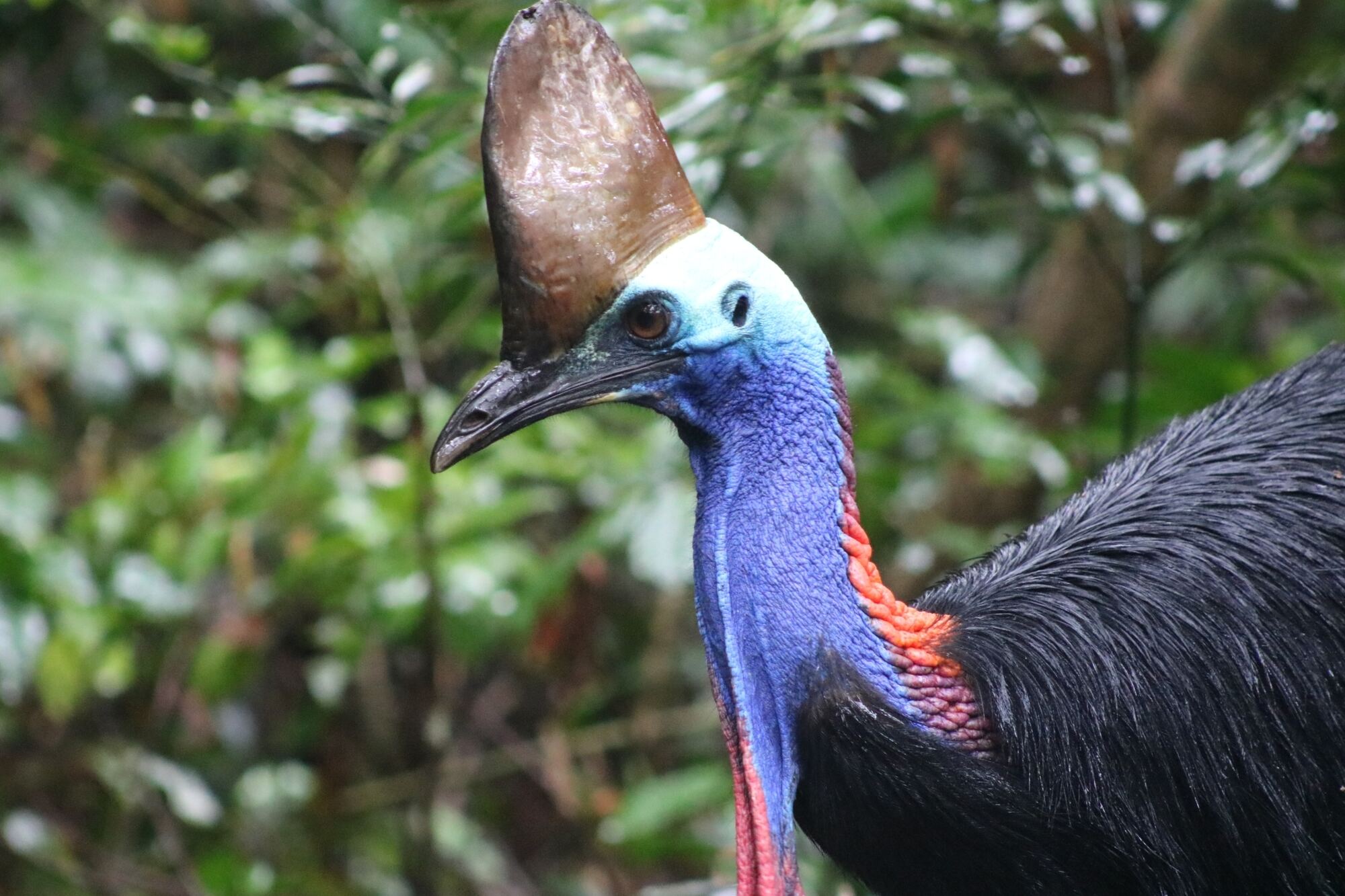
A massive, flightless bird standing up to about 2 m tall, with powerful legs, three-toed feet bearing a long, dagger-like inner claw, and vestigial wings whose quills are reduced to bare spines. A tall, helmet-like casque crowns the head. Females are larger than males: in Queensland, females weigh up to 76 kg and males up to 55 kg.
Plumage & colour
Coarse, hair-like, glossy black body feathers. The bare skin of the head and neck is bright blue, with red on the back of the neck and two red wattles hanging from the throat. Chicks are striped cream and brown; juveniles are plain brown and gain adult colours over several years. Sexes look alike apart from size.
Behaviour
Cassowaries are mostly solitary. In Queensland the breeding season runs from May to November: the female lays 3–5 eggs between June and October, and the male alone incubates the eggs for about 50 days and guards the striped chicks. Young birds become independent at 8–18 months and mature at about 3 years.
Measurements: Queensland Government (Department of Environment): height up to 2 m; weight up to 76 kg (females) and 55 kg (males). Only maximum values were found, so ranges are not given.
Did you knowMore than 238 plant species are recorded in the cassowary’s diet — including many fruits that are poisonous to people.
Range shown at country level (countries of regular occurrence). In New Guinea it is absent from the northern watershed between the Vogelkop and the Huon Peninsula.
- Where
- Lowland New Guinea (Papua and West Papua in Indonesia, and Papua New Guinea), including the Aru Islands and Seram (where it was probably introduced), and north-eastern Queensland, Australia. In Australia three populations remain: the largest in the Wet Tropics from the Paluma Range north of Townsville to the Cooktown area, and two on Cape York Peninsula.
- Continents
- Oceania
- Habitat
Mainly lowland tropical rainforest, but also swamp forest, mangroves, adjacent savanna woodland and fruit plantations. In New Guinea it occurs mostly below 300 m; in Australia it has been recorded up to 1,400 m.
- Movement · resident
- Sedentary. Individuals in Queensland occupy home ranges of about 0.5–2.4 km².
What it eats
Mainly fallen fruit: over 238 plant species are recorded in its diet in Queensland, including many fruits poisonous to people. BirdLife describes it as fairly undiscriminating in what it eats.
Feeding strategy
Cassowaries forage on the forest floor for fallen fruit, swallowing even large fruits whole. Seeds are deposited in dung, often in clumps, typically hundreds of metres from the parent plant.
- PlantFallen fruits of rainforest plants (over 238 species)The bulk of the diet.
- PlantIntroduced fruits (e.g. pond apple) in disturbed areasMore common in the diet near towns.
What eats it
The animals that prey on the Southern Cassowary, grouped by the life stage they attack: its eggs, its chicks, or grown birds.
EggsWho eats its eggs
- MammalFeral pigLikelyListed by the Queensland Government among introduced predators; impact not quantified.
ChicksWho kills its chicks
- MammalDogs (domestic and wild)DocumentedDog attacks are a recognised threat in Queensland.
- MammalFeral pigLikely
AdultsWho kills grown birds
- MammalDogs (domestic and wild)Documented
Natural predation on cassowaries is poorly documented. In Australia, introduced dogs and pigs are the recognised predators, and vehicle strikes are a major cause of death. In New Guinea, people hunt cassowaries heavily for food and trade.
Its place in nature
The cassowary is the only large-bodied seed disperser in Australia’s rainforests. By swallowing fruits whole and walking long distances before depositing the seeds, it moves seeds of many plants — including large-fruited species that few other animals can swallow — an estimated mean of about 337 m from the parent plant. In fragmented landscapes it still carries native seeds between rainforest patches, but it also spreads some invasive plants.
- Disperses seeds ofDocumentedRainforest fruiting plants (over 238 species)
Cassowaries eat the fruit of more than 238 plant species and pass many of their seeds intact. Modelling based on cassowary movements estimated a mean seed-dispersal distance of 337 m (Westcott et al. 2005).
- Disperses seeds ofDocumentedRainforest fragments
A 2023 study at four Wet Tropics sites found cassowaries still deposit native seeds between rainforest patches in developed landscapes, although birds near towns eat more introduced fruit (Campbell et al. 2023).
- Disperses seeds ofDocumentedPond apple (invasive Annona glabra)
Cassowaries also eat and disperse this invasive weed of Queensland wetlands and rainforest margins, which means the bird can help spread unwanted plants as well as native ones.
- Preyed on byDocumentedDogs
Domestic and wild dogs attack cassowaries, especially chicks and juveniles, near settlements.
- Preyed on byLikelyFeral pig
Introduced pigs are listed as predators of cassowaries in Queensland; they also eat fallen fruit and disturb the forest floor, but their effects on cassowaries have not been quantified.
What if it disappeared?
In New Guinea the species is still widespread, but in Australia only a few thousand remain and the bird has already vanished from parts of its former range. Because it is the only large seed disperser in Australia’s rainforests, its local loss is a serious concern for plant communities.
Press Remove to see which organisms could be affected, how, and how confident scientists are. 3 possible effects are recorded for this species.
Smaller fruit-eaters such as fruit-doves, flying-foxes and musky rat-kangaroos disperse smaller seeds, and rodents move some larger ones, but none can swallow and carry the largest fruits as cassowaries do. Compensation would therefore be limited for the biggest-fruited plants.
Which plants depend entirely on cassowaries for dispersal, and how quickly forest composition would change without them, remain poorly known. Population size and trends in New Guinea are also poorly known.
These scenarios summarise published ecology. They are not predictions: ecosystems are complex, other pressures interact, and documented, likely and hypothesised effects are labelled separately.
Conservation
- LCLeast Concern
- NTNear Threatened
- VUVulnerable
- ENEndangered
- CRCritically Endangered
- EWExtinct in the Wild
- EXExtinct
Downlisted to Least Concern in 2018 because the New Guinea population appears larger than previously thought. In Australia the southern population (Casuarius casuarius johnsonii) is listed as Endangered under the federal EPBC Act and Queensland’s Nature Conservation Act.
- Population estimate
- 20,000–49,999 mature individuals (precautionary estimate; probably higher). Australian population c. 4,000 individuals (Westcott et al. 2014).
- Estimate year: 2016
- Trend
- Decreasing
- Source
- BirdLife International factsheet (2018 assessment)
No reliable historical time series is available for this species, so no population chart is shown. We do not interpolate or estimate missing data.
Threats
- Habitat loss and fragmentation
In Australia, clearing for agriculture and development caused a rapid decline until much of the remaining habitat was protected by World Heritage listing in 1988. In New Guinea, industrial logging and planned oil-palm plantations threaten lowland forest.
- Vehicle strikes
Collisions with vehicles are a major cause of death in Queensland; road deaths increased significantly after cyclones, although a 20-year analysis did not find that this caused significant population declines (Dwyer et al. 2016, cited by BirdLife).
- Dogs and feral pigs
Domestic and wild dogs attack cassowaries, and introduced pigs are listed among their predators.
- Hunting in New Guinea
Cassowaries are culturally important and heavily hunted and traded near populated areas in New Guinea, which has caused local extinctions.
What is being done
In Australia, much cassowary habitat lies within the Wet Tropics World Heritage Area, and the southern population is protected as Endangered under federal and Queensland law, with a national recovery plan. Conservation focuses on protecting and reconnecting habitat, reducing road deaths and dog attacks, and monitoring the population.
- Listed as Endangered under the EPBC Act and the Queensland Nature Conservation Act (southern population).
- National recovery plan for the southern cassowary.
- Population survey of the Wet Tropics by CSIRO (2014), estimating up to about 4,400 birds.
- Habitat protection within the Wet Tropics World Heritage Area (listed 1988).
Sources
Conservation status: IUCN Red List (assessed by BirdLife International), assessed 2018. Media credits accompany each image and recording; see Sources & credits.
Taxonomy. Australian birds are often referred to the subspecies C. c. johnsonii, the name used in Australian legislation; subspecies of cassowaries are poorly defined.
- BirdLife International (2018 assessment). Species factsheet: Southern Cassowary Casuarius casuarius.
- Queensland Government. Southern cassowary (threatened species featured project).
- Queensland Government species profile: Casuarius casuarius johnsonii (southern population).
- Westcott, D.A., Bentrupperbäumer, J., Bradford, M.G. & McKeown, A. (2005). Incorporating patterns of disperser behaviour into models of seed dispersal and its effects on estimated dispersal curves. Oecologia 146: 57–67.
- Campbell, M. et al. (2023). The southern cassowary (Casuarius casuarius johnsonii) remains an important disperser … Austral Ecology (author copy).
- Australian Government. Recovery plan for the southern cassowary Casuarius casuarius johnsonii.