Toco Toucan
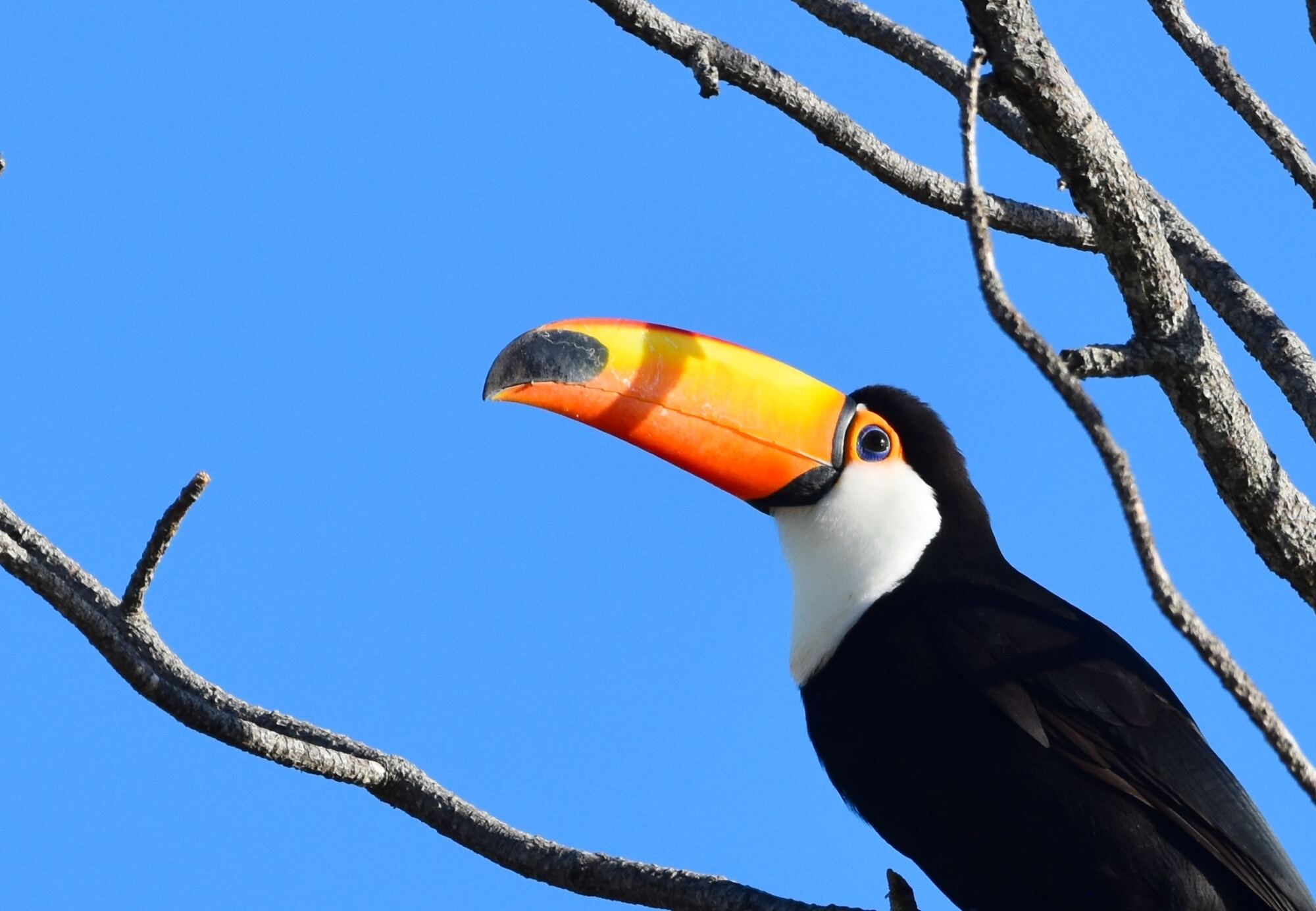
The largest toucan is both the main planter of the hyacinth macaw’s nest tree and a thief of its eggs.
Meet the bird
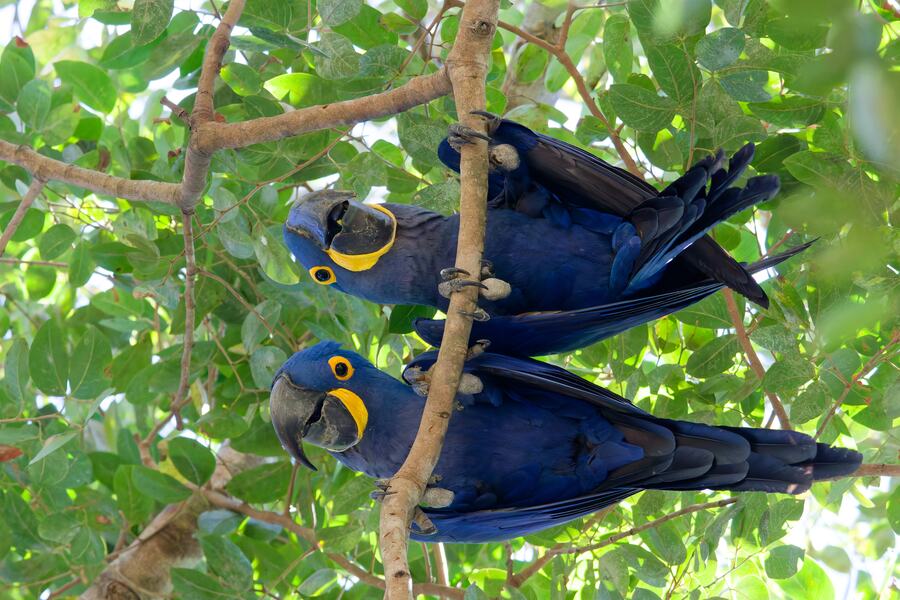
The largest of the toucans, with an enormous orange bill, the Toco Toucan lives in open woodland, savanna and forest edges across central South America. It eats mainly fruit and is an important seed disperser, but it also takes eggs and nestlings of other birds. In the Brazilian Pantanal it is at the centre of a famous “conservation puzzle”: it plants most of the manduvi trees in which Hyacinth Macaws nest, yet it is also the macaws’ main egg predator.
Appearance
A large, black toucan whose huge, lightweight bill makes up about a third of its total length. Its body is about 61 cm long on average.
Plumage & colour
Glossy black body with a white throat and bib, red undertail coverts, and bare orange skin around a blue eye-ring. The bill is bright orange with a black tip and a black band at the base. Sexes look alike; young birds have shorter bills that are still growing.
Behaviour
Toco Toucans usually travel in pairs or small groups. They nest in tree cavities, and both parents incubate the clutch of about 2–4 eggs. Research with thermal cameras showed that the bill works as an adjustable radiator: by changing blood flow, the bird can shed heat through the bill when warm and conserve it when cool.
Measurements: Animal Diversity Web (University of Michigan): average length 61 cm; mass 592–760 g.
Did you knowA toucan’s bill is one of the largest “thermal windows” in the animal kingdom, rivalling an elephant’s ears in its ability to radiate body heat (Tattersall et al. 2009).
Range shown at country level (countries of regular occurrence).
- Where
- Central and eastern South America: much of Brazil outside the dense Amazon forest, eastern Bolivia, Paraguay, northern Argentina and Uruguay, with populations also in the Guianas and south-eastern Peru.
- Continents
- South America
- Habitat
Unlike most toucans it favours semi-open country: savanna, dry forest, gallery forest, forest edges and the Pantanal wetlands, as well as plantations and rural gardens, and occasionally towns. It occurs from sea level to about 1,900 m.
- Movement · resident
- Not a migrant, although birds move locally in search of fruiting trees.
What it eats
Mainly fruit, plus insects and the eggs and nestlings of other birds. It is an opportunistic feeder.
Feeding strategy
It plucks fruit with the tip of its long bill and swallows it, later dropping the seeds away from the parent tree. It also raids other birds’ nests for eggs and chicks, as documented for Hyacinth Macaw nests in the Pantanal.
- PlantManduvi (Sterculia apetala) seeds with their fleshy coatThe toucan disperses 83% of manduvi seeds in the Pantanal (Pizo et al. 2008).
- PlantOther fruits
- BirdEggs and nestlings of other birds, including Hyacinth MacawsResponsible for about 53% of predated Hyacinth Macaw eggs in the Pantanal.
- InsectInsects
What eats it
The animals that prey on the Toco Toucan, grouped by the life stage they attack: its eggs, its chicks, or grown birds.
EggsWho eats its eggs
No predators documented at this stage.
ChicksWho kills its chicks
No predators documented at this stage.
AdultsWho kills grown birds
No predators documented at this stage.
Predation on Toco Toucans is not well documented. Animal Diversity Web lists jaguars, snakes, coatis and eagles as predators, but published observations are scarce.
Its place in nature
As a large fruit-eater moving between scattered trees in open landscapes, the Toco Toucan carries seeds away from parent trees, including those of the manduvi, a giant tree whose cavities are vital nest sites for macaws and other animals. At the same time it is a significant nest predator. In the Pantanal, these two roles link it to the Hyacinth Macaw in a way that shows how one species can both help and harm another.
- Disperses seeds ofDocumentedManduvi (Sterculia apetala)
In the Pantanal, the toco toucan was responsible for 83.3% of manduvi seed dispersal, and the tree’s recruitment depends greatly on it (Pizo et al. 2008). Old manduvis develop the cavities that Hyacinth Macaws nest in.
- Preys onDocumentedHyacinth Macaw
The toucan was responsible for about 53% of predated Hyacinth Macaw eggs in the Pantanal (Pizo et al. 2008) — so the macaw depends for nest trees on the very species that is its main egg predator.
- Preys onDocumentedEggs and nestlings of other birds
Toucans opportunistically raid other birds’ nests, adding animal protein to a mainly fruit diet.
- Nests in / depends onDocumentedTree cavities
Nests in natural holes in trees, which it does not excavate itself, so it depends on old trees with cavities.
What if it disappeared?
The Toco Toucan is widespread and not threatened. Its disappearance is a thought experiment, but an instructive one, because its effects on the Pantanal’s Hyacinth Macaws have been measured in both directions.
Press Remove to see which organisms could be affected, how, and how confident scientists are. 3 possible effects are recorded for this species.
Other fruit-eating birds and mammals disperse some manduvi seeds, but in the Pantanal study they accounted for less than a fifth of dispersal. Nest predation would continue from other predators such as jays, coatis and snakes.
The manduvi–toucan–macaw link is documented mainly from one region of the Pantanal. How general the toucan’s dominance as a disperser is across its large range, and how long-lived manduvi populations would respond, is not known.
These scenarios summarise published ecology. They are not predictions: ecosystems are complex, other pressures interact, and documented, likely and hypothesised effects are labelled separately.
Conservation
- LCLeast Concern
- NTNear Threatened
- VUVulnerable
- ENEndangered
- CRCritically Endangered
- EWExtinct in the Wild
- EXExtinct
- Population estimate
- Not quantified; described as fairly common
- Trend
- Decreasing
- Source
- BirdLife International factsheet (2025 assessment); decline of 1–19% over three generations inferred from tree-cover loss
No reliable historical time series is available for this species, so no population chart is shown. We do not interpolate or estimate missing data.
Threats
- Loss of tree cover
Tree cover within the mapped range is estimated to have declined by 20.8% over the past three generations, from which a slow population decline is inferred.
- Trade and hunting
The species is found frequently in wildlife-trade datasets and is captured as a pet and hunted for food at subsistence and national scales.
What is being done
No targeted conservation programme is needed at present, but the species benefits from protected areas and from conservation of large old trees in landscapes such as the Pantanal, which also helps Hyacinth Macaws.
- Occurs in many protected areas across its range.
- Retaining large fruiting and cavity-bearing trees on ranches and farmland.
Sources
Conservation status: IUCN Red List (assessed by BirdLife International), assessed 2025. Media credits accompany each image and recording; see Sources & credits.
- BirdLife International (2025 assessment). Species factsheet: Toco Toucan Ramphastos toco.
- Pizo, M.A., Donatti, C.I., Guedes, N.M.R. & Galetti, M. (2008). Conservation puzzle: endangered hyacinth macaw depends on its nest predator for reproduction. Biological Conservation 141: 792–796.
- Tattersall, G.J., Andrade, D.V. & Abe, A.S. (2009). Heat exchange from the toucan bill reveals a controllable vascular thermal radiator. Science 325: 468–470.
- Animal Diversity Web (University of Michigan). Ramphastos toco.