Wandering Albatross
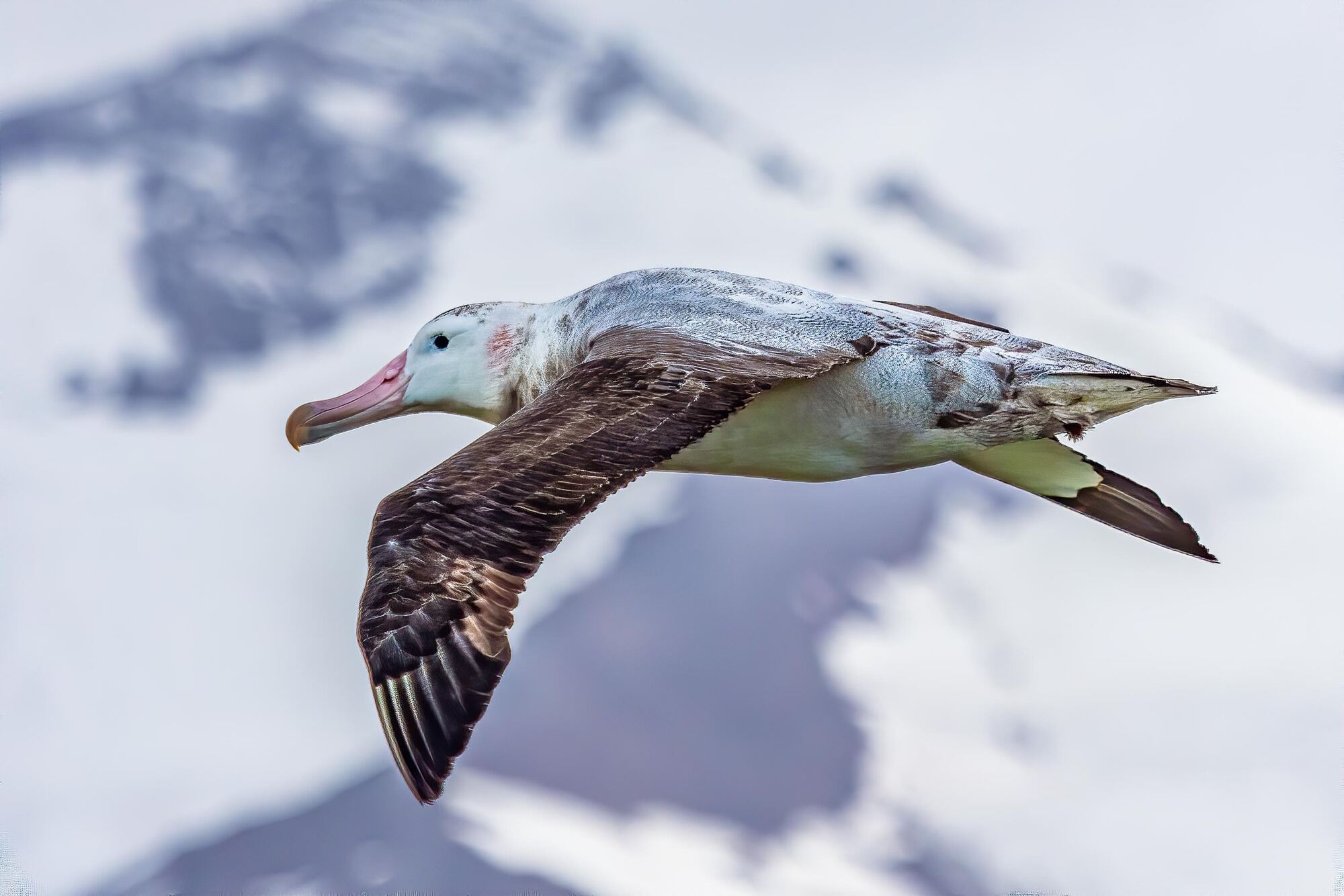
The bird with the longest wings on Earth, which can forage thousands of kilometres from its nest.
Meet the bird
A huge, long-lived albatross of the Southern Ocean that breeds on a handful of sub-Antarctic islands and ranges right around the globe between them. It feeds mainly on squid and fish taken at the surface. Because pairs raise at most one chick every two years, the accidental drowning of birds on longline fishing hooks has been enough to drive populations down.
Appearance
An enormous seabird with very long, narrow wings built for dynamic soaring over ocean swells, a heavy pink bill with a hooked tip, and pinkish feet. It has the largest wingspan of any living bird; the record, accepted by Guinness World Records, is 3.63 m for a male caught in the Tasman Sea in 1965.
Plumage & colour
Plumage whitens with age. Juveniles are chocolate-brown with a white face; over many years the body becomes white and the upperwing gradually whiter from the leading edge. The oldest birds, especially males, are almost entirely white apart from black wingtips and trailing edges.
Behaviour
Wandering Albatrosses breed at most every two years because raising a chick takes almost a full year. Adults return to the colonies in November, the single egg is laid in December–January, most chicks hatch in March and they fledge the following December. Young birds first return to land at 5–7 years old and usually begin breeding at about 10–12. Even in a breeding year, about 30% of successful and 35% of failed breeders on average defer breeding further.
Measurements: Length and wingspan: Animal Diversity Web (University of Michigan); weight: New Zealand Birds Online; record wingspan: Guinness World Records.
Did you knowThe widest bird wingspan ever measured — 3.63 m — belonged to a male Wandering Albatross caught in the Tasman Sea in 1965.
Range shown at country level (countries of regular occurrence). Includes breeding territories and waters off countries where BirdLife lists it as a regular non-breeding visitor; vagrant records are not shown. Much of its range is the high seas.
- Where
- Breeds on South Georgia (about 18% of breeding pairs), the Prince Edward Islands (South Africa; about 44%), the Crozet and Kerguelen Islands (French Southern Territories; about 38%) and Macquarie Island (Australia; a few pairs). At sea it ranges across the whole Southern Ocean, north into subtropical waters off South America, southern Africa and Australia.
- Continents
- Antarctica · Africa · South America · Oceania
- Habitat
Open ocean for most of its life, foraging mainly over deep oceanic waters but also over continental shelves at some stages of breeding. It nests on sub-Antarctic islands in open or patchy vegetation near exposed ridges or hillocks, where it can take off into the wind.
- Movement · migratory
- Breeding birds forage up to about 4,000 km from their colonies. Non-breeders and juveniles range north of 50°S, with many crossing the Indian Ocean to waters off southern and eastern Australia; a fledgling from Marion Island covered 6,590 km in its first 28 days at sea.
What it eats
Mainly squid and other cephalopods and fish, plus offal and discards from ships. Patagonian toothfish is the main fish in the diet, probably often obtained as fishery discards.
Feeding strategy
Feeds mostly by day, seizing prey from the sea surface. Birds habitually follow ships to take offal and galley waste, which brings them into contact with baited fishing hooks.
- InvertebrateSquid and other cephalopodsA main food.
- FishPatagonian toothfishPrimary fish prey, probably partly as discarded offal (Xavier et al. 2004).
- FishOther fish
- CarrionOffal and discards from ships
What eats it
The animals that prey on the Wandering Albatross, grouped by the life stage they attack: its eggs, its chicks, or grown birds.
EggsWho eats its eggs
No predators documented at this stage.
ChicksWho kills its chicks
- MammalHouse mouse (introduced)DocumentedOn Marion Island mice have attacked large chicks since 2003, affecting under 1% of the population there.
AdultsWho kills grown birds
No predators documented at this stage.
Natural predation on Wandering Albatrosses is not well documented. The main human-caused mortality is drowning on longline hooks. Historically, sealers harvested the Macquarie Island population heavily.
Its place in nature
As a wide-ranging surface predator and scavenger, the Wandering Albatross feeds on squid and fish across an enormous area of the Southern Ocean and transfers that energy to a few remote breeding islands. Its long life, slow breeding and habit of following fishing boats make it an indicator of how well fisheries are managed far from land.
- Preys onDocumentedSquid and other cephalopods
Cephalopods are a main part of the diet, taken at or near the surface.
- Feeds onDocumentedPatagonian toothfish
The primary fish species in the diet. Because toothfish live deep, albatrosses probably obtain much of it as offal discarded by fishing vessels.
- Feeds onDocumentedLongline fishing vessels
Albatrosses follow ships for offal and bait, and are hooked and drowned when they grab baited longline hooks. Fisheries were responsible for a 54% decrease in numbers on the Crozet Islands between 1970 and 1986.
- Preyed on byDocumentedHouse mouse (introduced, Marion Island)
Introduced mice have attacked and wounded large Wandering Albatross chicks on Marion Island since 2003; night filming confirmed mice cause the wounds (Dilley et al. 2016).
What if it disappeared?
The Wandering Albatross is declining but not close to extinction. Its ecological effects are spread thinly over a vast ocean, so the consequences of its loss are mostly a matter of inference.
Press Remove to see which organisms could be affected, how, and how confident scientists are. 3 possible effects are recorded for this species.
Other large albatrosses and giant petrels feed on similar prey and scavenge behind ships, so the feeding role would largely be filled. No other species, however, has quite the same combination of size and range.
Much of the bird’s life is spent far from land, so diet and foraging are known mainly from tracking and samples collected at a few colonies. The species’ role in Southern Ocean food webs has not been quantified.
These scenarios summarise published ecology. They are not predictions: ecosystems are complex, other pressures interact, and documented, likely and hypothesised effects are labelled separately.
Conservation
- LCLeast Concern
- NTNear Threatened
- VUVulnerable
- ENEndangered
- CRCritically Endangered
- EWExtinct in the Wild
- EXExtinct
Listed as Vulnerable because of past and projected declines of more than 30% over three generations (70 years), mainly attributed to longline fisheries bycatch.
- Population estimate
- c. 20,100 mature individuals (c. 6,000 pairs breeding in any one year)
- Estimate year: 2007
- Trend
- Decreasing
- Source
- BirdLife International factsheet (2018 assessment), from colony counts compiled by ACAP and others
No reliable historical time series is available for this species, so no population chart is shown. We do not interpolate or estimate missing data.
Threats
- Longline fisheries bycatch
Birds are hooked and drowned when taking bait from longlines. This has reduced adult survival and recruitment; on South Georgia the population fell by 1.8% per year in 1984–2004 and continued to decline at the same rate to 2015. Juveniles and females forage further north, where they overlap more with tuna longline fleets.
- Introduced house mice
On Marion Island, mice have attacked albatross chicks since 2003. Attacks on Wandering Albatross chicks remain at a low level, but mice now also attack the chicks of other albatross species.
- Past exploitation
The Macquarie Island population was harvested extensively by sealers and remains tiny (about four breeding pairs a year).
What is being done
Conservation focuses on reducing bycatch at sea and removing invasive mammals from breeding islands. The species is covered by the Agreement on the Conservation of Albatrosses and Petrels (ACAP), which promotes bycatch-mitigation measures for longline fleets.
- Bycatch mitigation on longline vessels, such as bird-scaring lines, setting lines at night and weighting lines so that baits sink quickly.
- Long-term population monitoring at South Georgia, Crozet, Kerguelen and the Prince Edward Islands.
- A planned eradication of house mice from Marion Island (Mouse-Free Marion Project).
Sources
Conservation status: IUCN Red List (assessed by BirdLife International), assessed 2018. Media credits accompany each image and recording; see Sources & credits.
Taxonomy. The former “wandering albatross” complex has been split by many authorities; Tristan, Antipodean and Amsterdam Albatrosses are now usually treated as separate species. This profile covers Diomedea exulans in the narrow sense.
- BirdLife International (2018 assessment). Species factsheet: Wandering Albatross Diomedea exulans.
- Dilley, B.J., Schoombie, S., Schoombie, J. & Ryan, P.G. (2016). ‘Scalping’ of albatross fledglings by introduced mice spreads rapidly at Marion Island. Antarctic Science 28: 73–80.
- ACAP. Catching up with “Wisdom”: the oldest known albatrosses and petrels on Bird Island, South Atlantic.
- Guinness World Records. Largest wingspan for a bird species (living).
- Animal Diversity Web (University of Michigan). Diomedea exulans.
- New Zealand Birds Online. Wandering albatross.
- Mouse-Free Marion Project.