Emperor Penguin
The largest penguin breeds on Antarctic sea ice in the depths of winter — and needs that ice to last.
Meet the bird
The tallest and heaviest of all penguins, the Emperor Penguin lives only around Antarctica and breeds through the polar winter on sea ice frozen fast to the coast. Males incubate the single egg on their feet for about two months while fasting. Because almost every colony depends on stable fast ice, climate-driven sea-ice loss is projected to cause steep declines this century, and record-low ice in 2022 already led to the total breeding failure of several colonies.
Appearance
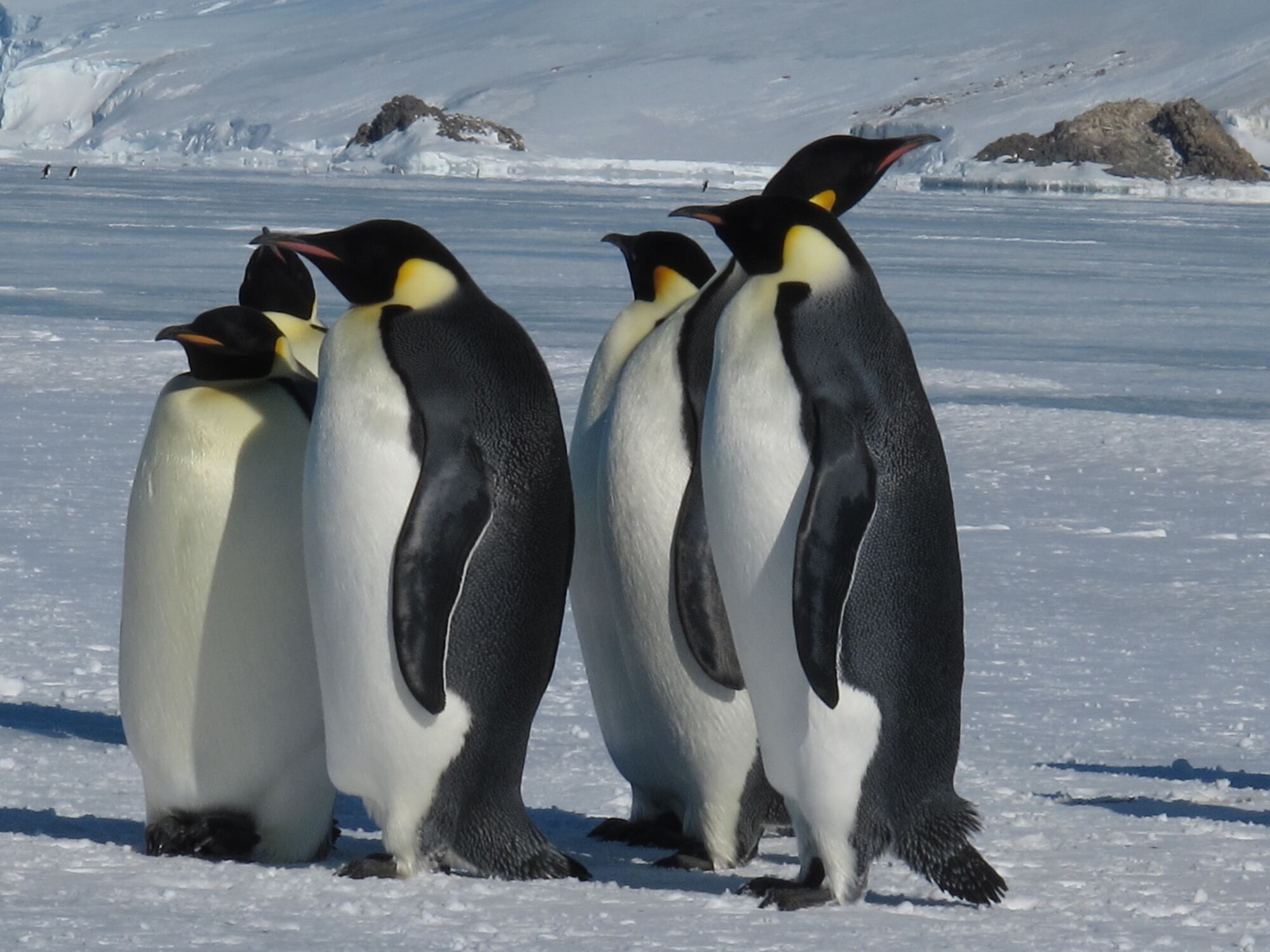
A massive, upright penguin with a relatively small head, a long, slightly down-curved bill and short, stiff, flipper-like wings. It walks or slides on its belly (tobogganing) on ice and is an exceptional diver.
Plumage & colour
Blue-black back, head and throat; white belly washed with pale yellow on the upper breast; bright yellow-orange ear patches that fade into the white of the neck; a pink to orange stripe along the lower mandible. Sexes look alike. Chicks are covered in silvery-grey down with a black head and white face mask.
Behaviour
Emperor Penguins are the only animals that breed during the Antarctic winter. The female lays a single egg in May–June and passes it to the male, who incubates it on his feet under a fold of skin for about 65 days while huddling with other males against the cold; males fast for roughly four months in total. Chicks hatch in mid-winter and fledge in December–January, when the sea ice breaks up. Most foraging dives reach 150–250 m, but the deepest recorded dive was 565 m.
Measurements: Animal Diversity Web (standing height 101–132 cm; adult mass 25–45 kg); Australian Antarctic Program.
Did you knowEmperor Penguins are the only animals that breed during the Antarctic winter.
Range shown at country level (countries of regular occurrence). Vagrants have reached South America, the Falkland Islands, South Georgia, New Zealand and sub-Antarctic islands; these are not shown.
- Where
- Circumpolar around the coast of Antarctica, with around 60 known breeding colonies (54 were included in the 2019 population estimate; more have been found since); the largest are in the Ross and Weddell Seas. Juveniles disperse north into the Southern Ocean.
- Continents
- Antarctica
- Habitat
An ice-obligate seabird. The vast majority of colonies breed on land-fast sea ice — ice attached to the coast — sometimes tens of kilometres from open water; only one known colony is wholly on land, and a few have moved onto ice shelves. Birds forage in the pack ice and open waters of the Southern Ocean.
- Movement · migratory
- Adults gather at colonies in late March and April, then leave after the breeding season; after moulting in summer, some travel up to about 1,200 km to areas of persistent pack ice. Fledged chicks disperse widely northward into the Antarctic Circumpolar Current.
What it eats
Mainly fish — especially Antarctic silverfish — plus Antarctic krill and squid. The balance varies between colonies and seasons.
Feeding strategy
A pursuit diver that hunts in the pack ice and open water. Adults eat about 2–3 kg of food per day, and up to 6 kg when fattening before moulting or breeding. Typical dives last 3–6 minutes; the longest recorded lasted 22 minutes.
- FishAntarctic silverfishOne of the most frequently eaten prey.
- FishOther fish
- InvertebrateAntarctic krill
- InvertebrateSquid
What eats it
The animals that prey on the Emperor Penguin, grouped by the life stage they attack: its eggs, its chicks, or grown birds.
EggsWho eats its eggs
- BirdSouth Polar SkuaDocumentedTakes eggs and chicks.
ChicksWho kills its chicks
- BirdSouth Polar SkuaDocumented
- BirdGiant petrelsLikelyWidely reported as predators of chicks; quantitative data were not verified for this profile.
AdultsWho kills grown birds
- MammalLeopard sealDocumentedHas been observed killing emperor penguins at sea.
- MammalKiller whale (orca)DocumentedHas been observed preying on emperor penguins.
Predation rates on Emperor Penguins are not well quantified. Breeding on fast ice far from open water keeps adults away from marine predators during the long incubation; at sea, leopard seals and killer whales take adults and fledglings.
Its place in nature
Emperor Penguins are among the top predators of the Antarctic marine ecosystem, consuming fish, krill and squid, and in turn are food for leopard seals, killer whales and, as eggs and chicks, for skuas and giant petrels. Because they depend on sea ice for breeding, foraging and resting, they are widely used as a sentinel species for the effects of climate change on Antarctic ecosystems.
- Nests in / depends onDocumentedLand-fast sea ice
Almost all colonies breed on sea ice attached to the coast, which must remain stable from April until chicks fledge in December–January. Early break-up drowns or strands chicks before they grow waterproof feathers.
- Preys onDocumentedAntarctic silverfish
One of the most frequently eaten prey species.
- Preys onDocumentedAntarctic krill
An important part of the diet at some colonies and seasons.
- Preyed on byDocumentedLeopard seal
Leopard seals kill emperor penguins in the water, particularly near colonies and ice edges.
- Preyed on byDocumentedKiller whale
Killer whales have been observed preying on emperor penguins.
- Preyed on byDocumentedSouth Polar Skua
Skuas steal and eat eggs and chicks.
What if it disappeared?
Climate models suggest that, without major cuts in emissions, many colonies could disappear this century, so this scenario is a real possibility for parts of Antarctica. The ecological consequences, however, have not been studied directly.
Press Remove to see which organisms could be affected, how, and how confident scientists are. 3 possible effects are recorded for this species.
Other penguins, seals and fish eat similar prey, so the consumption of silverfish and krill would probably continue. No other bird, however, exploits the winter fast ice or forages at such depths, so this part of the ecosystem would lose its largest diving bird.
Most colonies are counted from satellite images rather than on the ground, and non-breeding birds are not counted at all. How quickly sea ice will decline in different regions, and whether penguins can relocate to new breeding sites, are major uncertainties.
These scenarios summarise published ecology. They are not predictions: ecosystems are complex, other pressures interact, and documented, likely and hypothesised effects are labelled separately.
Conservation
- LCLeast Concern
- NTNear Threatened
- VUVulnerable
- ENEndangered
- CRCritically Endangered
- EWExtinct in the Wild
- EXExtinct
Listed as Threatened under the US Endangered Species Act in October 2022 because of projected sea-ice loss. BirdLife expects rapid declines once sea-ice changes intensify after about 2050.
- Population estimate
- c. 256,500 breeding pairs in 54 colonies (from satellite imagery of 2009, updated 2019); non-breeders not counted
- Estimate year: 2019
- Trend
- Decreasing
- Source
- BirdLife International factsheet (2020 assessment), citing Trathan et al. (2019)
No reliable historical time series is available for this species, so no population chart is shown. We do not interpolate or estimate missing data.
Threats
- Loss of sea ice due to climate change
Under a high-emissions scenario, projections suggest about 80% of colonies (43 of 54) could be quasi-extinct by 2100 and the global population could fall by about 86%; limiting warming to 2 °C would still mean a decline of at least 44% (Jenouvrier et al. 2020, cited by BirdLife).
- Early sea-ice break-up and breeding failures
In 2022, record-low Antarctic sea ice led to total breeding failure at four of five colonies in the central and eastern Bellingshausen Sea, as fast ice broke up before chicks had fledged (Fretwell et al. 2023). A satellite study estimated an 81% probability that there were fewer adults in 2018 than in 2009, with a median decline of 9.6% (LaRue et al. 2024).
- Changes in food supply
Receding sea ice and changes in fisheries are expected to affect fish and krill stocks, which could reduce food for emperors and other predators.
What is being done
The only lasting solution is to limit climate change and the resulting loss of sea ice. Meanwhile, satellite monitoring tracks colonies across the continent, and the species gained protection under the US Endangered Species Act in 2022, which recognises climate change as the main threat.
- Listed as Threatened under the US Endangered Species Act (2022).
- Continent-wide satellite monitoring of colonies by the British Antarctic Survey and others.
- Research on demography and projected responses to sea-ice loss.
Sources
Conservation status: IUCN Red List (assessed by BirdLife International), assessed 2020. Media credits accompany each image and recording; see Sources & credits.
- BirdLife International (2020 assessment). Species factsheet: Emperor Penguin Aptenodytes forsteri.
- Fretwell, P.T. et al. (2023). Record low 2022 Antarctic sea ice led to catastrophic breeding failure of emperor penguins. Communications Earth & Environment 4.
- LaRue, M. et al. (2024). Advances in remote sensing of emperor penguins: first multi-year time series documenting trends in the global population. Proceedings of the Royal Society B.
- Woods Hole Oceanographic Institution (2022). Emperor penguins granted protections under Endangered Species Act.
- Australian Antarctic Program. Emperor penguin.
- Animal Diversity Web (University of Michigan). Aptenodytes forsteri.