Western Barn Owl
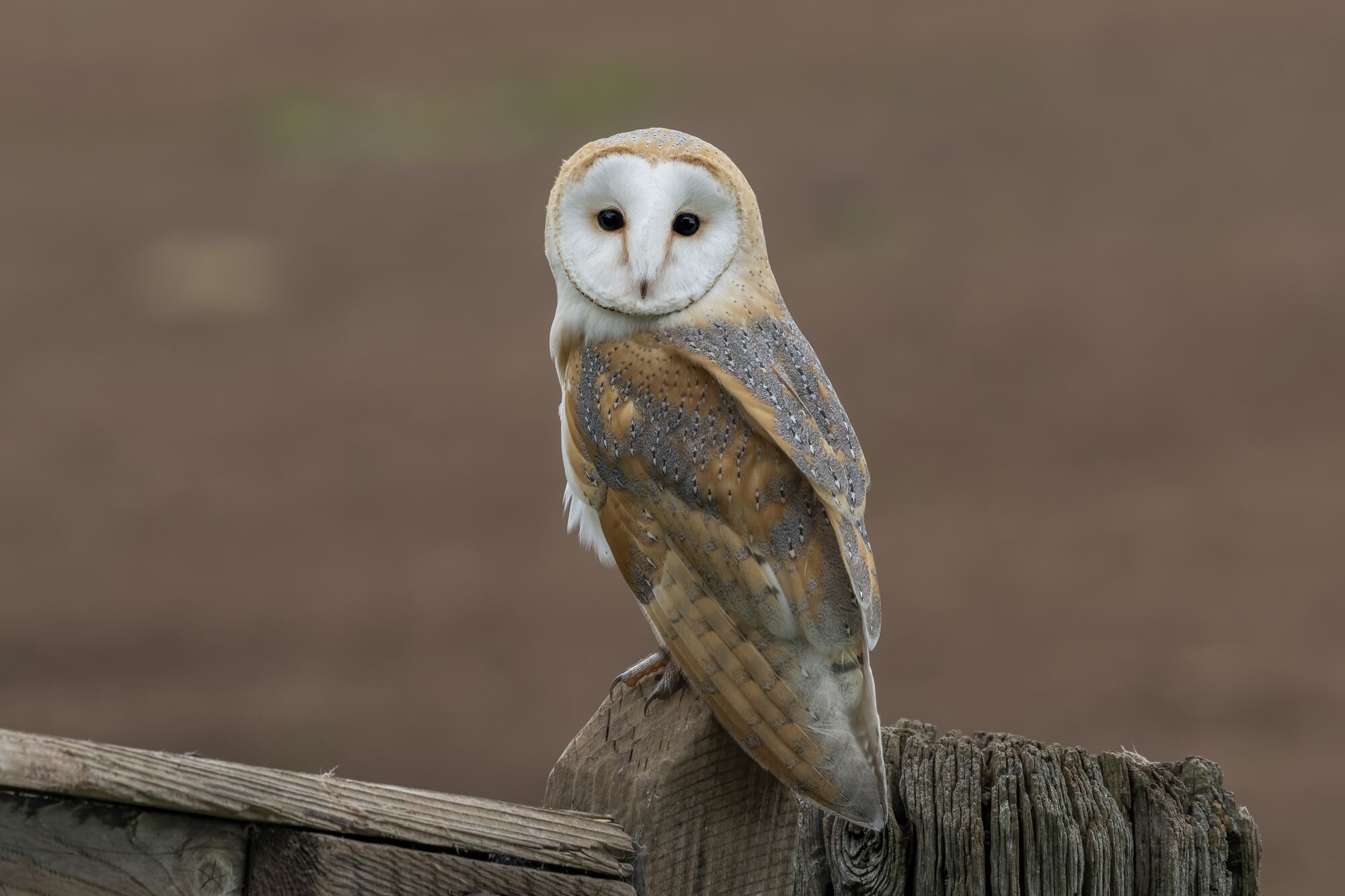
A ghostly farmland hunter that can catch a vole in total darkness by sound alone.
Meet the bird
The Western Barn Owl is a pale, heart-faced owl of open farmland, grassland and savanna across Europe, Africa and western Asia. It hunts small mammals — especially voles, mice and shrews — mainly at night, locating them by hearing. Because it relies on buildings, tree holes and nest boxes for nesting and on rough grassland for hunting, its fortunes are closely tied to farming practices.
Appearance
A medium-sized, long-legged owl with a large head, rounded wings and no ear tufts. The white, heart-shaped facial disc frames small dark eyes. Flight is buoyant and silent, often low over rough grass. The ears are placed asymmetrically on the head, which sharpens the bird’s ability to pinpoint sounds.
Plumage & colour
Upperparts golden-buff to orange-buff, finely flecked with grey and white; underparts vary between regions from white to orange-buff. Females are typically about 10% heavier than males, though the sexes overlap considerably.
Behaviour
Mainly nocturnal, though it sometimes hunts in daylight. It locates prey largely by sound and drops onto it from low flight or a perch. A cavity nester that builds no real nest. In Britain, clutches are typically 4–6 eggs (recorded range 2–12), incubated by the female for about 32 days; the young fledge after about eight weeks (49–62 days observed), and two broods are sometimes raised in a season. Indigestible fur and bones are regurgitated as pellets, which are widely used to study small-mammal populations.
Measurements: Length and wingspan: Cramp (1985), Birds of the Western Palearctic Vol. 4, as summarised on Wikipedia. Weight (adult range, n = 522; females average c. 354 g, males c. 312 g) and longevity: BTO BirdFacts.
Did you knowExperiments by Knudsen and Konishi (1979) showed that barn owls can locate prey in complete darkness using hearing alone, helped by their asymmetrically placed ears and dish-shaped facial disc.
Shown at continent level — this species is too widespread for a country list. Consult BirdLife International or eBird for detailed range maps. Occurs in far more than 40 countries. Country-level data from BirdLife cover the broad species (including the Americas, southern Asia and Australasia), so they are not used here; the map shades continents for the Western Barn Owl only. Exact boundaries with Eastern Barn Owl in south-west Asia are not well defined.
- Where
- Most of Europe except the far north, with the densest populations in western, central and Mediterranean Europe; Africa (including Madagascar and several Atlantic and Indian Ocean islands); and the Middle East and Arabia east to about Iran.
- Continents
- Europe · Africa · Asia
- Habitat
Open lowland country with some trees: farmland with hedges, ditches and rough field margins, grassland, young plantations, semi-arid savanna and scrub. Roosts and nests in buildings (farm sheds, barns, church towers), tree cavities, cliff crevices and nest boxes, often close to villages and farms. In Britain, rough grassland strips along field margins are a key hunting habitat.
- Movement · resident
- Largely sedentary. Adults usually stay in the same area year-round; young birds disperse after fledging, sometimes over considerable distances.
What it eats
Specialist predator of small mammals — mainly voles, mice, shrews and young rats. Frogs, small birds and insects are occasional prey.
Feeding strategy
The locally most abundant small rodent usually forms the largest share of the diet; in mainland Britain this is the field vole. Prey is swallowed whole and remains are coughed up as pellets, so diets are well documented from pellet analysis.
- MammalField vole and other volesMost important prey in mainland Britain.
- MammalMice and young rats
- MammalShrewsCan be important secondary prey.
- BirdSmall birds and frogsOccasional.
What eats it
The animals that prey on the Western Barn Owl, grouped by the life stage they attack: its eggs, its chicks, or grown birds.
EggsWho eats its eggs
No predators documented at this stage.
ChicksWho kills its chicks
No predators documented at this stage.
AdultsWho kills grown birds
- BirdEurasian Eagle-owlDocumentedA known predator of barn owls in Europe.
- BirdNorthern GoshawkDocumentedNamed among the main daytime predators in Europe (Voous 1988).
- BirdCommon BuzzardDocumentedNamed among the main daytime predators in Europe (Voous 1988).
Larger owls and raptors take barn owls, and increases in protected Eagle-owls and goshawks may add pressure locally. Predation on eggs and chicks in nest cavities is not well documented here. Severe winters, road traffic and poisoning are better-documented causes of death.
Its place in nature
The barn owl is one of the most specialised small-mammal predators in Europe and Africa. Each pair removes large numbers of voles, mice and shrews over a year, and in parts of the Middle East farmers deliberately attract owls with nest boxes as a biological alternative to rodenticides. How far owl predation actually reduces rodent numbers or crop damage is harder to show, because rodent populations are driven by many factors, but the practice is widespread and growing. Owl pellets also give ecologists a cheap, long-term record of local small-mammal communities.
- Preys onDocumentedVoles (e.g. field vole)
Voles are the staple prey in much of Europe; in mainland Britain the field vole is the single most important prey.
- Preys onDocumentedShrews and mice
Pellet studies show shrews and mice are major secondary prey across the range.
- Nests in / depends onDocumentedFarmers and nest boxes
In much of Europe and the Middle East, barn owls now depend heavily on buildings and nest boxes. In Israel’s Beit She’an valley, a programme begun in 1983 with 14 boxes grew to about 300 boxes by 2007, and 86.7% of 248 monitored boxes were occupied at least once in five years (Meyrom et al. 2009).
- Preyed on byDocumentedEurasian Eagle-owl
Eagle-owls kill and eat barn owls; this may limit barn owls locally where eagle-owls are recovering.
What if it disappeared?
The Western Barn Owl is not globally threatened, but it has declined in parts of north-west Europe. Imagining its loss shows how much farmland pest control and rodent monitoring rely on it — and how hard those effects are to measure.
Press Remove to see which organisms could be affected, how, and how confident scientists are. 3 possible effects are recorded for this species.
Other rodent predators — kestrels, tawny and little owls, buzzards, foxes and weasels — would take over some predation, but none hunts open grassland at night in quite the same way. Partial compensation is likely.
Quantitative evidence that barn owls reduce rodent damage to crops is still limited, so the agricultural consequences of their loss are uncertain.
These scenarios summarise published ecology. They are not predictions: ecosystems are complex, other pressures interact, and documented, likely and hypothesised effects are labelled separately.
Conservation
- LCLeast Concern
- NTNear Threatened
- VUVulnerable
- ENEndangered
- CRCritically Endangered
- EWExtinct in the Wild
- EXExtinct
The assessment covers Tyto alba in the broad sense (including American and Eastern Barn Owls); the narrower Western Barn Owl has no separate global assessment. Green-listed in the UK (moved from Amber in 2015) and specially protected at the nest under Schedule 1 of the Wildlife and Countryside Act.
- Population estimate
- Broad species (T. alba sensu lato): very preliminary 1,960,000–3,240,000 mature individuals. Western Barn Owl has no separate global estimate; the European population is 164,000–356,000 mature individuals.
- Estimate year: 2021
- Trend
- Unknown
- Source
- BirdLife International factsheet (2025 assessment), citing BirdLife International (2021) European Red List of Birds for Europe, where the population is suspected to be decreasing. UK: c. 4,000 pairs in 2016 (APEP4, via BTO).
No reliable historical time series is available for this species, so no population chart is shown. We do not interpolate or estimate missing data.
Threats
- Loss of rough grassland and farm buildings
Agricultural intensification and mechanisation have removed hunting habitat such as field margins, stockyards and rough grassland, and old barns used for nesting have been converted or demolished.
- Pesticides and rodenticides
Organochlorine pesticides in the 1950s–60s and rodenticides from the 1970s–80s had severe effects on owl populations, especially in north-west Europe. Second-generation anticoagulant rodenticides remain a concern through secondary poisoning.
- Road traffic
Collisions with vehicles are an important cause of death, with recently fledged young at greater risk than adults (studies in the Netherlands and Israel).
- Severe winters
The species suffers in severe winters, particularly in the northern part of its range.
What is being done
Barn owls respond well to practical help: nest boxes, protection and restoration of rough grassland margins, and controls on rodenticide use. In Britain, BTO estimates suggest a strong increase in recent decades, although this nocturnal species is not well covered by standard bird surveys.
- Nest-box programmes in Europe and the Middle East.
- Protection and re-establishment of rough-grassland foraging habitat.
- Controls on the use of second-generation anticoagulant rodenticides.
A conservation story
In 1983, farmers at Kibbutz Sde Eliyahu in Israel’s Beit She’an valley put up 14 nest boxes to attract barn owls as a natural form of rodent control. By 2007 the scheme covered about 90 km² of the valley with roughly 300 boxes, most of which were occupied (Meyrom et al. 2009). The idea spread nationally and, from 2002, across the border into Jordan, with later partnerships reported in the Palestinian territories, Cyprus and Morocco; by 2025 media reports cited around 5,000 boxes in Israel. The project is often presented as an example of conservation crossing political borders, though its effect on crop losses is still being evaluated.
Sources
Conservation status: IUCN Red List (assessed by BirdLife International), assessed 2025. Media credits accompany each image and recording; see Sources & credits.
Taxonomy. The barn owls were long treated as one near-cosmopolitan species, Tyto alba. Molecular work (Uva et al. 2018) found three main lineages, and the IOC World Bird List, AviList and others now split them into Western Barn Owl (T. alba, Europe, Africa and western Asia), American Barn Owl (T. furcata) and Eastern Barn Owl (T. javanica, southern Asia to Australasia); the American Ornithological Society recognised T. furcata in 2024. BirdLife International — and therefore the IUCN Red List — had not adopted the split as of its 2025 assessment and still treats "Common Barn-owl" T. alba in the broad sense. This profile describes the narrower Western Barn Owl; global status and population figures below refer to the broad species.
- BirdLife International (2025 assessment). Species factsheet: Common Barn-owl Tyto alba.
- British Trust for Ornithology. BirdFacts: Barn Owl (biometrics, ringing longevity, breeding, UK population).
- Uva, V., Päckert, M., Cibois, A., Fumagalli, L. & Roulin, A. (2018). Comprehensive molecular phylogeny of barn owls and relatives (Family: Tytonidae), and their six major Pleistocene radiations. Molecular Phylogenetics and Evolution 125: 127–137.
- Chesser, R.T. et al. (2024). Sixty-fifth Supplement to the American Ornithological Society’s Check-list of North American Birds. Ornithology.
- Meyrom, K., Motro, Y., Leshem, Y., Aviel, S., Izhaki, I., Argyle, F. & Charter, M. (2009). Nest-box use by the Barn Owl Tyto alba in a biological pest control program in the Beit She’an valley, Israel. Ardea 97: 463–467.
- Knudsen, E.I. & Konishi, M. (1979). Mechanisms of sound localization in the barn owl (Tyto alba). Journal of Comparative Physiology 133: 13–21.
- Euronews / AP (2025). Barn owls know no boundaries: how Arab and Israeli conservationists transcend division.
- Wikipedia. Western barn owl (summary of measurements from Cramp 1985 and predator records from Voous 1988).