White-rumped Vulture
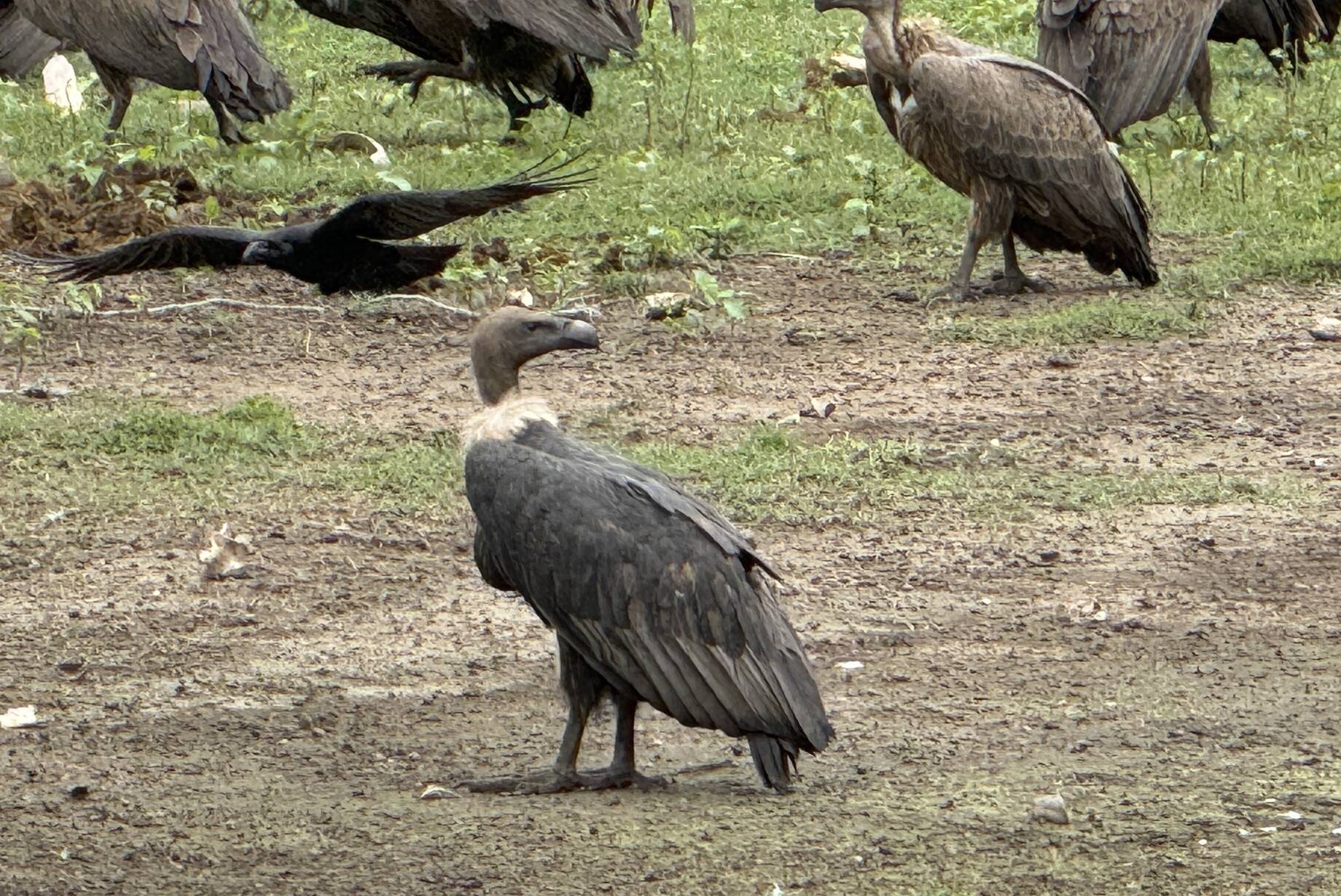
Once perhaps the commonest large raptor on Earth, it lost over 99% of its numbers to a cattle painkiller.
Meet the bird
A colonial, carcass-eating vulture of South and South-East Asia that until the 1990s cleared the carcasses of India’s livestock in enormous numbers. Within about fifteen years, residues of the veterinary painkiller diclofenac in cattle carcasses killed more than 99% of the Indian population. Its collapse has become one of the best-documented examples of what happens to people and ecosystems when a scavenger disappears.
Appearance
The smallest of the Gyps vultures but still a very large bird, with long, broad wings for soaring, a short tail, a sparsely feathered head and neck, and a heavy, hooked bill for tearing carrion.
Plumage & colour
Adults are mainly dark, blackish-brown with a conspicuous white rump and lower back that gives the species its name. Juveniles are browner and lack the clean white rump. Sexes look alike.
Behaviour
A highly social vulture that roosts communally and gathers in large numbers at carcasses. It nests in colonies in tall trees; a pair usually lays a single egg, which both parents incubate for about 50 days, and the chick is fed on regurgitated food. Its slow breeding rate means populations cannot recover quickly from extra adult deaths.
Measurements: The Peregrine Fund, Global Raptor species account (White-rumped Vulture)
Did you knowAs recently as 1985 it was described as “possibly the most abundant large bird of prey in the world”.
Range shown at country level (countries of regular occurrence). BirdLife lists the species as possibly extinct in Afghanistan, Iran, Laos, Thailand and Viet Nam, and extinct in mainland China and Malaysia. It disappeared from most of South-East Asia during the 20th century.
- Where
- Indian Subcontinent (India, Pakistan, Nepal, Bangladesh, Bhutan) and small remnant populations in South-East Asia, mainly in Myanmar and northern Cambodia.
- Continents
- Asia
- Habitat
Mostly plains, less often hills, where it uses open country, light woodland, villages and even cities. It usually occurs below about 1,500 m, occasionally to 3,000 m. Colonies nest in tall trees, often close to human habitation.
- Movement · nomadic
- Not a regular migrant. BirdLife describes it as nomadic: movements are poorly known, but satellite-tagged birds have foraged over very large areas.
What it eats
An obligate scavenger of carrion, both fresh and putrid. In South Asia its main food was the carcasses of domestic cattle and water buffalo; it also feeds on wild animal carcasses.
Feeding strategy
Birds search for carcasses by soaring and by watching other vultures, then feed in large, competitive groups that can strip a carcass in a short time. In parts of South Asia vultures were also part of human funerary practice, consuming bodies placed in the Parsi Towers of Silence.
- CarrionCarcasses of domestic cattle and water buffaloMain food in the Indian Subcontinent, and the route by which vultures were exposed to diclofenac.
- CarrionCarcasses of goats, sheep and roadkill
- CarrionWild animal carcasses, including tiger kills
What eats it
The animals that prey on the White-rumped Vulture, grouped by the life stage they attack: its eggs, its chicks, or grown birds.
EggsWho eats its eggs
No predators documented at this stage.
ChicksWho kills its chicks
No predators documented at this stage.
AdultsWho kills grown birds
No predators documented at this stage.
Natural predation on this species is not well documented. Its catastrophic decline was caused by poisoning from veterinary drugs in livestock carcasses, not by predators.
Its place in nature
In India, where religious and cultural practices mean that many cattle are not eaten when they die, millions of livestock carcasses were left in the open each year. White-rumped Vultures, feeding in large flocks, removed this flesh quickly and almost completely. That made them an unpaid sanitation service: carcasses were cleared before they rotted, and less food was left for feral dogs and rats. Their near-disappearance turned this from a theory into a measured natural experiment.
- Feeds onDocumentedDomestic cattle and water buffalo (carcasses)
The vulture’s main food source in South Asia. Oaks et al. (2004) showed that vultures died of kidney failure and visceral gout after eating carcasses of livestock treated with diclofenac shortly before death.
- Competes withLikelyFeral and free-ranging dogs
Dogs also eat livestock carcasses. Dog populations increased substantially in parallel with the vulture decline (Markandya et al. 2008), consistent with dogs taking over food that vultures used to remove, although the exact causal share is hard to establish.
- Commensal withDocumentedPeople (sanitation and public health)
By disposing of carcasses, vultures benefited human health. Frank & Sudarshan (2024) found that all-cause human mortality rose by more than 4% in Indian districts that had been good vulture habitat after the vultures collapsed.
- Feeds onDocumentedParsi community (Towers of Silence)
In the Zoroastrian sky burial practised by India’s Parsis, bodies are laid in Towers of Silence to be consumed by vultures. The vulture collapse disrupted this practice in Mumbai, where solar reflectors were installed to speed decomposition.
- Feeds onDocumentedWild animal carcasses, including tiger kills
Besides livestock, it feeds on the remains of wild animals, including prey left by tigers.
What if it disappeared?
For this species the scenario is not hypothetical. Between the early 1990s and 2007 the White-rumped Vulture all but vanished from India, and researchers have since measured some of the knock-on effects. Several of the effects below are documented or statistically estimated, not merely predicted.
Press Remove to see which organisms could be affected, how, and how confident scientists are. 4 possible effects are recorded for this species.
The other vultures that could have taken over — the Long-billed and Slender-billed Vultures — collapsed at the same time from the same cause (by 96.8% combined between 1992 and 2007 on Indian survey routes). Dogs and rats did eat some of the carrion, but they leave remains and can spread disease, so the sanitation service was not replaced.
The human-health figures come from statistical comparisons and models, and different studies use different methods and periods, so the numbers should be read as estimates with wide uncertainty. How much of the rise in dogs was caused by the vulture decline, rather than by other changes in Indian towns and villages, is not precisely known.
These scenarios summarise published ecology. They are not predictions: ecosystems are complex, other pressures interact, and documented, likely and hypothesised effects are labelled separately.
Conservation
- LCLeast Concern
- NTNear Threatened
- VUVulnerable
- ENEndangered
- CRCritically Endangered
- EWExtinct in the Wild
- EXExtinct
Listed as Critically Endangered because of a decline of more than 99% over three generations, driven mainly by the veterinary drug diclofenac. Listed on CITES Appendix II and CMS Appendices I and II.
- Population estimate
- 4,000–6,000 mature individuals (c. 6,000–9,000 individuals in total; estimated, data quality poor)
- Estimate year: 2021
- Trend
- Decreasing
- Source
- BirdLife International factsheet (2021 assessment)
Threats
- Veterinary diclofenac
Vultures that eat the carcasses of livestock treated with diclofenac suffer kidney failure and visceral gout. Indian road-transect counts fell by 99.9% between 1992 and 2007, with an average decline of 43.9% per year from 2000 to 2007 (Prakash et al. 2007). Illegal use of human diclofenac formulations on livestock continued after the 2006 ban.
- Other vulture-toxic veterinary drugs
Ketoprofen, aceclofenac and nimesulide have also been found to be toxic to vultures and were recently banned in India. Meloxicam and tolfenamic acid are considered safe alternatives.
- Food shortage and poisoning in South-East Asia
The earlier disappearance from most of South-East Asia is attributed mainly to the collapse of large wild ungulate populations and changes in livestock husbandry that reduced carcass availability, plus accidental poisoning linked to local hunting and fishing practices.
What is being done
Conservation has focused on removing vulture-toxic drugs from the food chain, establishing Vulture Safe Zones, and building captive populations for release. The decline appears to have stopped in India around 2010, with numbers stable at a very low level or increasing slowly, and there has been a partial recovery in Nepal.
- India, Nepal and Pakistan banned veterinary diclofenac in 2006; Bangladesh followed in 2010.
- India banned large multi-dose vials of diclofenac in 2015 to curb illegal veterinary use.
- The SAVE (Saving Asia’s Vultures from Extinction) consortium was formed in 2011.
- Vulture Safe Zones of about 100 km radius around colonies and release sites; Nepal declared the first fully diclofenac-free zone in 2021.
- Conservation breeding centres run by the Bombay Natural History Society in India, with breeding programmes also in Nepal (final releases in 2023) and Pakistan.
A conservation story
In 1985 the White-rumped Vulture was described as possibly the most abundant large bird of prey in the world. Villagers in northern India first noticed vultures disappearing in 1996–97, and by 2000 road surveys showed declines of more than 90%. The cause was a mystery until 2004, when Oaks and colleagues showed that birds dying in Pakistan had visceral gout and residues of diclofenac, a cheap anti-inflammatory given to sick cattle.
Governments in India, Nepal and Pakistan banned veterinary diclofenac in 2006. Since then the rate of decline has slowed and may have reversed locally, and captive-bred birds have been released into diclofenac-free Vulture Safe Zones. The species remains Critically Endangered, and the story is now used worldwide to argue for safety-testing veterinary drugs on scavengers.
Sources
Conservation status: IUCN Red List (assessed by BirdLife International), assessed 2021. Media credits accompany each image and recording; see Sources & credits.
- BirdLife International (2021 assessment). Species factsheet: White-rumped Vulture Gyps bengalensis.
- Oaks, J.L. et al. (2004). Diclofenac residues as the cause of vulture population decline in Pakistan. Nature 427: 630–633.
- Prakash, V. et al. (2007). Recent changes in populations of resident Gyps vultures in India. Journal of the Bombay Natural History Society 104: 127–133.
- Markandya, A. et al. (2008). Counting the cost of vulture decline — an appraisal of the human health and other benefits of vultures in India. Ecological Economics 67: 194–204.
- Frank, E. & Sudarshan, A. (2024). The Social Costs of Keystone Species Collapse: Evidence from the Decline of Vultures in India. American Economic Review 114(10): 3007–3040.
- Energy Policy Institute at the University of Chicago (2024). Social cost of collapse of vulture population (summary of Frank & Sudarshan).
- RSPB. Spotlight on Asia’s vultures twenty years after game-changing drug ban (news article).
- The Peregrine Fund. White-rumped Vulture species account.
- NPR (2012). Vanishing vultures a grave matter for India’s Parsis.