Whooping Crane
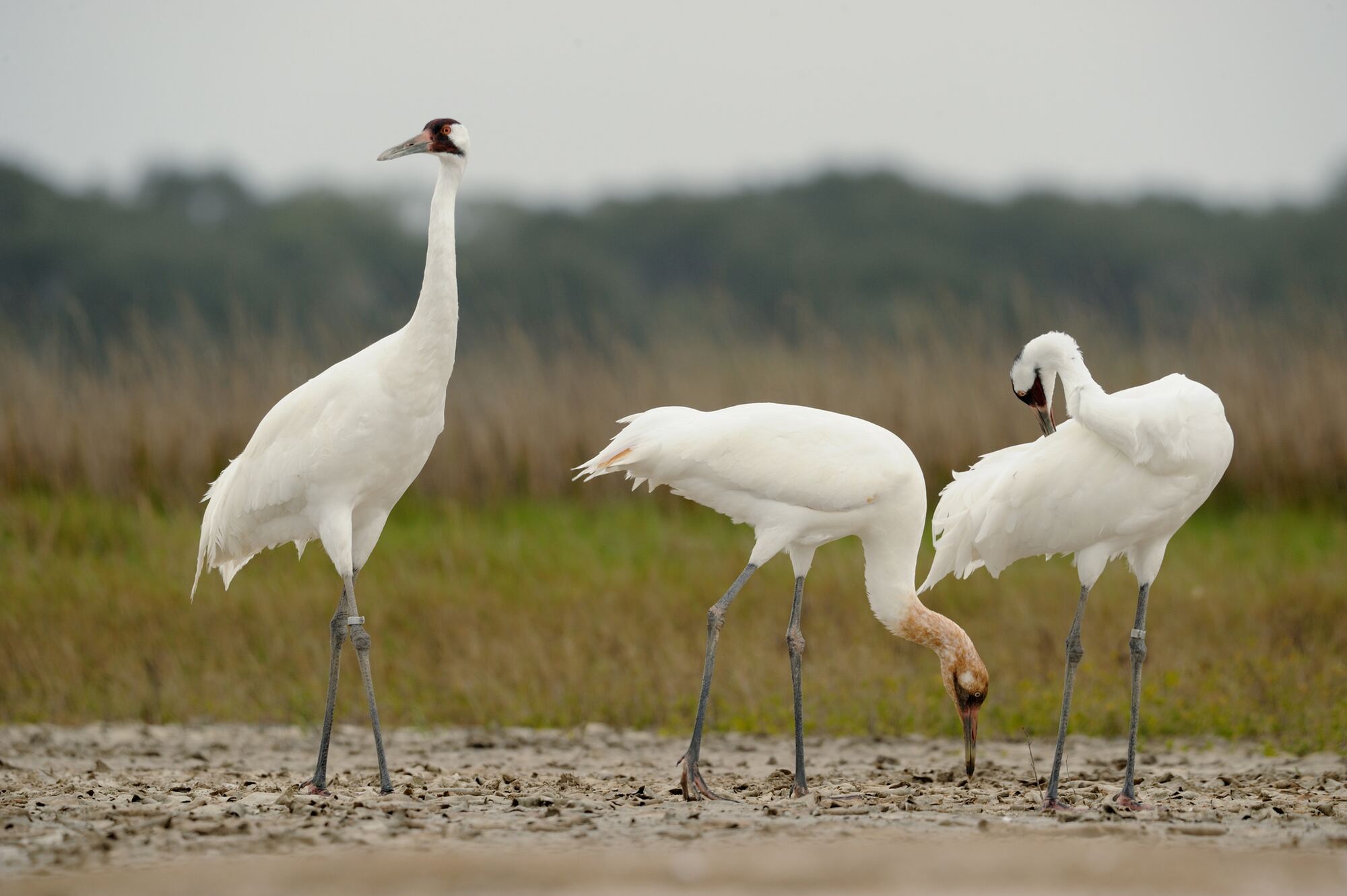
North America’s tallest bird, rebuilt from about 15 or 16 wild cranes in 1941.
Meet the bird
A tall, white crane that breeds in the wetlands of Wood Buffalo National Park in Canada and winters on the Texas coast. Hunting and the drainage of prairie wetlands reduced the only surviving migratory flock to 15 or 16 birds in 1941. Protection, habitat management and decades of monitoring have since brought that flock to more than 500 birds, and reintroduced flocks have been established elsewhere in the United States.
Appearance
Males approach 1.5 m when standing upright, making this the tallest North American bird, with a long neck, long dark legs and a strong, dagger-like bill. In flight the neck and legs are held straight out and black wingtips show against the white wings. The name probably comes from the loud call the birds give repeatedly when alarmed.
Plumage & colour
Adults are snowy white with black primaries (visible mainly in flight), a red crown, a dark patch on the nape and black "whisker" marks; the iris is yellow. Juveniles are reddish-cinnamon and gradually turn white through their first winter. Sexes look alike, although males are generally larger.
Behaviour
Eggs are laid from late April to mid-May, usually two per clutch, and both parents incubate for 29–31 days, with one parent on the nest almost all the time. Chicks can fly at 80–100 days old. Young stay with their parents through the first winter and become independent before the next breeding season.
Measurements: Length and wingspan: Audubon Guide to North American Birds; weight: USFWS species profile (6.0–7.8 kg) and Audubon (5–7.3 kg); height and longevity: International Recovery Plan (2007)
Did you knowStanding upright, a male Whooping Crane approaches 1.5 m, making it the tallest bird in North America.
Range shown at country level (countries of regular occurrence). The species formerly wintered in Mexico, where BirdLife lists it as extinct.
- Where
- The only natural wild population, the Aransas–Wood Buffalo population, breeds in and around Wood Buffalo National Park (Northwest Territories and Alberta, Canada) and winters on and around Aransas National Wildlife Refuge on the Texas Gulf coast. Reintroduced populations live in Louisiana (non-migratory) and in the eastern USA (migrating between Wisconsin and the south-east); a non-migratory Florida flock persists in very small numbers.
- Continents
- North America
- Habitat
Breeds in wetlands with small, shallow lakes and ponds, marshes, willow stands and mudflats. Winters in brackish coastal bays, marshes and salt flats. Migration stopovers are mainly in wetlands, lowland grasslands and harvested grain fields.
- Movement · migratory
- The Aransas–Wood Buffalo cranes migrate between northern Canada and the Texas coast. Juveniles travel with their parents and stay with them through the first winter. The Louisiana and Florida reintroduced flocks are non-migratory, while the eastern flock was taught its migration route by following ultralight aircraft.
What it eats
Omnivorous. In winter mainly blue crabs, clams and the fruit of Carolina wolfberry; in summer insect larvae and nymphs, frogs, rodents, small birds, minnows and berries. On migration they eat frogs, fish, plant tubers, crayfish, insects and waste grain.
Feeding strategy
Cranes probe mud and shallow water with their bills and pick food from the surface or from vegetation. At Aransas they eat blue crabs and wolfberries in flooded marshes, then turn to clams in shallow bays in mid-winter. Small crabs and clams are swallowed whole; larger crabs are pecked to pieces.
- InvertebrateBlue crab (Callinectes sapidus)Key winter food; mortality rises in years with few crabs.
- InvertebrateClams (e.g. Tagelus, Rangia, Ensis)Important in cold, low-water or drought winters.
- PlantCarolina wolfberry (Lycium carolinianum)Winter fruit.
- InsectInsect larvae and nymphsSummer, on the breeding grounds.
- AmphibianFrogs
- PlantWaste grain and acornsOn migration and in uplands.
What eats it
The animals that prey on the Whooping Crane, grouped by the life stage they attack: its eggs, its chicks, or grown birds.
EggsWho eats its eggs
- MammalAmerican black bearDocumentedBlack bears and other mammals destroy eggs at Wood Buffalo.
ChicksWho kills its chicks
- MammalGrey wolfDocumented
- MammalRed foxDocumented
- BirdCommon ravenDocumented
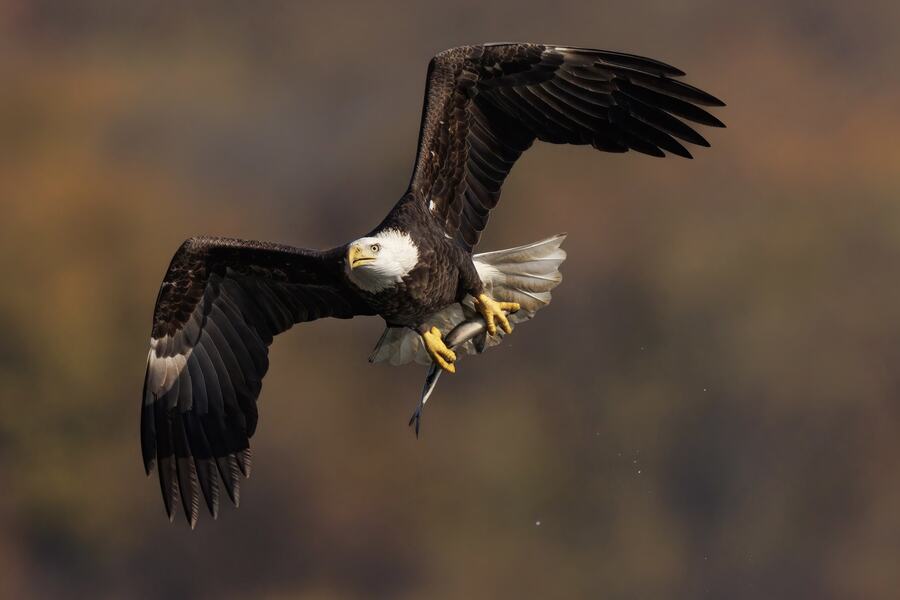
- BirdBald eagleDocumentedKilled a hatchling of the reintroduced Florida flock in 2002.
AdultsWho kills grown birds
- MammalBobcatDocumentedA significant predator of reintroduced cranes in Florida; also takes sick or injured cranes at Aransas.
- ReptileAmerican alligatorDocumentedSignificant predator of reintroduced Florida cranes.
- BirdGolden eagleDocumentedTwo attacks on juvenile whooping cranes recorded during migration.
Healthy adult whooping cranes are rarely killed by predators unless weakened by disease or injury or flightless during moult. Predation on wild birds in Texas appears very low. The overall effect of predation on recruitment of the Aransas–Wood Buffalo population is uncertain.
Its place in nature
Whooping cranes are predators of crabs, clams, insects and small vertebrates, and also eat fruit. Because the birds concentrate in a few places, they can deplete local food such as blue crabs at Aransas. The International Recovery Plan stresses, however, that the population is so small that it is unlikely to have ecological effects except in small areas. The crane’s greatest influence has been as a flagship: protecting it has meant protecting coastal marshes and northern wetlands.
- Preys onDocumentedBlue crab
The main winter prey at Aransas. Winter mortality of cranes is higher in years when blue crabs are scarce, and a drought in 2008–09 that reduced crabs and wolfberries roughly doubled crane mortality.
- Preys onDocumentedClams
Several clam species become important food when water is low, temperatures are cold or blue crabs are scarce.
- Feeds onDocumentedCarolina wolfberry
A coastal shrub whose fruit is an important winter food, especially when high tides flood the tidal flats.
- Preyed on byDocumentedGrey wolf, red fox and common raven
Kill chicks on the Wood Buffalo breeding grounds; black bears and other mammals take eggs.
- Preyed on byDocumentedBobcat
A major cause of death in reintroduced Florida cranes, especially birds that roost in poor sites.
- Parasitic relationship withLikelyBlack flies
Harassment of incubating birds by biting black flies can cause nest abandonment and has been proposed as a key reason for breeding failure in the reintroduced eastern flock.
What if it disappeared?
Whooping cranes have always been rare in modern times, and the Recovery Plan judges that their numbers are too small to have more than local ecological effects. Any consequences of their loss would therefore be modest and local.
Press Remove to see which organisms could be affected, how, and how confident scientists are. 3 possible effects are recorded for this species.
Other wading birds and sandhill cranes also eat crabs, clams and invertebrates in the same habitats, so any ecological gap would probably be small and partly filled.
The crane’s ecological role at its historical abundance, possibly more than 10,000 birds before European settlement, cannot be reconstructed from today’s small population.
These scenarios summarise published ecology. They are not predictions: ecosystems are complex, other pressures interact, and documented, likely and hypothesised effects are labelled separately.
Conservation
- LCLeast Concern
- NTNear Threatened
- VUVulnerable
- ENEndangered
- CRCritically Endangered
- EWExtinct in the Wild
- EXExtinct
Listed as Endangered under the US Endangered Species Act since 1967. BirdLife notes that its precautionary mature-population band (50–249) may now be a considerable underestimate and that the species may merit downlisting to Vulnerable.
- Population estimate
- c. 540 birds (95% CI 483–609) in the Aransas–Wood Buffalo population’s primary wintering area, winter 2025–26 (preliminary USFWS estimate), with more birds outside the survey area and in reintroduced flocks. The IUCN assessment uses a precautionary 50–249 mature individuals (based on a 2007 estimate).
- Estimate year: 2026
- Trend
- Increasing
- Source
- USFWS Whooping Crane Survey Results: Winter 2025–2026; BirdLife International factsheet (IUCN figures)
Threats
- Power-line collisions
Collision with power lines is the most significant known cause of death or injury to fledged young; 45 collision deaths were recorded between 1956 and 2006. Line markers cut collisions by 50–80%, but most lines remain unmarked.
- Energy development in the migration corridor
Wind farms, new power lines and oil and gas activity along the migration route reduce stopover habitat and add collision risk.
- Drought and freshwater inflows
Drought lowers breeding success in Canada and reduces blue crabs and wolfberries in Texas; in 2008–09 it roughly doubled crane mortality. Reduced river inflows to the coast have similar effects.
- Coastal development and sea-level rise
Housing, chemical spills, sea-level rise and human disturbance threaten the Texas wintering marshes and the unoccupied habitat into which the growing flock would expand.
- Low genetic diversity
All living whooping cranes descend from the few birds that survived the 1941 bottleneck.
What is being done
Canada and the United States manage the species under a joint International Recovery Plan. The wild flock is protected at both ends of its migration, captive flocks support reintroductions, and the wintering population is surveyed every year.
- Protection of the wintering grounds at Aransas National Wildlife Refuge and the breeding grounds in Wood Buffalo National Park.
- Listing under the US Endangered Species Act (1967) and Canadian legislation; CITES Appendix I.
- Captive breeding from eggs taken from wild nests, supporting reintroduced flocks in Florida, the eastern USA and Louisiana.
- Annual aerial winter surveys by USFWS, with marking and tracking of birds.
- Marking power lines to reduce collisions.
A conservation story
Before European settlement there may have been more than 10,000 whooping cranes; by about 1870 there were perhaps 1,300–1,400. Hunting and the conversion of prairie wetlands to farmland drove them close to extinction, and by winter 1941–42 the migratory flock wintering in Texas numbered just 15 or 16 birds. Protection of the wintering grounds at Aransas, legal protection and protection of the Wood Buffalo nesting grounds allowed this flock to grow at about 4% a year, reaching more than 500 birds by the late 2010s.
Reintroductions have had mixed results. A Rocky Mountain flock established in the 1970s had died out by 2002–03. A non-migratory Florida flock suffered poor breeding and high mortality and was discontinued in 2007. An eastern migratory flock, whose first birds learned their route by following ultralight aircraft, reached about 100 birds but has struggled to raise young, partly because black flies drive birds off their nests. A non-migratory Louisiana flock was started in 2011.
The Aransas–Wood Buffalo flock remains the only self-sustaining population, which puts all its birds at risk from a single hurricane, spill or disease event on the Texas coast. Its growth has slowed since about 2015, and the cranes are now spreading into new, less protected areas where they meet power lines, development and other hazards.
Sources
Conservation status: IUCN Red List (assessed by BirdLife International), assessed 2020. Media credits accompany each image and recording; see Sources & credits.
- Butler, M.J. et al. (2026). Whooping Crane Survey Results: Winter 2025–2026 (preliminary). U.S. Fish & Wildlife Service.
- Canadian Wildlife Service & U.S. Fish and Wildlife Service (2007). International Recovery Plan for the Whooping Crane, third revision.
- BirdLife International (2020 assessment). Species factsheet: Whooping Crane Grus americana.
- U.S. Fish & Wildlife Service (17 June 2026). Service estimates 540 whooping cranes wintered on Texas coast in 2025–2026 (press release).
- U.S. Fish & Wildlife Service (2018). Estimated Texas wintering whooping crane population breaks 500 (press release).
- U.S. Fish & Wildlife Service. Whooping crane (Grus americana) species profile.
- Whooping Crane Conservation Association. Stehn frustrated with new whooper count method (on the switch from complete counts to distance sampling after 2011).
- National Audubon Society. Guide to North American Birds: Whooping Crane.