Andean Condor
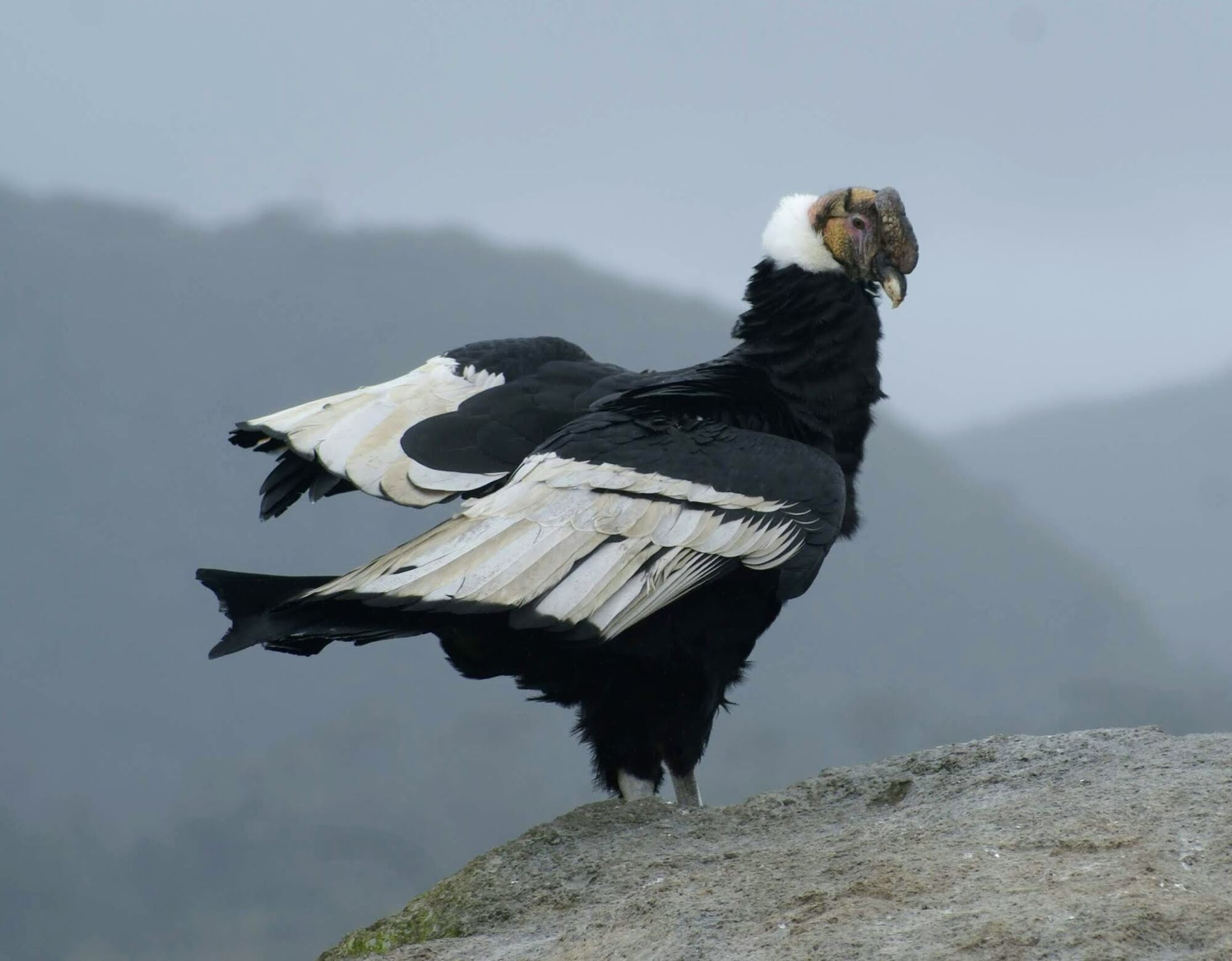
The heaviest soaring bird alive — it can glide for hours over the Andes without a single wingbeat.
Meet the bird
A huge black-and-white New World vulture of the Andes and Patagonia that lives almost entirely on carrion. It is naturally scarce and breeds very slowly, so even modest extra mortality — above all from poisoned carcasses and lead from hunting ammunition — causes populations to decline.
Appearance
An enormous, broad-winged vulture with long “fingered” primary feathers and a bare head. Adults can reach about 1.3 m in length and a wingspan of up to about 3.2 m; males weigh up to about 15 kg and females up to about 11 kg. Males have a fleshy comb (caruncle) on the head.
Plumage & colour
Adults are glossy black with a white collar ruff at the base of the neck and large white panels on the upper side of the wings. The bare head and neck are dull reddish to blackish. Juveniles are brown, without the white ruff or wing panels, and take several years to acquire adult plumage.
Behaviour
Condors roost and gather communally and find food by soaring over open country. A pair raises at most one chick every other year: the single egg is incubated by both parents for about 50–60 days, and the young bird depends on its parents for well over a year. Birds do not mature until about 6–8 years of age. Tracking of immature birds in Argentina showed that they flapped for only about 1% of their flight time, using thermals and slope winds instead.
Measurements: San Diego Zoo Wildlife Alliance, Animals & Plants: Andean condor (maximum values only, so numeric ranges are left blank).
Did you knowOne GPS-tagged condor in Argentina flew for more than 5 hours, covering about 172 km, without flapping its wings once.
Range shown at country level (countries of regular occurrence). Very rare in the north of its range. In Venezuela it may no longer be resident (birds there include reintroduced individuals); it is a vagrant to Brazil and Paraguay. Reintroduction programmes have operated in Colombia, Chile and Argentina.
- Where
- Along the Andes from Colombia and Ecuador through Peru and Bolivia to Chile and Argentina, including Patagonia and, in Chile and Peru, coastal deserts and shorelines.
- Continents
- South America
- Habitat
Mainly open grassland and mountains up to about 5,000 m, as well as adjacent cloud forest; it descends to lowland deserts and coastlines in Chile and Peru and occurs over steppe and southern-beech forest in Patagonia. It needs cliffs for roosting and nesting and open country where carcasses can be seen from the air.
- Movement · resident
- Not a long-distance migrant. BirdLife classes it as an altitudinal migrant, and individuals range over very large areas while searching for food; satellite tracking is now revealing the scale of these movements.
What it eats
Almost exclusively carrion. In Argentina, carcasses of introduced herbivores (livestock and other exotic species) made up 98.5% of the diet in one study. Condors also scavenge the kills of pumas and, on the coast, marine carrion.
Feeding strategy
Condors locate carcasses by soaring and by watching other scavengers, and a single bird can eat more than 6.8 kg of meat at one meal. In Patagonia, condors gather at puma kills in open country. Very rarely, individuals attack the soft parts of newborn domestic cattle, but field studies indicate this accounts for less than 1% of livestock deaths.
- CarrionCarcasses of livestock and introduced herbivores98.5% of the diet in an Argentine study (Lambertucci et al. 2009).
- CarrionPrey left by pumas (e.g. guanaco)Documented in Chilean Patagonia.
- CarrionMarine carrion on coastsWhere its range reaches the Pacific and Atlantic shores.
What eats it
The animals that prey on the Andean Condor, grouped by the life stage they attack: its eggs, its chicks, or grown birds.
EggsWho eats its eggs
No predators documented at this stage.
ChicksWho kills its chicks
No predators documented at this stage.
AdultsWho kills grown birds
No predators documented at this stage.
Natural predation on Andean Condors is not well documented; adults have no known regular predators. Almost all documented mortality is caused by people — poisoned baits, lead from ammunition, shooting and collisions with power lines.
Its place in nature
As the largest scavenger of the Andes and Patagonia, the condor recycles the carcasses of large animals across vast, open landscapes. Today much of that carrion comes from livestock and introduced herbivores, which ties the bird closely to ranching. It also interacts with large predators: in Chilean Patagonia, condors gather at puma kills, and research suggests pumas abandon carcasses sooner and kill more often as a result.
- Feeds onDocumentedLivestock and introduced herbivores (carcasses)
In north-west Patagonia, 98.5% of the diet came from exotic herbivores such as sheep, cattle and introduced wild species (Lambertucci et al. 2009). This dependence exposes condors to poisoned baits and to lead fragments in animals shot by hunters.
- Parasitic relationship withDocumentedPuma
Condors scavenge puma kills — a form of food theft (kleptoparasitism). In Chilean Patagonia, pumas left large amounts of edible meat at half of 266 large carcasses after a single night, and appeared to compensate with higher kill rates; harassment by condors was the best explanation (Elbroch & Wittmer 2013).
- Competes withLikelyAmerican Black Vulture
Black Vultures have recently spread into condor areas in Patagonia and compete for carcasses; studies suggest this may have a negative effect on condors, but the population-level impact is not yet measured.
- Competes withHypothesisedFeral dogs
BirdLife lists competition with feral dogs at carcasses as a threat, based on field observations; it has not been quantified.
What if it disappeared?
The Andean Condor is declining but still present across its range, so its loss is a thought experiment. Because it is the dominant large scavenger over much of the Andes and Patagonia, the main effects would be on how carcasses are recycled and on the animals that interact with them.
Press Remove to see which organisms could be affected, how, and how confident scientists are. 3 possible effects are recorded for this species.
Black and Turkey Vultures, caracaras and foxes already scavenge in condor country and would probably take over part of the role, especially near settlements. Whether they could match the condor’s ability to find and consume large carcasses scattered across high, open landscapes is not known.
The condor’s population has never been counted precisely across its range; the global figure of about 6,700 mature individuals dates from 2001 and is now thought to be a maximum. The wider ecological effects of condor scavenging have been studied in only a few places, mainly in Patagonia.
These scenarios summarise published ecology. They are not predictions: ecosystems are complex, other pressures interact, and documented, likely and hypothesised effects are labelled separately.
Conservation
- LCLeast Concern
- NTNear Threatened
- VUVulnerable
- ENEndangered
- CRCritically Endangered
- EWExtinct in the Wild
- EXExtinct
Uplisted to Vulnerable mainly because of poisoning and lead contamination. Listed on CITES Appendix I and CMS Appendix II.
- Population estimate
- c. 6,700 mature individuals (c. 10,000 individuals; now thought to be a maximum estimate)
- Estimate year: 2001
- Trend
- Decreasing
- Source
- BirdLife International factsheet (2020 assessment)
No reliable historical time series is available for this species, so no population chart is shown. We do not interpolate or estimate missing data.
Threats
- Poisoned baits
Carcasses laced with poison to kill pumas and foxes kill condors in Argentina, Chile, Colombia, Ecuador, Peru and probably Bolivia. By early 2020 experts had compiled 225 poisoned individuals across the range, about half of which died; many cases are never detected.
- Lead poisoning
Condors swallow lead fragments from hunting ammunition in carcasses. Wild condors examined in Argentina (76 birds) had blood lead levels up to 104 µg/dL, far above those of captive-bred birds, and lead poisoning is now considered a widespread major threat across the range (Wiemeyer et al. 2017).
- Persecution
Some ranchers shoot condors because of alleged attacks on livestock, although such attacks are extremely rare. Birds are also illegally captured for trade, pets and folkloric events.
- Power lines and habitat change
Collisions with electricity and telecommunication infrastructure, and conversion of natural vegetation to farmland and plantations, add to mortality and habitat loss.
What is being done
Conservation focuses on stopping poisoning and lead exposure, counting and tracking condors, and reintroducing rescued and captive-bred birds where populations have collapsed. Experts have identified priority Andean Condor conservation units across the range.
- Listed on CITES Appendix I and CMS Appendix II.
- Population counts at feeding stations and roosts, genetic studies and satellite tracking in Argentina, Bolivia, Colombia, Ecuador and Peru.
- Reintroduction of rescued and captive-bred condors in Colombia, Chile and Argentina.
- Campaigns against poisoned baits and for lead-free ammunition.
Sources
Conservation status: IUCN Red List (assessed by BirdLife International), assessed 2020. Media credits accompany each image and recording; see Sources & credits.
Taxonomy. Checklists differ on the order: some place the New World vultures in their own order, Cathartiformes; others include them in Accipitriformes with hawks and eagles.
- BirdLife International (2020 assessment). Species factsheet: Andean Condor Vultur gryphus.
- Williams, H.J. et al. (2020). Physical limits of flight performance in the heaviest soaring bird. Proceedings of the National Academy of Sciences 117.
- Elbroch, L.M. & Wittmer, H.U. (2013). Nuisance ecology: do scavenging condors exact foraging costs on pumas in Patagonia? PLoS ONE 8: e53595.
- Wiemeyer, G.M. et al. (2017). Repeated conservation threats across the Americas: high levels of blood and bone lead in the Andean Condor widen the problem to a continental scale. Environmental Pollution 220: 672–679 (repository record).
- San Diego Zoo Wildlife Alliance. Animals & Plants: Andean condor.