California Condor
North America’s largest flying bird, brought back from just 27 birds, all held in captivity.
Meet the bird
The California Condor is a huge scavenging vulture of western North America. By 1987 every surviving condor had been taken into captivity, and the species was extinct in the wild. Captive breeding and releases since 1992 have raised the world population above 600, but the wild flocks still depend on intensive management because lead poisoning from ammunition kills many birds.
Appearance
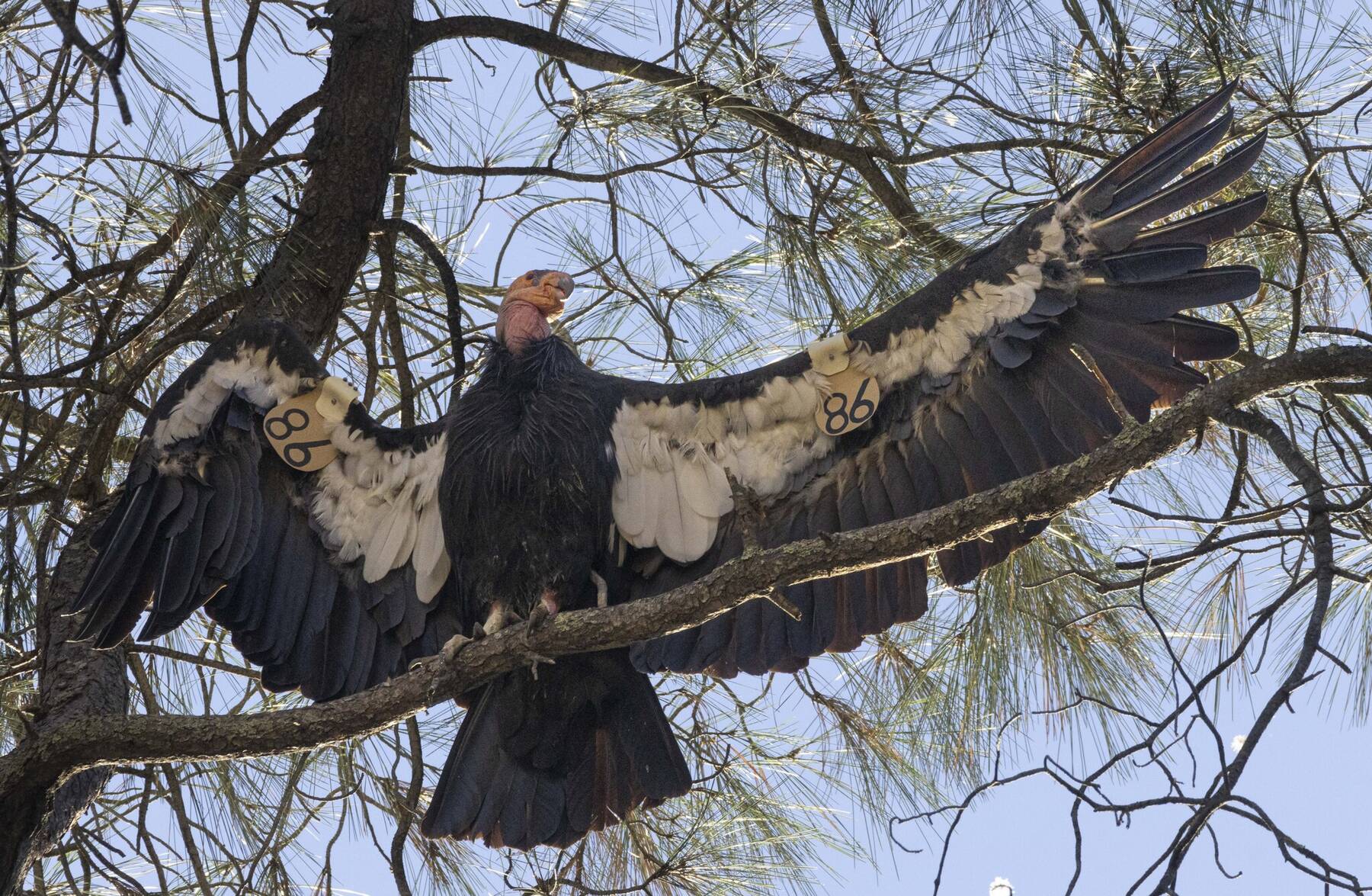
A massive, broad-winged vulture with a bare head and neck. In flight it soars on flat, plank-like wings with long, spread "fingers" at the tips. Released birds carry numbered wing tags and radio or GPS transmitters.
Plumage & colour
Adults are black with bright white triangles under the wings and a bare head and neck that range from yellowish to orange-pink. Immatures have dark heads and mottled underwing patches; full adult colouring takes several years.
Behaviour
Condors soar for hours on thermals and updrafts, searching for carcasses and watching other scavengers. They are social and often feed in groups. Breeding is very slow: they do not mature until about six to eight years old, and the female lays a single egg on the bare floor of a cliff cave, with no nest material. Incubation takes almost two months, and parents care for the chick for many months, so a pair usually raises only one young every other year.
Measurements: Length: Audubon Guide to North American Birds (1.1–1.2 m) and The Peregrine Fund (46–52 in); wingspan: Audubon (2.7–3.0 m); weight: USFWS (17–25 lb) and The Peregrine Fund (17–26 lb)
Did you knowIn 1987 every California Condor on Earth, 27 birds in all, was in captivity. All of today’s 600-plus condors descend from that group.
Range shown at country level (countries of regular occurrence). All current wild birds come from reintroductions. Arizona birds sometimes wander into Wyoming, Colorado and New Mexico.
- Where
- Historically from British Columbia to Baja California; by 1937 the species had reportedly disappeared from everywhere outside California. Reintroduced flocks now live in southern and central California, northern Arizona and southern Utah (around the Vermilion Cliffs and Grand Canyon), the Sierra de San Pedro Mártir in Baja California (Mexico), and, since the 2020s, an experimental Pacific Northwest flock in northern California.
- Continents
- North America
- Habitat
Rocky, open-country scrubland, coniferous forest and oak savanna, mostly between about 450 and 2,000 m. Condors nest in caves and crevices on cliffs and rocky outcrops, or in cavities in large trees, and forage over very large areas of open country.
- Movement · resident
- Not migratory, but condors travel widely in search of carcasses. Released birds may range more than 400 km from their release sites.
What it eats
An obligate scavenger. Condors feed on the carcasses of mammals, from ground squirrels to deer and cattle.
Feeding strategy
Condors find food by sight, often by watching other scavengers, and then feed on the soft tissues of carcasses. Because they eat what hunters leave behind, they swallow fragments of lead bullets and shot from shot animals and gut piles. California ground squirrels, which are often shot as pests on ranches, are both a food and a source of lead.
- CarrionCarcasses of large mammals (deer, cattle and others)Main food.
- CarrionCalifornia ground squirrelsOften shot as nuisance animals; a documented source of lead.
- CarrionHunter-killed carcasses and gut pilesA major route of lead exposure.
What eats it
The animals that prey on the California Condor, grouped by the life stage they attack: its eggs, its chicks, or grown birds.
EggsWho eats its eggs
No predators documented at this stage.
ChicksWho kills its chicks
No predators documented at this stage.
AdultsWho kills grown birds
No predators documented at this stage.
USFWS records predation among the known causes of death of free-flying condors since reintroduction began in 1992, but its annual summaries do not name the predators. Natural predation is poorly documented compared with human-caused deaths such as lead poisoning, shooting and power-line collisions.
Its place in nature
As the largest scavenger in its range, the condor helps recycle large carcasses. Its huge foraging range means a few birds can visit carcasses spread over a vast area. The wild population is still small, however, so its present contribution to carcass removal, compared with turkey vultures, ravens, eagles and mammalian scavengers, has not been measured.
- Feeds onDocumentedLarge-mammal carcasses
Condors depend on dead mammals for all their food, from ground squirrels to deer and cattle.
- Feeds onDocumentedCalifornia ground squirrel
A documented small-mammal food in California. Squirrels are routinely shot on ranches, so they can carry lead fragments into the condor food chain.
- Feeds onDocumentedHunters (lead ammunition)
Condors feed on carcasses and gut piles left by hunters. This provides food but also exposes them to lead, the leading known cause of death in the wild population.
What if it disappeared?
The condor has already been absent from the wild once, from 1987 to 1992, and has been missing for longer from most of its historical range. Nobody measured what changed, and today’s flocks are small, so most effects are inferred.
Press Remove to see which organisms could be affected, how, and how confident scientists are. 3 possible effects are recorded for this species.
Turkey vultures, common ravens, golden eagles, coyotes and bears all scavenge within the condor’s range, so carcass removal would probably largely continue. How far they would make up for condors in remote areas is not well documented.
The ecological role of condors at historical densities is unknown, and the current wild population is too small and too intensively managed to reveal it.
These scenarios summarise published ecology. They are not predictions: ecosystems are complex, other pressures interact, and documented, likely and hypothesised effects are labelled separately.
Conservation
- LCLeast Concern
- NTNear Threatened
- VUVulnerable
- ENEndangered
- CRCritically Endangered
- EWExtinct in the Wild
- EXExtinct
BirdLife’s 2020 assessment says the population then met the threshold for Endangered but stayed Critically Endangered under the five-year rule, and that downlisting could be warranted in 2024 if growth continued. Listed as Endangered under the US Endangered Species Act.
- Population estimate
- 607 condors in the world on 31 December 2025: 392 free-flying and 215 in captivity (USFWS). The IUCN assessment counted 93 mature individuals (2020), meaning wild birds that had already produced viable young.
- Estimate year: 2025
- Trend
- Increasing
- Source
- USFWS California Condor Recovery Program, 2025 Annual Population Status; BirdLife International factsheet (IUCN figure)
Threats
- Lead poisoning
Condors swallow lead bullet and shot fragments in carcasses. From 1992 to 2025 there were 161 confirmed lead-poisoning deaths in the free-flying population, which is 50% of the 324 deaths with a known cause (USFWS). Lead harms adult survival, which a slow-breeding species cannot afford.
- Highly pathogenic avian influenza
In 2023, 21 condors in the Arizona–Utah flock died in an HPAI outbreak. Vaccinated condors have been released since late 2023.
- Shooting, power lines and other human causes
Shooting, collisions with and electrocution on power lines, other poisonings and wildfire (including the 2020 Dolan Fire in Big Sur) have also killed free-flying birds.
- Dependence on management
Growth in all wild flocks still relies on releasing captive-bred birds, because deaths outnumber wild-fledged young.
What is being done
A partnership led by the US Fish and Wildlife Service with The Peregrine Fund, zoos, state, tribal and Mexican partners breeds condors in captivity, releases them at several sites, monitors every bird and treats lead-poisoned birds.
- All remaining wild condors (27 birds in total) brought into captivity by April 1987.
- Captive breeding at The Peregrine Fund’s World Center for Birds of Prey (since 1993), Los Angeles Zoo, San Diego Zoo Safari Park, Oregon Zoo and Chapultepec Zoo (Mexico City).
- Releases since 1992 in California, since 1996 at Vermilion Cliffs (Arizona), since 2002 in Baja California, and more recently in the Pacific Northwest.
- California’s AB 711 (passed 2013) phased out lead ammunition for hunting statewide by 2019.
- Release of condors vaccinated against avian influenza since late 2023.
A conservation story
By 1982 only 22 California Condors remained, and in 1985 only nine wild birds were left. The remaining wild birds were then captured, the last on 19 April 1987, so that every condor alive (27 in total) was in captivity. Eggs had already been taken from wild nests from 1983 for captive rearing. Captive pairs were induced to lay extra eggs by removing their first clutch, and in January 1992 the first captive-bred condors were released in California.
Releases followed in Arizona in 1996 and in Baja California in 2002, and wild breeding resumed in 2002. USFWS recorded 16 wild-fledged chicks across the flocks for 2025. By 31 December 2025 the world population had reached 607, with 392 birds flying free.
The central problem has not been solved. Lead from ammunition remains the leading known cause of death, and the wild population grows only because captive-bred birds keep being released. In 2023, avian influenza killed 21 birds in Arizona and Utah in a matter of weeks, showing how vulnerable small flocks are. Self-sustaining populations will require much lower lead exposure across the condor’s range.
Sources
Conservation status: IUCN Red List (assessed by BirdLife International), assessed 2020. Media credits accompany each image and recording; see Sources & credits.
Taxonomy. Some classifications place the New World vultures in the order Accipitriformes.
- U.S. Fish & Wildlife Service, California Condor Recovery Program (2026). 2025 Annual Population Status (as of 31 December 2025).
- U.S. Fish & Wildlife Service, California Condor Recovery Program (2025). 2024 Annual Population Status.
- BirdLife International (2020 assessment). Species factsheet: California Condor Gymnogyps californianus.
- U.S. Fish & Wildlife Service. California Condor Recovery Program.
- National Park Service, Grand Canyon. Condor Reintroduction and Recovery.
- National Park Service. California Condor World Population 2021.
- The Peregrine Fund. California Condor (species account).
- National Audubon Society. Guide to North American Birds: California Condor.