Bald Eagle
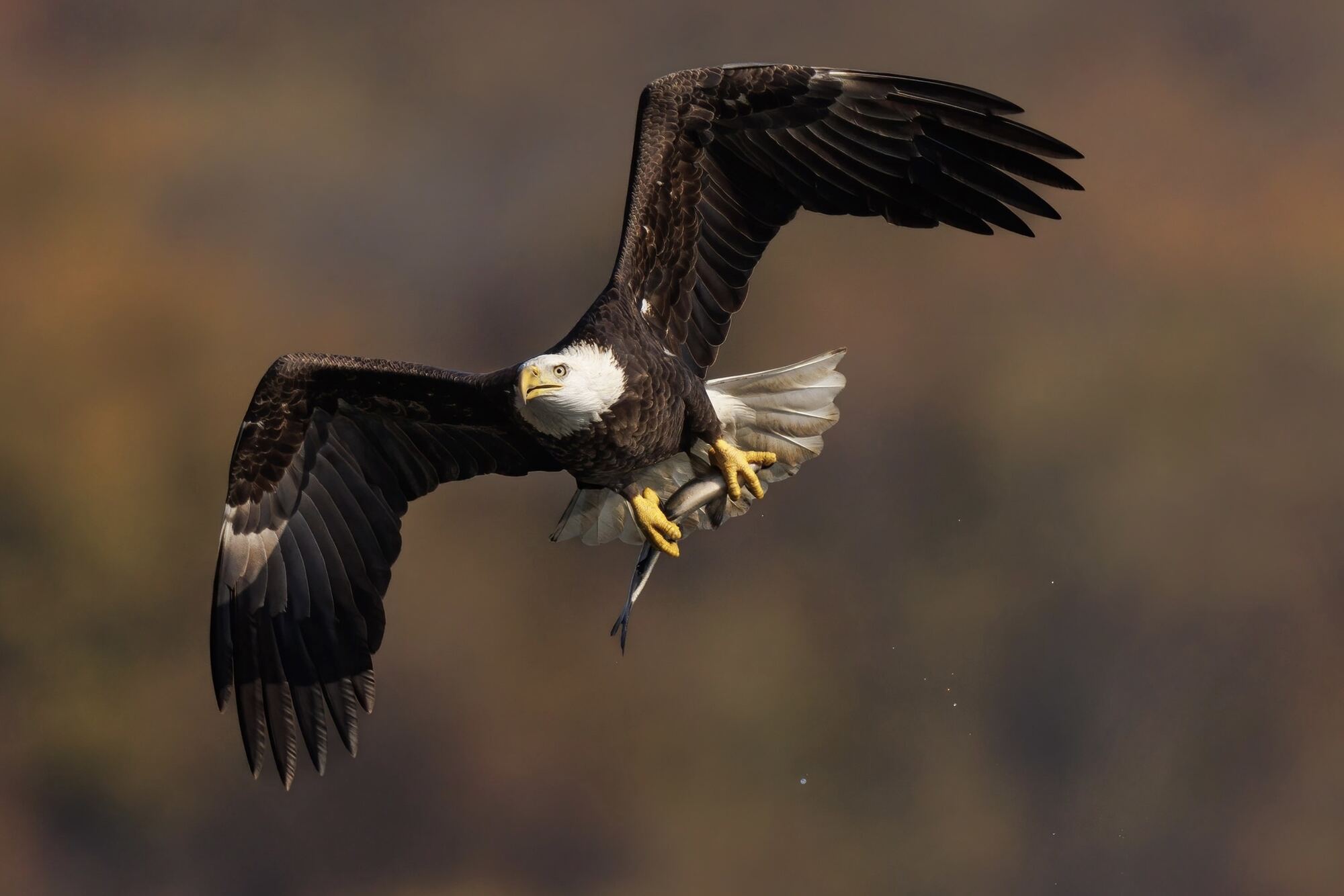
The US national bird, pushed to the brink by DDT and back to more than 300,000 eagles in the lower 48 states.
Meet the bird
The Bald Eagle is a large sea eagle of North American lakes, rivers and coasts, feeding mainly on fish but also on waterbirds and carrion. In the lower 48 United States it declined to a few hundred known nesting pairs by 1963, as shooting, poisoning, habitat loss and DDT-induced eggshell thinning took their toll. After DDT was banned in 1972 and the species was protected, it recovered so strongly that it was delisted in 2007.
Appearance
One of the largest birds in North America, with a heavy body, large head, big hooked bill and long, broad wings; its wingspan is slightly greater than a Great Blue Heron’s.
Plumage & colour
Adults are dark brown with a gleaming white head and tail and yellow bill, eyes and feet. Immatures are mostly dark brown, blotched with white to varying degrees, and take several years to acquire full adult plumage.
Behaviour
Adults use the same breeding territory, and often the same nest, year after year, and may also maintain alternative nests within the territory. Bald eagles are opportunistic, combining hunting with scavenging. In the lower 48 states between 1990 and 2000, nesting pairs averaged at least one fledgling per year, and the nesting population grew by about 8% per year.
Measurements: Cornell Lab of Ornithology, All About Birds (length, weight, average wingspan of 204 cm). Longevity record reported by All About Birds and Maryland DNR.
Did you knowIn 2006 a pair of Bald Eagles nested in Vermont — the first in that state since the 1940s, completing the species’ return to every one of the lower 48 states.
Range shown at country level (countries of regular occurrence). Vagrants recorded in Russia, Ireland, Belize, Bermuda, Puerto Rico and the US Virgin Islands are not shown.
- Where
- Throughout much of Canada and the United States including Alaska, and in Mexico; also the French islands of St Pierre and Miquelon off Newfoundland. Nesting pairs now occur in every one of the lower 48 states.
- Continents
- North America
- Habitat
Associated with aquatic habitats throughout its life — lakes, reservoirs, rivers, estuaries and sea coasts. Usually nests in large trees along shorelines, though sometimes 800 m or more from the water; cliff nests occur in the south-western United States and Alaska, and ground nests have been reported in Alaska.
- Movement · partial
- BirdLife classes the species as migratory, but movements vary with latitude and the availability of open water and food: many northern birds move south in winter, while others remain near their breeding areas year-round.
What it eats
Primarily fish; also waterfowl, coots, gulls, cormorants and a wide variety of carrion.
Feeding strategy
Takes live fish and waterbirds and scavenges a wide variety of carrion. Historically, the great bison herds provided a seasonally important food source, and their loss contributed to past declines.
- FishFishMain food in most areas.
- BirdWaterbirds (ducks, coots, gulls, cormorants)
- CarrionCarrion (fish and mammal carcasses)
What eats it
The animals that prey on the Bald Eagle, grouped by the life stage they attack: its eggs, its chicks, or grown birds.
EggsWho eats its eggs
No predators documented at this stage.
ChicksWho kills its chicks
No predators documented at this stage.
AdultsWho kills grown birds
No predators documented at this stage.
Adult Bald Eagles have few natural predators, and predation on eggs and nestlings is not well documented in the sources reviewed for this profile. Human-related causes — shooting, poisoning, lead from ammunition, collisions and electrocution — dominate recorded mortality.
Its place in nature
The Bald Eagle is a top predator and scavenger of North American waters. By eating fish and waterbirds it sits near the top of aquatic food webs, which is exactly why it accumulated DDT so strongly; and by feeding on carcasses it helps recycle dead animals. Its role as a scavenger also exposes it to lead from spent ammunition.
- Preys onDocumentedFish
Fish are the main food in most populations.
- Preys onDocumentedWaterbirds, including American Coot
Eagles take waterfowl, coots, gulls and cormorants. Eating sick coots has exposed eagles to avian vacuolar myelinopathy, a neurological disease that killed at least 80 Bald Eagles after its discovery at DeGray Lake, Arkansas, in 1994.
- Feeds onDocumentedCarcasses of large mammals
Carrion is an important food. The loss of the great bison herds removed a seasonally important food source, and carcasses containing fragments of lead ammunition are a source of lead poisoning.
- Nests in / depends onDocumentedLarge shoreline trees
Nests are usually built in large trees near water and reused for years; habitat protection and management around nests formed part of the recovery effort.
What if it disappeared?
This scenario was partly realised: by the 1960s the Bald Eagle had vanished from much of the lower 48 states. Few studies documented ecological consequences at the time, so most effects below are inferred.
Press Remove to see which organisms could be affected, how, and how confident scientists are. 3 possible effects are recorded for this species.
Other scavengers and fish-eaters — Golden Eagles, Ospreys, ravens, gulls, vultures, otters and bears — overlap in diet and would take over much of the eagle’s ecological role, though not its cultural one.
Because the eagle’s mid-century decline coincided with many other environmental changes, its specific ecological effects were never measured.
These scenarios summarise published ecology. They are not predictions: ecosystems are complex, other pressures interact, and documented, likely and hypothesised effects are labelled separately.
Conservation
- LCLeast Concern
- NTNear Threatened
- VUVulnerable
- ENEndangered
- CRCritically Endangered
- EWExtinct in the Wild
- EXExtinct
Removed from the US List of Endangered and Threatened Wildlife in the lower 48 states, effective 8 August 2007. It remains protected under the Bald and Golden Eagle Protection Act and the Migratory Bird Treaty Act.
- Population estimate
- c. 200,000 mature individuals globally (Partners in Flight estimate). Separately, USFWS estimated c. 316,700 individuals (all ages) in the lower 48 states in 2019, including 71,467 occupied nests.
- Estimate year: 2020
- Trend
- Increasing
- Source
- BirdLife International factsheet (2024 assessment), citing Partners in Flight (2020); U.S. Fish & Wildlife Service (2021), Bald Eagle Population Size: 2020 Update.
Threats
- DDT and organochlorine pesticides (historical)
From the late 1940s, DDE — the breakdown product of DDT — accumulated in female eagles and impaired calcium metabolism, causing eggshell thinning, broken eggs and widespread reproductive failure from the 1950s to the mid-1970s. DDT was banned in the USA from the end of 1972; residual effects are now highly localised.
- Lead poisoning
Eagles swallow lead fragments from spent ammunition in carcasses. A continent-wide study found chronic lead exposure in 46% of Bald Eagles sampled and estimated it suppresses population growth by about 3.8% (Slabe et al. 2022).
- Shooting, poisoning and habitat loss (historical and ongoing)
Past declines were also caused by intense hunting, poison baits set for livestock predators, and habitat destruction. Illegal shooting and poisoning remain prohibited under federal law.
What is being done
Recovery followed the 1972 US ban on DDT, later restrictions on other persistent pesticides, legal protection under the Bald and Golden Eagle Protection Act and Endangered Species Act, and habitat protection around nests. The population growth exceeded all numeric recovery goals, and the species was delisted in the lower 48 states in 2007.
- DDT registration cancelled in the USA (31 December 1972); dieldrin, heptachlor, chlordane and other persistent pesticides restricted from 1976.
- Listed as endangered south of 40°N in 1967, and in 43 states (threatened in five) under the Endangered Species Act in 1978.
- Delisted in the lower 48 states, effective 8 August 2007; still protected under the Bald and Golden Eagle Protection Act and Migratory Bird Treaty Act.
A conservation story
By 1963 only about 417 known nesting pairs of Bald Eagles remained in the lower 48 United States. DDT, sprayed widely after the Second World War, was the main culprit: its breakdown product DDE thinned eggshells so much that many eggs broke during incubation. After the US cancelled DDT’s registration at the end of 1972 and the eagle was protected under the Endangered Species Act, productivity recovered — between 1990 and 2000 the nesting population grew by about 8% a year. By 2007 there were an estimated 9,789 breeding pairs and the species was delisted. The most recent federal estimate (2019 data) put the lower-48 population at about 316,700 eagles, though new survey methods mean that figure is not directly comparable with the historical counts.
Sources
Conservation status: IUCN Red List (assessed by BirdLife International), assessed 2024. Media credits accompany each image and recording; see Sources & credits.
- BirdLife International (2024 assessment). Species factsheet: Bald Eagle Haliaeetus leucocephalus.
- Cornell Lab of Ornithology. All About Birds: Bald Eagle identification.
- U.S. Fish & Wildlife Service (2007). Endangered and threatened wildlife and plants; removing the bald eagle in the lower 48 States from the List of Endangered and Threatened Wildlife. Federal Register 72: 37346–37372.
- U.S. Fish & Wildlife Service (2021). America’s bald eagle population continues to soar (2020 population update).
- U.S. Fish & Wildlife Service (2021). Final report: Bald Eagle Population Size: 2020 Update.
- Slabe, V.A. et al. (2022). Demographic implications of lead poisoning for eagles across North America. Science 375: 779–782.