Philippine Eagle
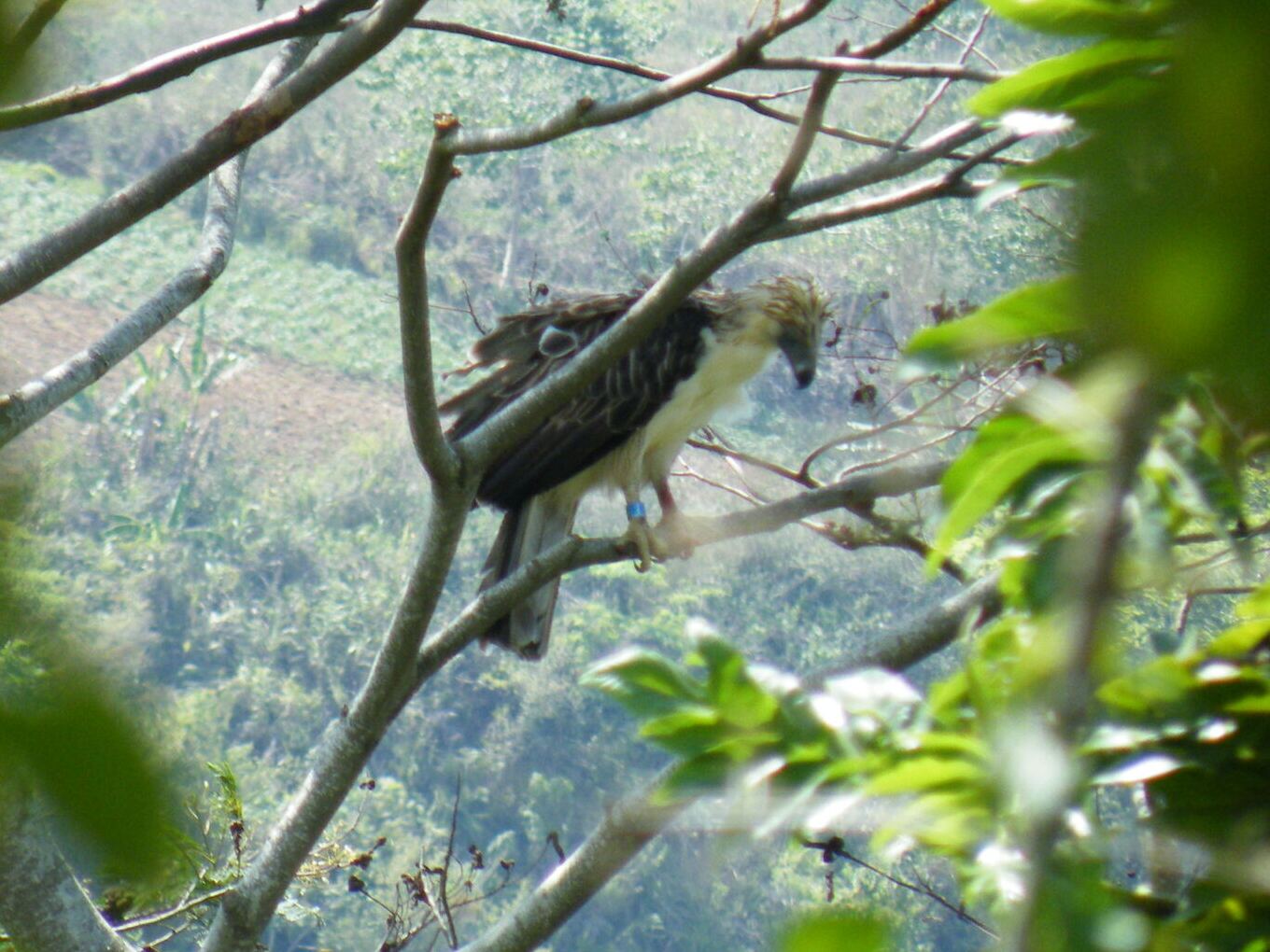
A giant forest eagle of the Philippines that raises a single chick every two years.
Meet the bird
The Philippine Eagle is one of the world’s largest and most powerful eagles and lives only in the rainforests of four Philippine islands. It hunts flying lemurs (colugos), cloud rats, civets and monkeys, and pairs need territories of around 70 km². Deforestation and shooting have reduced it to a few hundred pairs at most, and estimates of how many remain differ widely.
Appearance
A huge forest eagle with a deep, arched, bluish-grey bill, a shaggy crest of long, pointed feathers on the head and nape, and short, broad wings and a long tail for flying through forest.
Plumage & colour
Dark brown upperparts and creamy-white underparts and underwings; the face and crest are pale buff streaked with dark brown. The legs are yellow and very powerful. Sexes look similar.
Behaviour
Philippine Eagles form monogamous pairs that are thought to last for life. Females mature at around five years old and males at around seven. On Mindanao, nesting begins between September and December. Pairs build huge stick nests high in large trees, and every other year the female lays a single egg, which both parents incubate for about 58–60 days. The young eagle fledges after about four to five months but stays near the nest for almost a year and a half, so a complete breeding cycle takes two years.
Measurements: The Peregrine Fund (length 2.5–3.3 ft / 76–102 cm; wingspan c. 6.5 ft / 1.9 m; weight 10–18 lb / 4.5–8.1 kg); longevity: BirdLife International and Philippine Eagle Foundation
Did you knowA Philippine Eagle pair needs two years to raise a single chick, and the young bird stays near the nest for about a year and a half after it fledges.
Range shown at country level (countries of regular occurrence). Pairs occupy territories of about 68–72 km², so even a small population is spread over a large area. Not all apparently suitable forest is occupied, largely because of persecution.
- Where
- Endemic to the Philippines: eastern Luzon, Samar, Leyte and Mindanao. Mindanao is the stronghold. On Luzon only three nests have been found in recent years, compared with 35 on Mindanao, despite considerable survey effort.
- Continents
- Asia
- Habitat
Primary dipterocarp rainforest, especially on steep terrain, from the lowlands to at least 1,800 m. It sometimes uses secondary and gallery forest but not open-canopy forest. Lowland forest, which it favours, has been cleared most heavily.
- Movement · resident
- Sedentary. Pairs hold large, permanent territories. Young birds stay in their parents’ territory for well over a year before dispersing.
What it eats
A predator of forest mammals and other vertebrates. On Mindanao its main prey is the Philippine flying lemur (colugo); on Luzon, where colugos are absent, it takes two endemic species of cloud rat. Other prey includes palm civets, monkeys (macaques), flying squirrels, bats, snakes, monitor lizards and birds.
Feeding strategy
Hunts inside the forest. Diet varies from island to island depending on which prey animals are present, most clearly between Mindanao (colugos) and Luzon (cloud rats).
- MammalPhilippine flying lemur (colugo)Primary prey on Mindanao.
- MammalCloud rats (two endemic species)Important prey on Luzon.
- MammalPalm civets
- MammalMacaques
- MammalFlying squirrels and bats
- ReptileSnakes and monitor lizards
- BirdBirds
What eats it
The animals that prey on the Philippine Eagle, grouped by the life stage they attack: its eggs, its chicks, or grown birds.
EggsWho eats its eggs
No predators documented at this stage.
ChicksWho kills its chicks
No predators documented at this stage.
AdultsWho kills grown birds
No predators documented at this stage.
As a top predator, the adult Philippine Eagle has no documented natural predators. Natural predation on eggs and chicks is not well documented. Shooting and trapping by people are the main documented causes of death: the Philippine Eagle Foundation reports that at least one eagle is killed by shooting every year.
Its place in nature
The Philippine Eagle is the top avian predator of the Philippine rainforest, hunting mammals as large as monkeys and civets. Its effect on prey populations has not been studied. Because each pair needs about 70 km² of forest, protecting enough forest for a single pair means protecting tens of square kilometres of habitat for many other species.
- Preys onDocumentedPhilippine flying lemur
The main prey on Mindanao. Its absence from Luzon may mean eagles there live at lower densities.
- Preys onDocumentedCloud rats
Two endemic Luzon cloud rat species replace colugos in the diet of Luzon eagles (Hurrell 2014).
- Preys onDocumentedPalm civets
Regularly recorded as prey.
- Preys onDocumentedMacaques
Monkeys are among the eagle’s prey, which explains its old name, "Monkey-eating Eagle".
- Nests in / depends onDocumentedLarge rainforest trees
Huge stick nests are built high in large trees, so logging of big trees removes nest sites.
What if it disappeared?
The Philippine Eagle has already vanished from large parts of the forest it once used, but no study has measured what changed where it disappeared. The effects below are therefore inferred.
Press Remove to see which organisms could be affected, how, and how confident scientists are. 3 possible effects are recorded for this species.
Smaller forest raptors might take some of the same prey, but whether any could fill the role of a top predator of monkeys, civets and colugos is unknown.
Basic ecological data are lacking: prey population sizes, eagle densities outside Mindanao and the share of suitable forest that is actually occupied are all poorly known.
These scenarios summarise published ecology. They are not predictions: ecosystems are complex, other pressures interact, and documented, likely and hypothesised effects are labelled separately.
Conservation
- LCLeast Concern
- NTNear Threatened
- VUVulnerable
- ENEndangered
- CRCritically Endangered
- EWExtinct in the Wild
- EXExtinct
Also listed as Critically Endangered nationally and legally protected in the Philippines; CITES Appendix I.
- Population estimate
- 64–462 pairs (128–924 mature individuals), a deliberately wide range covering all published estimates
- Estimate year: 2025
- Trend
- Decreasing
- Source
- BirdLife International factsheet (2025 assessment), combining Sutton et al. (2023, 2024) and Collar & Berryman (2025)
No reliable historical time series is available for this species, so no population chart is shown. We do not interpolate or estimate missing data.
Threats
- Deforestation
Clear-felling for timber through much of the 20th century and, from about the late 1980s, widespread swidden (slash-and-burn) agriculture removed most lowland forest. Forest cover in the Philippines fell from 34.9% of the land area in 1969 to 22.2% in 1987. Forest loss has slowed in the past 20 years but continues.
- Shooting and persecution
Hunting and persecution have reduced occupancy across much of the range. Forest clearance also opens up the remaining forest to hunters.
- Very slow breeding
A pair can raise at most one young every two years, and recruitment of young birds into the adult population currently appears very low.
- Mining and severe weather
Mining concessions and typhoons are more minor threats.
What is being done
The eagle is legally protected, and the Philippine Eagle Foundation runs the only two breeding and rehabilitation centres for the species. National conservation plans since 1996 guide protection of nesting territories, law enforcement and community programmes.
- Legal protection against persecution and for nest sites; CITES Appendix I.
- The Philippine Eagle Foundation operates the Philippine Eagle Center and the National Bird Breeding Sanctuary for captive breeding, rescue and rehabilitation.
- Philippine Eagle Integrated Conservation Plan (1996, revised 2008; current framework 2021–2030).
- Education and community programmes by the Haribon Foundation on Luzon, including forest guards and local rules on slash-and-burn farming.
- Satellite tracking of eagles to map suitable habitat and identify priority conservation areas.
A conservation story
Before widespread deforestation began around 1900, there may have been as many as 6,000 Philippine Eagles. Clear-felling, then slash-and-burn agriculture, removed much of the lowland forest the eagle favours, and shooting emptied many remaining forests of breeding pairs. The species has been listed as Critically Endangered since 1994.
Conservation work since 1970 has included legal protection, surveys, awareness campaigns and captive breeding. The Philippine Eagle Foundation runs the only two facilities in the world that breed and rehabilitate the species, rescuing injured birds and releasing them where possible. On Luzon, the Haribon Foundation has worked with schools and Indigenous communities. Satellite tracking by researchers has mapped suitable habitat: about a third of it lies within protected areas, and new protected areas have been proposed on Mindanao, Leyte and Luzon.
How many eagles remain is still uncertain. Using tracking data, Sutton et al. (2023) estimated a potential maximum of 392 pairs (range 318–447), later revised to 387–462 pairs. Collar and Berryman (2025) argued that much suitable habitat is unoccupied and that Luzon densities are lower, suggesting 64–223 pairs as a best estimate. Whichever figure is closer, the population is small, slow-breeding and still declining, and its future depends on keeping large blocks of forest and stopping the shooting of eagles.
Sources
Conservation status: IUCN Red List (assessed by BirdLife International), assessed 2025. Media credits accompany each image and recording; see Sources & credits.
- BirdLife International (2025 assessment). Species factsheet: Philippine Eagle Pithecophaga jefferyi.
- Philippine Eagle Foundation. The Philippine Eagle.
- Philippine Eagle Foundation. Priority conservation areas and global population estimate for the Philippine Eagle (on Sutton et al. 2023, Animal Conservation).
- Mongabay (2023). New map boosts Philippine eagle population estimate but highlights threats.
- The Peregrine Fund. Philippine Eagle (species account).