Harpy Eagle
A giant forest eagle built to snatch sloths and monkeys from the rainforest canopy.
Meet the bird
One of the largest and most powerful eagles in the world, the Harpy Eagle hunts mammals in the canopy of lowland tropical forests from southern Mexico to northern Argentina. Sloths and monkeys dominate its diet. Because a pair raises at most one chick every two years and needs large areas of forest, it is highly sensitive to deforestation and hunting.
Appearance
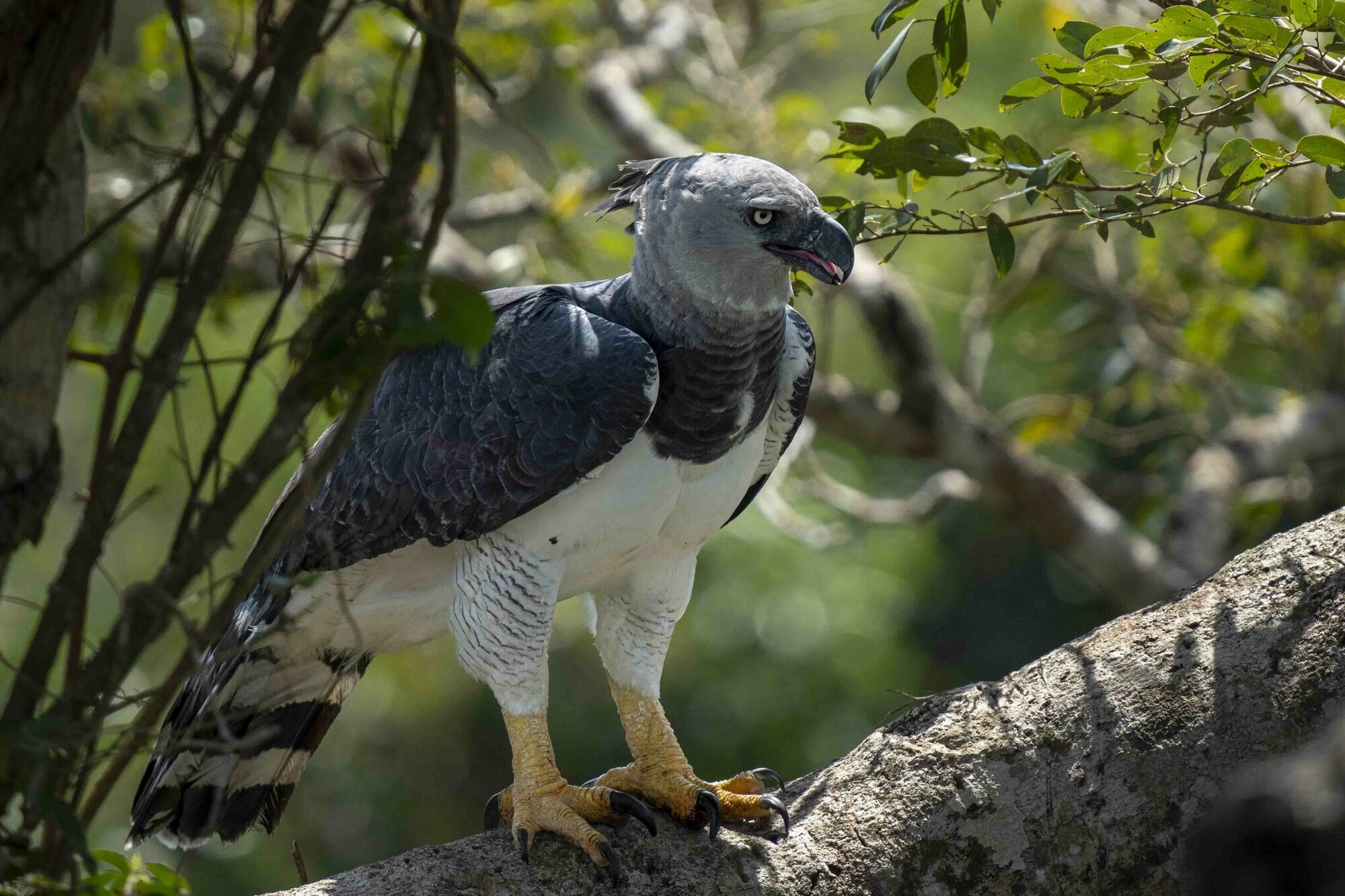
A very large, broad-winged forest eagle with relatively short, rounded wings and a long tail that suit manoeuvring between trees. It has massive legs and feet with huge talons, a heavy hooked bill and a split, erectile crest on the head. Wingspan reaches about 2 m. Females are much larger than males and can weigh up to twice as much.
Plumage & colour
Head pale grey with a dark, two-pointed crest; upperparts and a broad band across the chest are black; underparts white; thighs finely barred black; tail banded black and grey. Sexes look alike apart from size. Young birds are much paler, with whitish heads and bodies, and take several years to reach adult plumage.
Behaviour
Pairs nest high in the largest emergent trees, around 40 m above the ground, in huge stick nests built from hundreds of branches. The female lays one or two eggs but usually only one chick is raised; incubation lasts about 55 days and the chick fledges at about 5–6 months. Because the young remain dependent for so long, a pair generally breeds only once every two years. Adults hunt mainly by perching in the canopy and watching for prey, then making short, fast attacks.
Measurements: The Peregrine Fund, Global Raptor species account: length 3–3.5 ft (converted), wingspan up to about 2 m, weight 4–9 kg.
Did you knowA Harpy Eagle nest can be built from more than 300 branches, about 40 m up in one of the tallest trees in the forest.
Range shown at country level (countries of regular occurrence). Extinct in El Salvador and thought to be locally or regionally extinct in large parts of its former range, including most of Central America, most of Brazil’s Atlantic Forest, parts of Bolivia and Venezuela north of the Orinoco, and parts of northern Argentina. It is now very scarce in Mexico and Costa Rica.
- Where
- Lowland tropical forest from southern Mexico through Central America to Colombia, Venezuela, the Guianas, Ecuador, Peru, Bolivia, Brazil (especially Amazonia), Paraguay and north-east Argentina.
- Continents
- North America · South America
- Habitat
Lowland tropical forest, typically below 900 m and locally up to 2,000 m. It tolerates some forest degradation if large nest trees and enough canopy prey remain, but in the Brazilian Amazon it could not raise young in landscapes with less than about 50% forest cover, and it rarely crosses forest gaps wider than about 500 m.
- Movement · resident
- Sedentary. Pairs occupy large home ranges around their nest trees; young birds stay near the nest and depend on their parents for one to two years before dispersing.
What it eats
Mainly medium-sized tree-dwelling mammals, above all sloths and monkeys, plus porcupines, opossums, coatis and other mammals, some large birds (such as macaws and hoatzins) and iguanas.
Feeding strategy
At six nests on the Xingu River, Brazil, 165 prey animals of 18 species were recorded; the two sloth species made up 35% of prey, followed by porcupines and brown capuchin monkeys (Aguiar-Silva et al. 2015). In central Amazonia, two sloth species dominated the diet at five nests both by number and by biomass (Aguiar-Silva et al. 2014). In heavily deforested landscapes, harpies did not switch to open-country prey but kept hunting canopy animals.
- MammalThree-toed and two-toed sloths35% of prey at Xingu River nests; dominant prey in central Amazonia.
- MammalMonkeys (e.g. brown capuchin, howler monkeys)Capuchins were the main primate prey on the Xingu.
- MammalBrazilian porcupine
- BirdLarge birds (e.g. macaws, hoatzin)Occasional.
- ReptileGreen iguanaRecorded near rivers.
What eats it
The animals that prey on the Harpy Eagle, grouped by the life stage they attack: its eggs, its chicks, or grown birds.
EggsWho eats its eggs
No predators documented at this stage.
ChicksWho kills its chicks
No predators documented at this stage.
AdultsWho kills grown birds
No predators documented at this stage.
As an apex predator, the adult Harpy Eagle has no documented natural predators. Natural predation on eggs and chicks is not well documented. Its main causes of death are shooting, collisions with power lines, and starvation of young in deforested landscapes.
Its place in nature
The Harpy Eagle is one of the few predators able to take adult sloths and monkeys from the forest canopy, so it sits at the top of the canopy food web. Its need for large trees, intact forest and abundant arboreal mammals makes it a sensitive indicator of forest health: in Brazil’s “Arc of Deforestation”, nests failed and fledglings starved where too much forest had been cleared.
- Preys onDocumentedSloths (brown-throated three-toed sloth, Linnaeus’s two-toed sloth)
The main prey in several Amazonian studies, taken from the canopy. Sloths made up 35% of prey items at Xingu River nests and dominated the diet by number and biomass in central Amazonia.
- Preys onDocumentedMonkeys (capuchins, howler monkeys and others)
Primates are regular prey; on the Xingu River, brown capuchins were the most frequent primate taken, alongside red-handed howlers, titi monkeys, squirrel monkeys and sakis.
- Preys onDocumentedBrazilian porcupine
Porcupines were among the most frequent prey at Xingu River nests.
- Nests in / depends onDocumentedGiant emergent trees (e.g. kapok Ceiba pentandra, Brazil-nut tree)
Harpies nest in very large trees that rise above the canopy; in the Amazon they appear to use only about 28 tree species. Selective logging that removes these giants can eliminate nest sites even where forest remains.
What if it disappeared?
Harpy Eagles have already vanished from large parts of Central America and Brazil’s Atlantic Forest, but the ecological consequences there have not been studied directly. The effects below are therefore mostly inferences from what it eats.
Press Remove to see which organisms could be affected, how, and how confident scientists are. 3 possible effects are recorded for this species.
Other large forest raptors, such as the Crested Eagle, and climbing cats like jaguars and ocelots also take arboreal mammals, so some predation would continue. None is known to specialise on large canopy mammals to the same extent, so compensation would probably be partial.
Where Harpy Eagles have disappeared, hunting by people has often reduced the same prey species at the same time, which makes it hard to separate the effect of losing the eagle from the effect of losing the forest and its animals.
These scenarios summarise published ecology. They are not predictions: ecosystems are complex, other pressures interact, and documented, likely and hypothesised effects are labelled separately.
Conservation
- LCLeast Concern
- NTNear Threatened
- VUVulnerable
- ENEndangered
- CRCritically Endangered
- EWExtinct in the Wild
- EXExtinct
Listed as Vulnerable because it is suspected to be declining rapidly owing to forest loss and degradation, hunting and persecution.
- Population estimate
- 100,000–250,000 mature individuals (tentative estimate from nest densities and forest cover; may be lower)
- Estimate year: 2021
- Trend
- Decreasing
- Source
- BirdLife International factsheet (2021 assessment)
No reliable historical time series is available for this species, so no population chart is shown. We do not interpolate or estimate missing data.
Threats
- Deforestation and forest degradation
About 8% of tree cover with at least 50% canopy cover was lost within the species’ range from 2001 to 2020; if this continues, about 27% would be lost over three generations (60 years). In Mato Grosso, Brazil, three fledglings starved in landscapes with 50–70% forest loss, and no nests were found where more than 70% had been cleared (Miranda et al. 2021).
- Hunting and persecution
Although not eaten, harpies are frequently shot across much of the range — sometimes to protect livestock, sometimes out of curiosity. In some areas this may affect the population more than forest loss.
- Selective logging and power lines
Removal of the largest trees eliminates nest sites, and collisions with power lines are an additional source of mortality.
What is being done
The species depends on large blocks of lowland forest with big nest trees and abundant canopy prey. Research and nest-monitoring programmes, such as Brazil’s Harpy Eagle Conservation Programme (Programa de Conservação do Gavião-real), study breeding success and diet and work with local landowners to protect nest trees.
- Protection of large forest areas and of known nest trees.
- Long-term nest monitoring and diet studies in the Brazilian Amazon.
- Research identifying a 50% forest-cover threshold for successful breeding, to inform land-use planning.
- Education to reduce shooting of eagles.

Sources
Conservation status: IUCN Red List (assessed by BirdLife International), assessed 2021. Media credits accompany each image and recording; see Sources & credits.
- BirdLife International (2021 assessment). Species factsheet: Harpy Eagle Harpia harpyja.
- The Peregrine Fund. Harpy Eagle species account.
- Aguiar-Silva, F.H., Sanaiotti, T.M. & Luz, B.B. (2014). Food habits of the Harpy Eagle, a top predator from the Amazonian rainforest canopy. Journal of Raptor Research 48: 24–35.
- Aguiar-Silva, F.H. et al. (2015). Resource availability and diet in Harpy Eagle breeding territories on the Xingu River, Brazilian Amazon. Brazilian Journal of Biology 75(3 suppl.): S181–S189.
- Miranda, E.B.P. et al. (2021). Tropical deforestation induces thresholds of reproductive viability and habitat suitability in Earth’s largest eagles. Scientific Reports 11.