Mauritius Kestrel
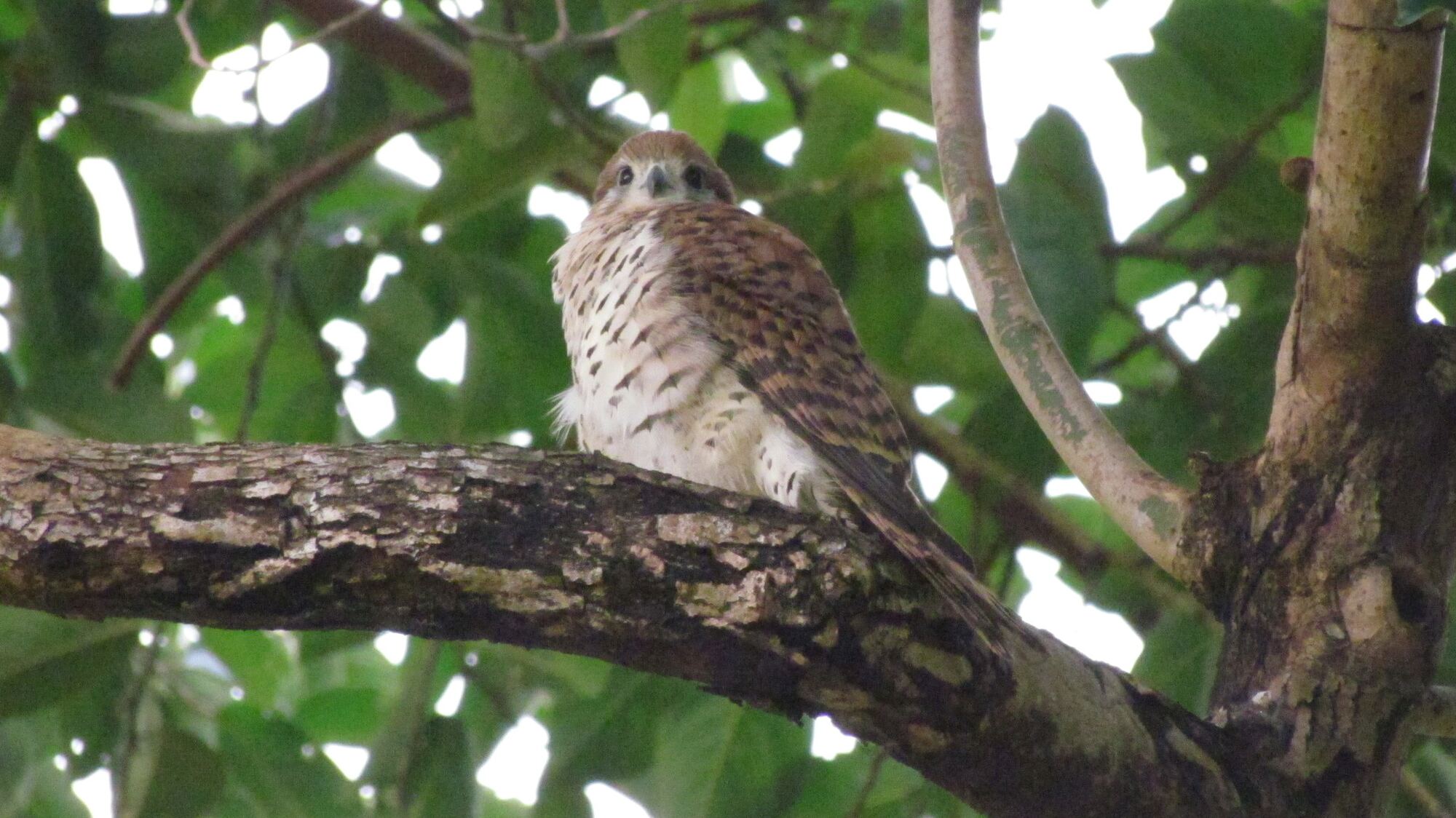
Once down to four known wild birds, this island falcon recovered dramatically and is now declining again.
Meet the bird
A small, forest-dwelling falcon found only on Mauritius in the Indian Ocean. In 1974 only four wild birds were known, but an intensive programme of captive breeding, releases and nest management raised numbers to several hundred by the late 1990s. Since the late 2000s the population has fallen again, and in 2018 it was estimated at fewer than 250 birds.
Appearance
A compact falcon with short, rounded wings and a long tail, adapted to manoeuvring through forest rather than hovering over open country. It hunts mainly by watching from perches and dashing after geckos on branches and trunks.
Plumage & colour
Rich chestnut-brown upperparts barred and spotted with dark brown, and whitish underparts heavily spotted with dark heart-shaped marks. Sexes look alike, with females larger.
Behaviour
Pairs are territorial and may stay together for several years, though they may split after a failed breeding attempt. Kestrels traditionally nest in cavities in volcanic cliffs and in tree holes; they build no stick nest and readily use nest boxes put up by conservationists, where clutches are larger than at natural sites. Clutches usually contain three or four eggs, but range from one to five.
Measurements: The Peregrine Fund (length 7–10 in / 17.7–25.5 cm; weight 6–8 oz / 170–227 g). Wingspan is not reliably documented in the sources consulted.
Did you knowIn 1974 only four Mauritius Kestrels were known in the wild; within about 25 years there were probably 350–500.
Range shown at country level (countries of regular occurrence). Extent of occurrence c. 540 km²; area of occupancy at most c. 316 km² (BirdLife 2023).
- Where
- Endemic to Mauritius. In 1974 it survived only in the Black River Gorges. Reintroductions created four subpopulations on mountain ranges in the north, east and south-west of the island, but the northern Moka Range subpopulation was gone by 2007. The species now lives in three separate subpopulations (east, south and west) with no known movement between them.
- Continents
- Africa
- Habitat
Originally native evergreen subtropical forest, which now survives mainly in south-west Mauritius; less than 2% of the island’s original forest remains. Captive-bred birds proved more tolerant of degraded habitat, secondary forest and scrub, but these areas may be "sinks", with more predation and disease, less food and lower breeding success. Kestrels tend to avoid farmland, perhaps partly because it lacks isolated tall trees for perches.
- Movement · resident
- Sedentary and territorial. Colour-ringing has shown no dispersal between the three subpopulations.
What it eats
Mainly endemic, tree-dwelling Phelsuma day geckos and other small lizards, which make up about 90% of the diet. It also takes small birds, insects and introduced shrews and young rats.
Feeding strategy
Hunts arboreal geckos within and below the forest canopy, often watching from perches in tall trees. Invasive plants such as strawberry guava and traveller’s palm make the forest so dense that hunting below the canopy can become impossible, and they also reduce gecko numbers.
- ReptilePhelsuma day geckosStaple prey; endemic arboreal geckos.
- ReptileOther small lizards
- BirdSmall birds
- InsectInsects
- MammalIntroduced shrews and juvenile rats
What eats it
The animals that prey on the Mauritius Kestrel, grouped by the life stage they attack: its eggs, its chicks, or grown birds.
EggsWho eats its eggs
No predators documented at this stage.
ChicksWho kills its chicks
- MammalBlack ratDocumentedRecorded as preying on eggs, young or adults; the source does not separate life stages.
- MammalCrab-eating macaqueDocumentedRecorded as preying on eggs, young or adults; the source does not separate life stages.
- MammalSmall Indian (Javan) mongooseDocumentedRecorded as preying on eggs, young or adults; the source does not separate life stages.
- MammalFeral catDocumentedRecorded as preying on eggs, young or adults; the source does not separate life stages.
AdultsWho kills grown birds
No predators documented at this stage.
All four predators were introduced to Mauritius by people. BirdLife (citing Cade & Jones 1993) records them preying on eggs, young or adults without itemising each stage, so they are listed here under the nest stage, when kestrels are most exposed. They also reduce the number of natural nest cavities the kestrels can safely use.
Its place in nature
The Mauritius Kestrel is a native predator that specialises in the island’s endemic day geckos. Its influence on gecko populations has not been measured; it is better known as a flagship of Mauritian conservation and a textbook example of an intensive species recovery.
- Preys onDocumentedPhelsuma day geckos
The kestrel’s main prey. Invasive plants that reduce gecko density and visibility lower the kestrel’s hunting success.
- Preyed on byDocumentedCrab-eating macaque
An introduced monkey that takes eggs, young or adults and limits which nest sites are safe.
- Preyed on byDocumentedBlack rat
An introduced predator of kestrel nests, which may also compete with kestrels for nest cavities.
- Preyed on byDocumentedSmall Indian (Javan) mongoose
An introduced predator recorded preying on kestrels.
- Competes withHypothesisedWhite-tailed tropicbird and common myna
With few suitable cavities left, kestrels may compete for nest sites with tropicbirds, feral pigeons, introduced common mynas and black rats (BirdLife, citing Jones et al. 2013).
What if it disappeared?
The kestrel came within a few birds of disappearing in the 1970s, and its northern subpopulation has already been lost. Because its ecological effects were never measured, the consequences of complete extinction can only be inferred.
Press Remove to see which organisms could be affected, how, and how confident scientists are. 3 possible effects are recorded for this species.
No other native bird of prey on Mauritius is known to specialise in hunting day geckos, so the role would probably not be taken over. Whether introduced predators that also eat lizards would fill any gap is unknown.
There are no data on how much kestrels influence gecko or other prey populations, so the ecological effects of losing them are essentially unknown.
These scenarios summarise published ecology. They are not predictions: ecosystems are complex, other pressures interact, and documented, likely and hypothesised effects are labelled separately.
Conservation
- LCLeast Concern
- NTNear Threatened
- VUVulnerable
- ENEndangered
- CRCritically Endangered
- EWExtinct in the Wild
- EXExtinct
Listed as Vulnerable from 2000 to 2013, after its recovery, and uplisted to Endangered in 2014 because of renewed decline. Listed on CITES Appendices I and II.
- Population estimate
- 140–170 mature individuals (fewer than 250 birds in total), estimated for 2018; at least c. 73 pairs
- Estimate year: 2018
- Trend
- Decreasing
- Source
- BirdLife International factsheet (2023 assessment), citing Nicoll et al. (2021)
No reliable historical time series is available for this species, so no population chart is shown. We do not interpolate or estimate missing data.
Threats
- Invasive plants
Traveller’s palm, strawberry guava, Ligustrum robustum and the liana Hiptage benghalensis have invaded much of the remaining forest, cutting hunting efficiency and gecko numbers.
- Introduced predators
Black rats, crab-eating macaques, mongooses and feral cats prey on eggs, young or adults and make natural nest sites unsafe.
- Shortage of nest sites
In the west, where natural cavities are scarce or deteriorating, birds have been lost from areas without nest sites; nest boxes help but need maintaining.
- Inbreeding and disease
The 1970s bottleneck caused an extreme loss of genetic variation. The species is very susceptible to trichomonosis and contracted adenovirus in captivity.
- Climate change
More wet days at the start of the breeding season are linked to later egg-laying.
What is being done
A recovery programme starting in 1973 used captive breeding, releases and intensive nest management to rescue the species. Since 1994 there have been no releases, and conservation has focused on nest boxes and monitoring; scientists now recommend restarting captive breeding and moving birds between subpopulations.
- Recovery programme initiated in 1973, at first focused on research; The Peregrine Fund was involved from the start.
- 1984–1994: captive breeding and releases, supplementary feeding, nest boxes, nest guarding, predator control at nests and release sites, clutch manipulation and rescue of eggs and chicks.
- Releases in the Bambous and Moka mountain ranges and the Bel Ombre region.
- Ongoing provision of nest boxes and monitoring of survival and breeding.
- A planned highway through the eastern mountains was rerouted in 2005, protecting forest that held about half the world population.
A conservation story
Forest clearance and organochlorine pesticides used in the 1950s and 1960s pushed the Mauritius Kestrel to the edge: by 1974 only four wild birds were known. A recovery effort had begun in 1973, and from the late 1970s it was led by the biologist Carl Jones. From 1984 to 1994 the team bred kestrels in captivity, removing first clutches so that pairs would lay again, released captive-bred birds into new mountain ranges, fed wild pairs, put up nest boxes, controlled predators around nests and rescued eggs from failing nests. The Peregrine Fund alone produced 46 captive-bred birds for release between 1988 and 1991.
The results were spectacular. By the end of the 1990s there were probably 350–500 birds and 99 breeding pairs across four subpopulations, and the species was downlisted from Endangered to Vulnerable. It became one of the best-known examples of a bird saved from extinction.
The recovery has not lasted. With releases stopped since 1994 and little active management, numbers fell from the late 2000s: the small northern subpopulation disappeared by 2007, the western one shrank to fewer than 15 pairs by 2018, and the total fell below 250 birds. The species was uplisted to Endangered in 2014. Invasive plants, introduced predators, scarce nest sites and very low genetic diversity all hold it back, and Mauritius probably cannot support more than about 1,000 kestrels even in the best case. The story shows that rescuing a species is not the same as securing it.
Sources
Conservation status: IUCN Red List (assessed by BirdLife International), assessed 2023. Media credits accompany each image and recording; see Sources & credits.