Northern Bald Ibis
A bald, cliff-nesting ibis once lost from Europe, now learning to migrate again with human foster parents.
Meet the bird
The Northern Bald Ibis once lived across North Africa, the Middle East and central and southern Europe, but disappeared from most of this range centuries ago. The last truly wild birds survive mainly on the Atlantic coast of Morocco, where protection has helped the colony grow to about 700 birds. A relict migratory colony found in Syria in 2002 is now functionally extinct, while reintroduction projects have re-established free-flying birds in Austria, Germany, Italy and Spain.
Appearance
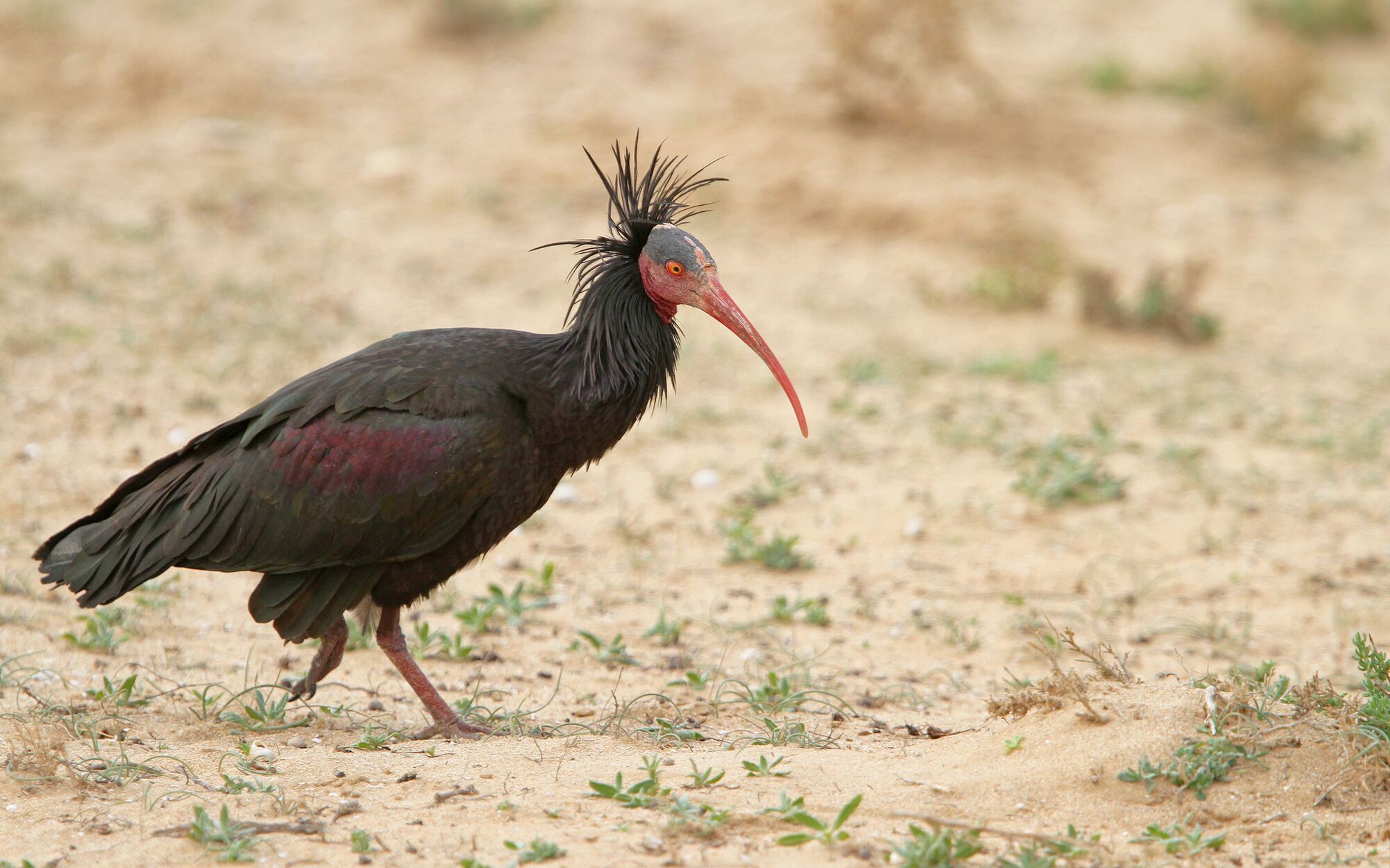
A medium-large, dark ibis with a long, down-curved red bill, a bare red face and crown, and a wispy ruff of long feathers on the back of the neck. It commutes in flocks between roosts and feeding areas.
Plumage & colour
Black-feathered body; face unfeathered, with the bare skin and bill dull red; a wispy ruff of feathers around the neck. Sexes are similar.
Behaviour
Gregarious throughout the year: birds breed in colonies of up to about 40 pairs, forage in loose groups and commute in flocks between roosts and feeding grounds. In Morocco breeding begins in mid-February, with eggs laid in March–April; clutches contain two to four eggs, incubated for about 24–25 days. Breeding success varies greatly from year to year.
Measurements: Animal Diversity Web (Murphy 2019)
Did you knowIn Europe, hand-raised young Northern Bald Ibises have learned their migration route by following their human foster parents south to Italy and Spain.
Range shown at country level (countries of regular occurrence). The relict Syrian colony at Palmyra, whose birds migrated through Jordan, Saudi Arabia and Yemen to winter in Ethiopia, is functionally extinct and is not shown. Vagrants are not shown.
- Where
- Wild birds: Souss-Massa National Park and nearby Tamri on the Atlantic coast of Morocco, with new breeding sites found in 2017. A semi-wild colony at Birecik, south-east Türkiye, is kept free-flying in the breeding season but taken into captivity afterwards to stop it migrating. Reintroduced free-flying colonies breed in Austria and southern Germany and winter in Italy (Tuscany) and, since 2023, Andalusia, Spain; a separate, mostly sedentary reintroduced population lives in Andalusia.
- Continents
- Africa · Europe · Asia
- Habitat
Nests in colonies on cliffs and rocky escarpments in remote, arid areas, often near rivers or the coast; in the past, castles, ruins and town walls were used too. Feeds in open, sparsely vegetated places such as dry steppe, rocky slopes, coastal sands, short grassland, stubble fields and pastures, avoiding vegetation taller than about 25 cm. In Morocco, coastal fogs may buffer the effects of low rainfall, which may help explain why birds stay there year-round.
- Movement · partial
- The Moroccan birds are resident or disperse locally, whereas the Syrian population was fully migratory, wintering in Ethiopia. Reintroduced European birds migrate: early generations were led along their migration routes by people (human-led migration), and many now migrate independently between the Alps and Italy or Spain.
What it eats
A broad diet of almost any available animal life: insects, spiders, scorpions, earthworms and snails, and small vertebrates such as fish, amphibians, lizards, snakes, rodents and small birds. It also eats some plant matter, including berries, shoots, duckweed and rhizomes.
Feeding strategy
Forages on foot in loose groups with birds well spread out, taking prey from the ground with its long, curved bill.
- InsectInsects
- InvertebrateScorpions, spiders, earthworms and snails
- ReptileLizards, snakes and amphibians
- MammalSmall rodents and small birds
- PlantBerries, shoots and rhizomesMinor part of the diet.
What eats it
The animals that prey on the Northern Bald Ibis, grouped by the life stage they attack: its eggs, its chicks, or grown birds.
EggsWho eats its eggs
- BirdBrown-necked ravenDocumentedThe most serious nest predator at the Syrian colony.
ChicksWho kills its chicks
- BirdBrown-necked ravenLikelyFour chicks lost in Syria in 2008, probably to this raven.
- BirdEgyptian vultureHypothesisedSuspected of taking young chicks in Syria (Serra et al. 2009).
- BirdEurasian eagle-owlDocumentedCaused near-complete breeding failure of the reintroduced Andalusian colony in 2017.
AdultsWho kills grown birds
- BirdLarge raptors (Spanish imperial eagle, golden eagle, eagle-owl)HypothesisedNamed as potential predators after predation rose to 21% of known-cause deaths of reintroduced birds in 2025, mostly in Spain.
At Souss-Massa, egg loss to predators and, more importantly, chick starvation and predation have been the main causes of breeding failure, but the predators there are not named in the sources consulted. The Birecik colony has also suffered predation losses in some years.
Its place in nature
The Northern Bald Ibis is a generalist ground predator of insects, other invertebrates and small vertebrates in arid and semi-arid open country. Its numbers are now far too small for it to have a measurable effect on prey populations. Because it nests colonially on cliffs and forages in open steppe and farmland, it depends on traditional, low-intensity land use near its colonies.
- Preys onDocumentedGround-dwelling insects and other invertebrates
Insects, scorpions, earthworms and similar prey make up much of the diet.
- Preyed on byDocumentedBrown-necked raven
The main nest predator at the Palmyra colony in Syria, contributing to repeated breeding failures there.
- Preyed on byDocumentedEurasian eagle-owl
Predation by eagle-owls caused almost complete breeding failure of the reintroduced colony in Andalusia in 2017.
- Nests in / depends onDocumentedCoastal cliffs and escarpments
Colonies nest on ledges of cliffs and rocky escarpments; disturbance and illegal building near the Moroccan breeding cliffs are major threats.
What if it disappeared?
Across most of its former range the Northern Bald Ibis has been gone for centuries, so its disappearance from those ecosystems is already complete and was never studied. The effects of losing the remaining birds would be small and local.
Press Remove to see which organisms could be affected, how, and how confident scientists are. 3 possible effects are recorded for this species.
Other insect-eating birds of open country would take similar prey, so any ecological gap would probably close quickly. The species’ cultural and evolutionary distinctiveness could not be replaced.
Nothing is known about the ecological role of the large colonies that once existed across North Africa, the Middle East and Europe.
These scenarios summarise published ecology. They are not predictions: ecosystems are complex, other pressures interact, and documented, likely and hypothesised effects are labelled separately.
Conservation
- LCLeast Concern
- NTNear Threatened
- VUVulnerable
- ENEndangered
- CRCritically Endangered
- EWExtinct in the Wild
- EXExtinct
Critically Endangered in every assessment from 1994 to 2016, then downlisted to Endangered in 2018 because of the growth of the Moroccan population. Considered Regionally Extinct in Europe in BirdLife’s 2015 European assessment, before the reintroduced flocks grew. CITES Appendix I; CMS Appendices I and II.
- Population estimate
- About 700 wild birds of all ages in Morocco (more than 700 after the 2018 breeding season, with 147 breeding pairs). Reintroduced migratory population in central Europe: 323 individuals at the end of 2025. The 2018 IUCN assessment retained an older estimate of 200–249 mature individuals (2006).
- Estimate year: 2018
- Trend
- Stable
- Source
- Böhm et al. (2021), Oryx; Waldrappteam/LIFE Northern Bald Ibis Annual Report 2025; BirdLife International factsheet (IUCN figure and overall trend)
Threats
- Disturbance and development near colonies
In Morocco, illegal building and disturbance close to the breeding cliffs, changes in farming on the feeding grounds and a proposed tourist development are considered the most severe threats.
- Hunting and poaching
Hunting was the main threat to the Syrian birds, especially on migration through the Arabian Peninsula. Illegal shooting in Italy is a key threat to reintroduced migratory birds; poaching caused 18% of known-cause deaths in the European population in 2025.
- Electrocution on power lines
Electrocution caused 21% of known-cause deaths among reintroduced European birds in 2025 and probably killed tagged birds in Jordan; 182 high-risk pylons have been retrofitted in Austria.
- Pesticides
Poisoning by pesticides used against locusts and mosquitoes was a major historical threat in Türkiye.
- Climate change
Birds from the Alpine colonies increasingly struggle to cross the Alps in autumn, prompting a shift of the human-led migration route towards Andalusia.
What is being done
Conservation combines protection and monitoring of the Moroccan colonies, an international action plan under AEWA, a semi-wild colony in Türkiye, and reintroduction of both sedentary (Spain) and migratory (Austria, Germany, Italy) populations from zoo-bred birds.
- Souss-Massa National Park designated in 1991 to protect nesting and feeding areas; monitoring with local wardens since 1994.
- Fresh water provided near Moroccan colonies, shown experimentally to increase breeding success.
- International Advisory Group (IAGNBI) since 1999 and an AEWA International Single Species Action Plan (revised 2015).
- Reintroduction in Andalusia, Spain (about 190 birds released 2004–2009) and the Waldrappteam/EU LIFE project in Austria and Germany with human-led migration.
- Retrofitting of dangerous power pylons and anti-poaching campaigns in Italy.
A conservation story
The Moroccan colonies came close to collapse in the 1990s: after a mysterious die-off of 40 birds in 1996 only 59 breeding pairs remained. Souss-Massa National Park had been created in 1991 specifically for the ibis, and from 1994 a monitoring and research programme involved local people. Protection from disturbance and providing fresh water near the colonies helped the population grow steadily, to 147 breeding pairs and more than 700 birds by 2018. This recovery led to the species being downlisted from Critically Endangered to Endangered in 2018.
The eastern population had a sadder story. A tiny migratory colony rediscovered at Palmyra, Syria, in 2002 bred well for a few years, but its birds were hunted on migration, and by 2015 none returned. Releases from the managed colony at Birecik, Türkiye, failed to rescue it. In Europe, where the species had been gone for centuries, Waldrappteam began hand-raising chicks and leading them to wintering grounds in Tuscany in human-led migrations. By the end of 2025 this migratory population had reached 323 birds, above the modelled threshold for a potentially self-sustaining population, and around 70% of birds migrated without human help in late 2025.
Challenges remain. The Moroccan birds still occupy only a few sites, so a single disaster could be devastating. Reintroduced birds die from electrocution, illegal shooting in Italy and predation, and climate change is making the crossing of the Alps harder, forcing the project to develop a new migration route to Andalusia. Long-term success will depend on enough birds migrating and breeding without help.
Sources
Conservation status: IUCN Red List (assessed by BirdLife International), assessed 2018. Media credits accompany each image and recording; see Sources & credits.
- BirdLife International (2018 assessment). Species factsheet: Northern Bald Ibis Geronticus eremita.
- Böhm, C. et al. (2021). The northern bald ibis Geronticus eremita: history, current status and future perspectives. Oryx 55(6): 934–946.
- Fritz, J., Gönner, B. & Steininger, B. (2026). LIFE Northern Bald Ibis (LIFE20 NAT/AT/000049) Annual Report 2025. Waldrappteam & Schönbrunn Zoo.
- Waldrappteam (2025). Migration 2025.
- Murphy, Z. (2019). Geronticus eremita. Animal Diversity Web, University of Michigan.