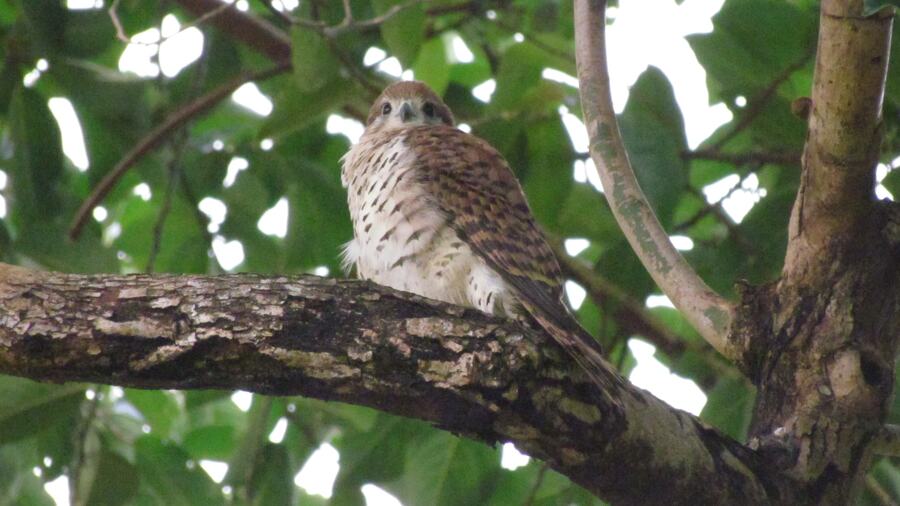
Laughing Owl
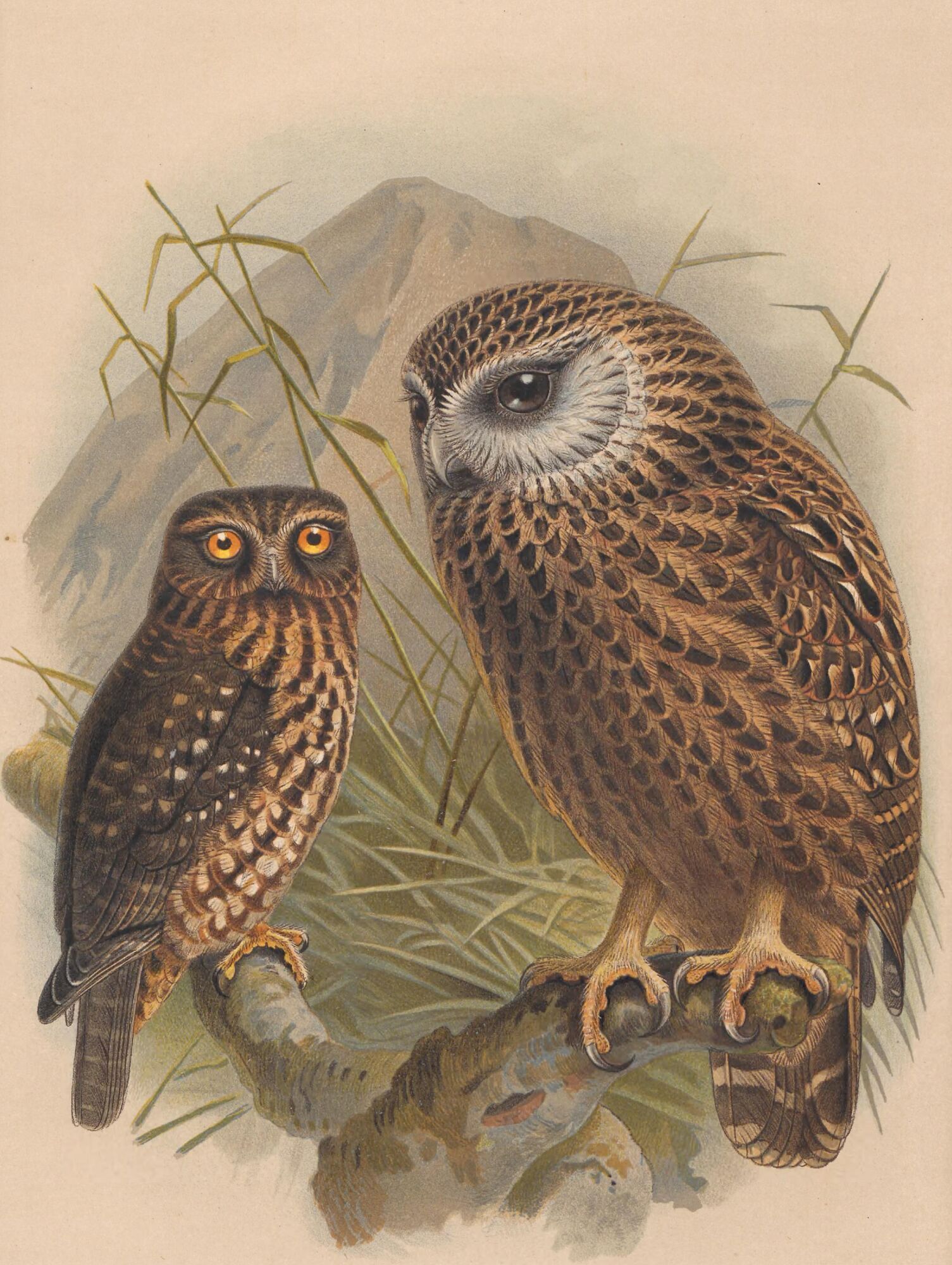
A ground-hunting New Zealand owl named for its shrieking call, last confirmed in 1914.
What it was like
The Laughing Owl, or whēkau, was a large owl found only in New Zealand that hunted and nested on the ground among rocks. It was still common in the South Island in the mid-1800s but declined quickly after stoats, ferrets and weasels were introduced in the 1880s and farmland replaced its habitat. The last confirmed bird was found dead in South Canterbury in 1914.
Appearance
A large, long-legged owl about twice the size of a Morepork: 40–45 cm long and about 600 g. Its legs were feathered to the toes. Wood et al. (2017) describe adaptations in its skeleton to a partly ground-based (terrestrial) way of life.
Plumage & colour
Dark brown above with buff-yellow streaks. Underparts buff to yellowish-brown, streaked with dark or reddish-brown.
Behaviour
Nocturnal. It nested on the ground in caves, rock crevices, on ledges or under boulders, lining the nest with dried grass. Two white eggs (about 47 × 39 mm) were laid in September–October and hatched after about 25 days. The female incubated while the male brought food. Its name comes from its call, which a contemporary naturalist described as “a loud cry made up of a series of dismal shrieks frequently repeated”.
Measurements: New Zealand Birds Online (Michaux 2013, updated 2022); weight is approximate
Did you knowIts regurgitated pellets, left in rock shelters, contain the bones of 43 native bird species. They have become one of the best records of New Zealand’s lost small animals.
Historical range shown at country level (countries of regular occurrence). Historical range.
- Where
- Originally throughout New Zealand. By the time Europeans arrived it was recorded only south of a line from Taranaki to East Cape in the North Island, in parts of the South Island, and on Stewart Island.
- Continents
- Oceania
- Habitat
Open country and forest edges with rocky outcrops, cliffs and boulders. It roosted and nested in caves, rock fissures and on ledges.
- Movement · resident
- A sedentary resident.
What it ate
A generalist predator. Before people arrived it ate small to medium birds, frogs, bats, lizards, young tuatara and large insects. After Polynesian settlement, the introduced Pacific rat (kiore) became an important food (New Zealand Birds Online).
Feeding strategy
Hunted at night, much of it on the ground. Its regurgitated pellets contain the remains of 43 native bird species, three bat species and seven lizard species (Te Papa).
- BirdSmall to medium native birdsAt least 43 species found in pellets.
- ReptileLizards and young tuatara
- AmphibianFrogs
- MammalBatsThree species found in pellets.
- MammalPacific rat (kiore)Important prey after Polynesian settlement.
- InsectLarge insects, including beetles
What hunted it
The animals that preyed on the Laughing Owl, grouped by the life stage they attacked.
EggsWho ate its eggs
- MammalStoats, ferrets and weaselsLikelyIntroduced in the 1880s to control rabbits. New Zealand Birds Online considers them the main cause of its decline.
ChicksWho killed its chicks
- MammalFeral catsLikelyNamed by Te Papa among the most dangerous introduced predators.
AdultsWho killed grown birds
- PeoplePeopleDocumentedCollected for museums, curio collections and zoos (Te Papa).
Natural predators before human arrival are not documented. Because it nested on the ground, it was highly exposed to introduced mammals. The Pacific rat probably did not cause its decline, since the two coexisted for centuries in the South Island (New Zealand Birds Online).
Its place in nature
The Laughing Owl was one of New Zealand’s main nocturnal predators of small birds, lizards, bats and large insects. After people arrived it also hunted the introduced Pacific rat. Its pellets, which piled up at roosts in rock shelters, preserve the bones of many small animals and are now an important record of New Zealand’s past fauna.
- Preys onDocumentedNative small birds, lizards and bats
Pellet remains include 43 native bird species, three bat species and seven lizard species (Te Papa).
- Preys onDocumentedPacific rat (kiore)
An important food after Polynesian settlement (New Zealand Birds Online).
- Preyed on byLikelyStoats, ferrets and weasels
Introduced in the 1880s. The owl’s decline followed their spread.
- Competes withHypothesisedMorepork (Ninox novaeseelandiae)
A smaller relative in the same genus that still lives in New Zealand. Whether the two competed for food is not known.
How it disappeared
- Extinct
- Last confirmed record 1914 (found dead); probably extinct by c. 1940
- Last confirmed record
- Found dead on a road at Blue Cliffs Station, near Timaru, South Canterbury, in 1914 (Te Papa). Later reports are unconfirmed.
- Where
- New Zealand
When Europeans arrived, the Laughing Owl still lived across much of the South Island and in parts of the North Island. In the mid-1800s it was common in places in the South Island.
In the 1880s stoats, ferrets and weasels were released to control rabbits. A large owl that nested on the ground among rocks was easy prey for them. At the same time, open country was turned into sheep farms, and collectors took birds for museums and zoos.
The last confirmed Laughing Owl was found dead on a road at Blue Cliffs Station in South Canterbury in 1914. People continued to report its calls for decades, and photographic evidence suggests birds lived into the 1920s. No report since has been confirmed.
The human role
Human-caused, though BirdLife International describes the exact causes as “obscure”. The most likely causes are introduced mammalian predators, especially mustelids released in the 1880s, and the conversion of its habitat by farming, grazing and burning. Collecting also took some birds.
About the date. The last confirmed bird of the South Island subspecies was found dead in 1914. BirdLife International notes photographic evidence suggesting the species survived until at least the 1920s, with unconfirmed reports until the 1960s. New Zealand Birds Online notes sight and sound reports into the 1930s and considers it probably extinct by 1940. The North Island subspecies was last collected in 1889, with unconfirmed reports until the 1930s.
What was lost
New Zealand lost a distinctive, partly ground-hunting owl and one of its main native nocturnal predators of small vertebrates and large insects. Its effects on prey populations were never measured. Its pellets survive as a valuable fossil record of the small animals of pre-human New Zealand.
Historical population
Never estimated. Described as common in parts of the South Island in the mid-1800s, then declining rapidly.
- Native prey (small birds, lizards, bats, insects)
Losing a native predator might be expected to relieve pressure on its prey. However, many of those prey species were themselves declining because of introduced mammals, so any benefit is unlikely to have been noticeable.
- Pacific rat (kiore)
The owl ate many kiore after Polynesian settlement. Its loss removed one native predator of this rat, but the effect on rat numbers was never measured.
Uncertainty. The owl was never studied in detail while common. Its diet is known mainly from pellets and historical notes, and its population size was never estimated.
Legacy
No effective protection reached the Laughing Owl. Its decline followed the deliberate release of stoats, ferrets and weasels to control rabbits in the 1880s, a lasting warning about introducing predators as “biological control”.
Sources
Conservation status: IUCN Red List (assessed by BirdLife International), assessed 2024. Media credits accompany each image and recording; see Sources & credits.
Taxonomy. Long placed in its own genus, Sceloglaux. Mitochondrial genome analysis by Wood et al. (published online 2016, in print 2017) found it belongs within the boobook genus Ninox, a result supported by Salter et al. (2020). BirdLife International, the IUCN and New Zealand Birds Online now use Ninox albifacies. Two subspecies are tentatively recognised: albifacies (South and Stewart Islands) and rufifacies (North Island). Rufifacies is sometimes merged with albifacies, and the size differences may be clinal.
- BirdLife International (2024). Species factsheet: Laughing Owl Ninox albifacies.
- Michaux, B. (2013, updated 2022). Laughing owl | whēkau. In Miskelly, C.M. (ed.) New Zealand Birds Online.
- Museum of New Zealand Te Papa Tongarewa. Laughing owl (topic page; originally Tai Awatea, 2006).
- Wood, J.R. et al. (2017; online 2016). Phylogenetic relationships and terrestrial adaptations of the extinct laughing owl, Sceloglaux albifacies (Aves: Strigidae). Zoological Journal of the Linnean Society 179: 907–918.