Peregrine Falcon
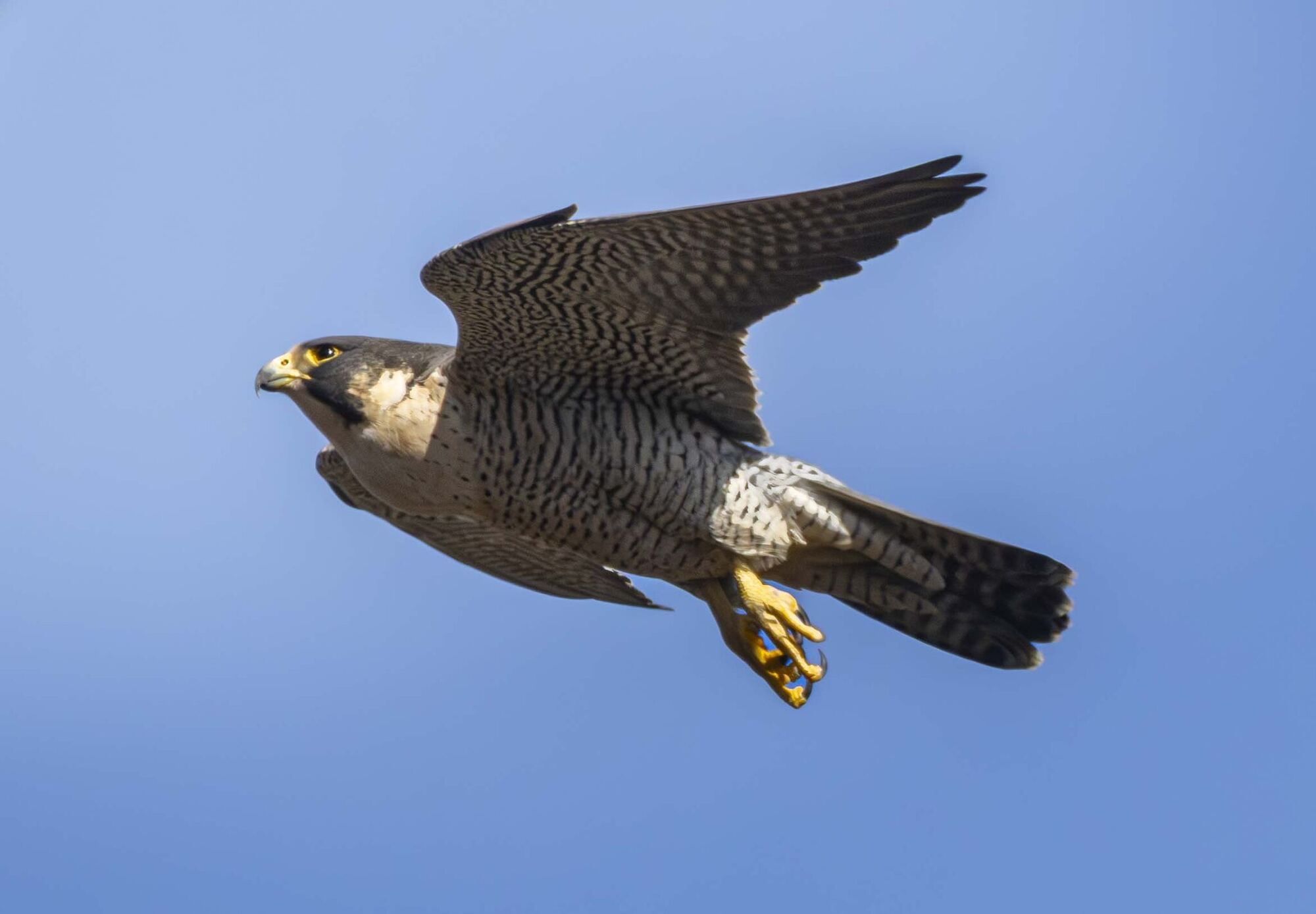
The falcon that DDT nearly erased — and one of conservation’s greatest comeback stories.
Meet the bird
The Peregrine Falcon is a powerful, medium-to-large falcon found on every continent except Antarctica. It hunts other birds — above all pigeons and doves — in fast aerial attacks, often after a steep, high-speed dive (the stoop). In the mid-20th century organochlorine pesticides such as DDT caused eggshell thinning and crashing populations across Europe and North America; bans on these chemicals and large captive-breeding programmes have since allowed a remarkable recovery.
Appearance
A large, compact falcon with long, pointed wings, a relatively short tail and a deep chest. Flight is powerful, with stiff, shallow wingbeats; it often soars and stoops from great heights. Females are distinctly larger and heavier than males, with normally no size overlap between the sexes within a subspecies.
Plumage & colour
Adults have blue-grey upperparts, a blackish hood with a thick dark “moustache” below the eye, and pale underparts finely barred dark. Juveniles are browner above and heavily streaked below. Plumage varies among the many regional subspecies.
Behaviour
No nest is built: eggs are usually laid in a scrape or depression on a rock ledge, or on an equivalent ledge on a building; a now-rare tree-nesting population in central Europe uses tree sites. In Britain, clutches are typically 3–4 eggs, incubation takes about 30–32 days and the young fledge at about 39–40 days.
Measurements: Cornell Lab of Ornithology, All About Birds (size, weight, US longevity); BTO BirdFacts (UK longevity).
Did you knowThe pesticide threat to peregrines was uncovered by weighing old eggs: museum eggshells collected over more than a century revealed a sudden drop in shell weight after DDT came into use.
Shown at continent level — this species is too widespread for a country list. Consult BirdLife International or eBird for detailed range maps. Occurs in more than 200 countries and territories (BirdLife International); the map shades continents.
- Where
- Breeds on every continent except Antarctica, from Arctic tundra to the tropics, and on many islands. Arctic and northern temperate populations are long-distance migrants, wintering as far south as South America, Africa and Indonesia; most other populations are resident.
- Continents
- Europe · Asia · Africa · North America · South America · Oceania
- Habitat
Tolerates an extreme range of habitats — wet and dry, hot and cold — from sea level to around 4,000 m. Needs tall cliffs or equivalent ledges for nesting, with open country nearby for hunting: sea cliffs, mountain crags, river gorges, tundra bluffs, quarries, and tall buildings, bridges and towers in cities.
- Movement · partial
- Highly migratory in Arctic and temperate regions: birds move from North America to South America, Europe to Africa, and northern Asia to southern Asia and Indonesia, readily crossing open sea. Migrants leave breeding sites between August and November and return between March and May. Birds breeding at lower latitudes or in the Southern Hemisphere tend to be resident.
What it eats
Almost entirely birds, principally pigeons and doves; also shorebirds, seabirds and other medium-sized birds.
Feeding strategy
Catches birds in the air, often after a steep, fast stoop from above, taking the prey with its feet. In cities, feral pigeons are a major food.
- BirdPigeons and doves (including feral Rock Pigeons)Principal prey in many regions.
- BirdShorebirds and waterfowlImportant on coasts and estuaries.
- BirdSongbirds and other medium-sized birds
What eats it
The animals that prey on the Peregrine Falcon, grouped by the life stage they attack: its eggs, its chicks, or grown birds.
EggsWho eats its eggs
No predators documented at this stage.
ChicksWho kills its chicks
- BirdGreat Horned OwlDocumentedIn the eastern USA, owl predation was the main cause of the higher mortality of young captive-bred falcons released at cliff sites in 1975–1979 (Barclay 1980).
AdultsWho kills grown birds
No predators documented at this stage.
As an apex aerial predator, the adult peregrine has few natural predators, and predation on adults is not well documented. Young birds — especially recently released or fledged juveniles — are vulnerable to large owls such as the Great Horned Owl in North America. Historically, people (shooting, egg collecting, poisoning) and pesticides were by far the most important causes of mortality.
Its place in nature
The peregrine is a top predator of birds. Beyond the individuals it kills, its presence changes how prey behave: as peregrine numbers recovered on the Pacific coast of North America, Western Sandpipers on migration carried less fat and spent less time at the most dangerous stopover sites (Ydenberg et al. 2004). Its near-extinction from pesticide poisoning also made it a sentinel species — its collapse revealed how persistent chemicals accumulate up food chains.
- Preys onDocumentedPigeons and doves
Pigeons and doves are the principal prey in many populations, including feral pigeons in cities.
- Preys onDocumentedWestern Sandpiper
At stopovers in British Columbia, sandpiper migratory body mass and stopover duration fell steadily after 1985 as peregrine populations recovered — a documented case of predation danger reshaping migration (Ydenberg et al. 2004).
- Preyed on byDocumentedGreat Horned Owl
Kills young peregrines; owl predation complicated early reintroductions in the eastern USA and influenced the choice of release sites.
- Nests in / depends onDocumentedTall buildings, bridges and towers
Peregrines now nest on human structures in many cities, where ledges substitute for cliffs and feral pigeons provide abundant food.
What if it disappeared?
This is not entirely hypothetical: in the 1960s the peregrine vanished as a breeding bird from the eastern United States and much of Europe. Yet few studies documented ecological consequences of its absence, so most effects below are inferred.
Press Remove to see which organisms could be affected, how, and how confident scientists are. 3 possible effects are recorded for this species.
Other bird-hunting raptors — such as sparrowhawks, goshawks, Merlins and Gyrfalcons — take overlapping prey, but none combines the peregrine’s worldwide range, high-speed stooping and use of open air space. Compensation would be partial and regional.
The pesticide era removed peregrines alongside many other changes, so its specific ecological effects were never isolated. Effects on prey populations, as opposed to prey behaviour, remain poorly quantified.
These scenarios summarise published ecology. They are not predictions: ecosystems are complex, other pressures interact, and documented, likely and hypothesised effects are labelled separately.
Conservation
- LCLeast Concern
- NTNear Threatened
- VUVulnerable
- ENEndangered
- CRCritically Endangered
- EWExtinct in the Wild
- EXExtinct
The American Peregrine Falcon was removed from the US Endangered Species List on 25 August 1999 after recovery. Listed on CITES Appendix I and Annex I of the EU Birds Directive; specially protected at the nest in the UK (Schedule 1).
- Population estimate
- 100,000–499,999 mature individuals (preliminary global estimate of 248,000–478,000; data quality poor). USA/Canada: c. 72,000 individuals; Europe: 16,100–31,100 pairs.
- Estimate year: 2021
- Trend
- Increasing
- Source
- BirdLife International factsheet (2021 assessment), citing Partners in Flight (2020) for North America and BirdLife International for Europe. North American low: 324 nesting pairs in 1975; at least 1,650 breeding pairs in the USA and Canada by 1999 (USFWS).
No reliable historical time series is available for this species, so no population chart is shown. We do not interpolate or estimate missing data.
Threats
- Organochlorine pesticides (historical)
Severe population declines in the 1960s–1970s were driven by eggshell breakage and mortality of adults and embryos from pesticide contamination. Ratcliffe (1967) showed that peregrine eggshells in Britain had become markedly lighter from the late 1940s, coinciding with the introduction of DDT.
- Illegal persecution
Persecution was the major threat in the 19th and early 20th centuries and still occurs: in 2014, four peregrines were confirmed poisoned and nine shot, trapped or had nests destroyed in the UK (RSPB).
- Trapping for falconry
In North Africa, illegal trapping and collection of nestlings for falconry is the main threat; elsewhere the population-level effect of falconry harvest is uncertain.
- Collisions and disturbance
Wind turbines, power lines, and windows and vehicles (for urban fledglings) cause deaths; rock climbing and careless fieldwork can disturb nests.
What is being done
The peregrine’s recovery followed restrictions on organochlorine pesticides such as DDT in the 1970s, legal protection, and — in North America and parts of Europe — captive breeding and release. Populations have since recovered strongly across much of the Northern Hemisphere.
- Restrictions on DDT and related organochlorine pesticides from the 1970s.
- Captive rearing and release under US Endangered Species Act recovery plans: nearly 7,000 birds released in North America by 1998.
- American Peregrine Falcon delisted in the USA on 25 August 1999, followed by post-delisting monitoring.
- Restoration of central Europe’s tree-nesting population — once c. 4,000 pairs, then extirpated — through releases in Germany and Poland, which had returned it to c. 20 pairs.
A conservation story
In the 1960s, British naturalist Derek Ratcliffe noticed peregrine eyries with broken eggs. Weighing eggshells in museum collections, he found that shells had become markedly lighter from the late 1940s onward — just after DDT came into widespread use (Ratcliffe 1967). Follow-up work in Britain and North America linked eggshell thinning to organochlorine residues. By 1975 North America held only an estimated 324 nesting pairs, and the species had all but disappeared as a breeding bird from the eastern United States. After DDT was restricted and thousands of captive-bred falcons were released — many on city buildings and bridges — numbers climbed to at least 1,650 pairs in the USA and Canada, and the US Fish and Wildlife Service removed the American Peregrine Falcon from the Endangered Species List in August 1999.
Sources
Conservation status: IUCN Red List (assessed by BirdLife International), assessed 2021. Media credits accompany each image and recording; see Sources & credits.
Taxonomy. BirdLife International (following del Hoyo & Collar 2014) includes the Barbary Falcon (pelegrinoides) of North Africa and the Middle East within Falco peregrinus; some earlier checklists (e.g. Sibley & Monroe 1990) treated it as a separate species.
- BirdLife International (2021 assessment). Species factsheet: Peregrine Falcon Falco peregrinus.
- Cornell Lab of Ornithology. All About Birds: Peregrine Falcon identification.
- British Trust for Ornithology. BirdFacts: Peregrine (ringing longevity, breeding, UK population).
- Ratcliffe, D.A. (1967). Decrease in eggshell weight in certain birds of prey. Nature 215: 208–210.
- U.S. Fish & Wildlife Service (1999). The Peregrine Falcon is back! Babbitt announces removal of world’s fastest bird from the Endangered Species List.
- Ydenberg, R.C., Butler, R.W., Lank, D.B., Smith, B.D. & Ireland, J. (2004). Western sandpipers have altered migration tactics as peregrine falcon populations have recovered. Proceedings of the Royal Society B 271: 1263–1269.
- Barclay, J.H. (1980). Release of captive-produced Peregrine Falcons in the eastern United States, 1975–1979 (thesis abstract, Journal of Raptor Research).