Common Kingfisher
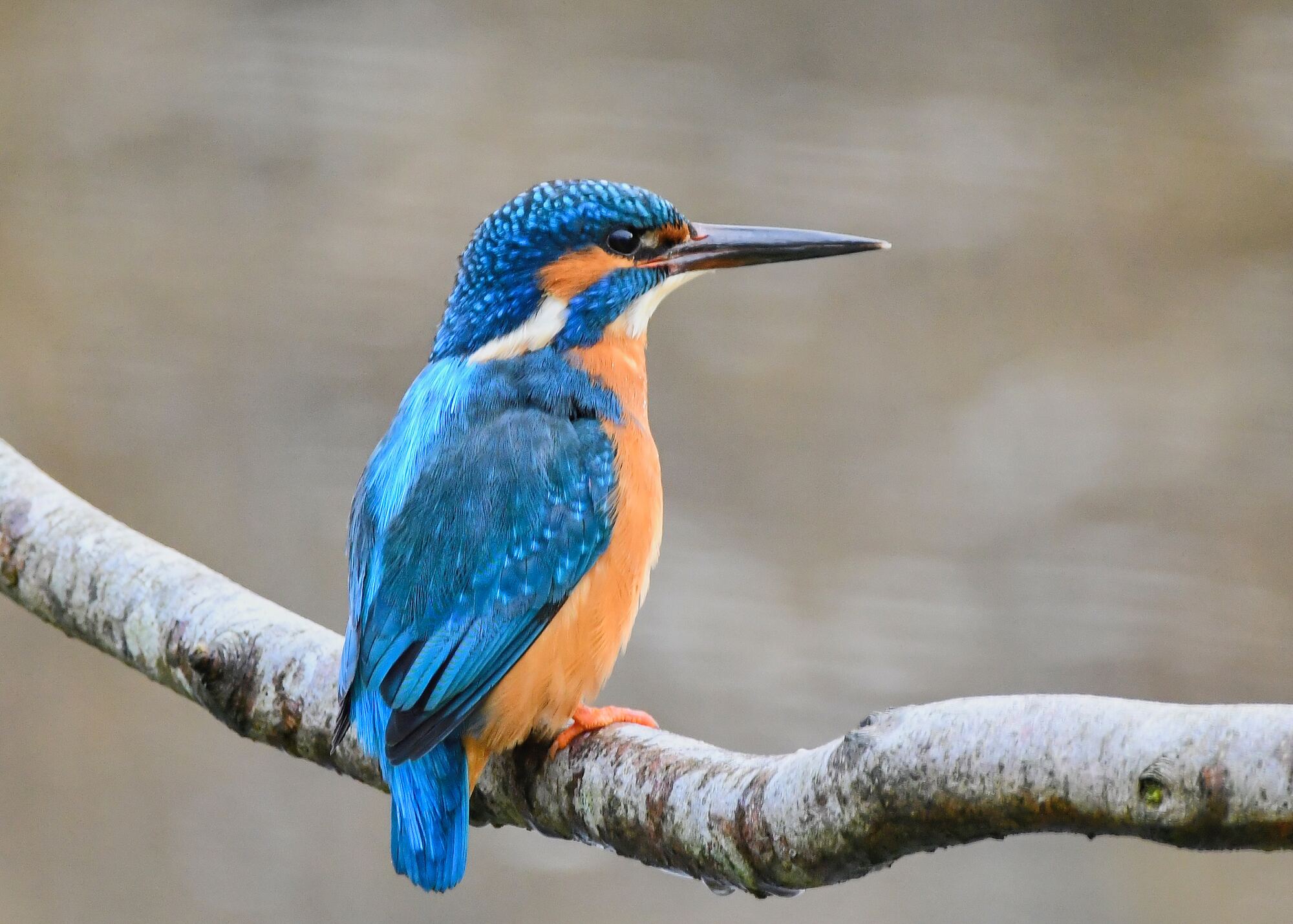
A sparrow-sized flash of blue that dives head-first for fish — and whose blue contains no blue pigment.
Meet the bird
The Common Kingfisher is a small, short-tailed, dagger-billed bird of slow rivers, streams, canals and lakes across Europe, Asia and North Africa, reaching east to New Guinea and the Solomon Islands. It hunts small fish by plunge-diving from a perch and nests at the end of a tunnel it digs into an earth bank. It is still widespread, but numbers are thought to be slowly declining and it is badly hit by hard winters.
Appearance
A compact, big-headed bird with a long, straight, pointed bill, very short tail and short legs. Usually seen perched low over water or as a fast, straight streak of electric blue just above the surface. Often located by its high, shrill whistled call.
Plumage & colour
Head and back azure blue; cheek patch and belly bright orange. The blue is structural — produced by light scattering from microscopic feather structures, not by pigment. Sexes look alike except for the bill: males have an all-black bill, females an orange-pink lower mandible — the easiest way to tell them apart.
Behaviour
Pairs nest at the end of a tunnel dug into a sandy or earthy bank, occasionally in walls, rotten stumps or the burrows of other animals. In Britain clutches are typically 5–7 eggs, incubated by both parents for about 20 days, and the young fledge after about 25 days; pairs raise one or two broods, exceptionally three. Survival is low: BTO estimates annual adult survival at only about 28%, and typical life expectancy at about two years.
Measurements: Length and wingspan: Fry, Fry & Harris (1999), Kingfishers, Bee-eaters and Rollers, as summarised on Wikipedia. Weight (adult range, n = 554) and longevity: BTO BirdFacts.
Did you knowThere is no blue pigment in a kingfisher’s feathers: the dazzling blue is produced by the way microscopic structures in the feathers scatter light.
Shown at continent level — this species is too widespread for a country list. Consult BirdLife International or eBird for detailed range maps. Occurs in around 100 countries and territories (BirdLife International), so the map shades continents rather than individual countries.
- Where
- Breeds across most of Europe and temperate and tropical Asia — from Ireland and Iberia east to Japan, and south through the Indian subcontinent and South-East Asia to Indonesia, New Guinea and the Solomon Islands. Also occurs in North Africa. Birds from areas with freezing winters move south, reaching the Middle East, Arabia and north-east Africa.
- Continents
- Europe · Asia · Africa · Oceania
- Habitat
Prefers still or gently flowing clear water with plenty of small fish and with perches such as overhanging branches, reeds or shrubs. Streams, small rivers, canals and ditches are favoured over open water, but it also uses lakes, ponds and flooded gravel pits. In the breeding season it needs vertical earth banks for nest burrows, sometimes over 250 m from the feeding water. In winter it becomes more coastal, using estuaries, harbours and rocky shores.
- Movement · partial
- Southern populations are largely sedentary. Where rivers freeze in winter, birds regularly move south or to the coast, generally staying within the breeding range, while some eastern populations travel further to non-breeding areas.
What it eats
Mainly small freshwater fish. Also takes aquatic insects, crustaceans such as freshwater shrimps and crayfish, and occasionally amphibians; in winter on the coast it takes marine fish and prawns.
Feeding strategy
Hunts mainly from a low perch over the water, plunging head-first to seize prey in its bill. In Central Europe, diet studies found fish to be the overwhelming majority of prey, with invertebrates, amphibians and reptiles taken only sporadically.
- FishSmall freshwater fishMain prey across the range.
- InsectAquatic insectsSecondary prey.
- InvertebrateFreshwater shrimps, crayfish and prawnsTaken especially in winter.
- AmphibianFrogsOccasional.
What eats it
The animals that prey on the Common Kingfisher, grouped by the life stage they attack: its eggs, its chicks, or grown birds.
EggsWho eats its eggs
No predators documented at this stage.
ChicksWho kills its chicks
No predators documented at this stage.
AdultsWho kills grown birds
- MammalDomestic catLikelyNamed by the RSPB among causes of kingfisher deaths; its population-level impact is not quantified.
Predation on kingfishers is poorly documented. The main recorded causes of death are severe winters (when fish become unreachable under ice), flooding of nest burrows, starvation of young, and collisions with windows and vehicles; the RSPB also lists cats and rats. Burrow nests in vertical banks are probably hard for many predators to reach, but this has not been quantified.
Its place in nature
The kingfisher is a small, specialised fish predator at the top of a short freshwater food chain. Because it needs clear water, healthy populations of small fish and undisturbed earth banks, it is often treated as a visible sign of a river in good condition, though it is only one of many fish-eating predators and its effect on fish numbers has not been shown to be significant.
- Preys onDocumentedSmall freshwater fish
Fish form the bulk of the diet everywhere it has been studied; brood-provisioning studies in Central Europe recorded hundreds of fish delivered to a single brood.
- Feeds onDocumentedAquatic invertebrates
Aquatic insects, freshwater shrimps, crayfish and prawns are taken as secondary prey, especially in winter.
- Nests in / depends onDocumentedSand Martin
Kingfishers usually dig their own burrows, but have been recorded nesting in burrows dug by Sand Martins, as well as in water vole burrows, rotten stumps and walls.
- Nests in / depends onDocumentedEroding river banks
Breeding depends on steep, soft earth banks created by natural erosion. Canalisation and bank reinforcement remove these sites.
- Preyed on byLikelyDomestic cat
Cats kill some kingfishers, but how often is not known.
What if it disappeared?
The kingfisher is widespread and not threatened. As a thought experiment, its loss would remove one small fish predator among many — so most ecological effects would probably be slight and hard to detect.
Press Remove to see which organisms could be affected, how, and how confident scientists are. 3 possible effects are recorded for this species.
Other fish-eating birds and mammals overlap broadly in diet, so the kingfisher’s predatory role would very likely be absorbed by them. No other European bird combines its exact niche — plunge-diving for small fish from low perches along narrow streams — but that niche is not known to be a keystone one.
The kingfisher’s quantitative effect on fish and invertebrate communities has not been measured, so all effects of its disappearance are inferred rather than demonstrated.
These scenarios summarise published ecology. They are not predictions: ecosystems are complex, other pressures interact, and documented, likely and hypothesised effects are labelled separately.
Conservation
- LCLeast Concern
- NTNear Threatened
- VUVulnerable
- ENEndangered
- CRCritically Endangered
- EWExtinct in the Wild
- EXExtinct
Listed on Schedule 1 of the UK Wildlife and Countryside Act, giving extra protection at the nest. Green-listed in the UK Birds of Conservation Concern.
- Population estimate
- c. 716,000–1,760,000 mature individuals (very preliminary global estimate, extrapolated from the European population of 179,000–440,000 mature individuals)
- Estimate year: 2018
- Trend
- Decreasing
- Source
- BirdLife International factsheet (2024 assessment), citing BirdLife International (2021) European Red List of Birds. UK: c. 3,850 pairs in 2016 (APEP4, via BTO).
No reliable historical time series is available for this species, so no population chart is shown. We do not interpolate or estimate missing data.
Threats
- Hard winters
Freezing conditions cut birds off from their prey. The severe winters of 1961–62 and 1962–63 almost wiped the species out in parts of Europe, and northern populations remain most vulnerable.
- River pollution
Long-term declines are attributed to chemical and biological pollution of rivers, mainly from industrial waste and agricultural run-off, which reduces fish stocks and water clarity.
- Canalisation and bank management
Straightening streams, reinforcing banks and clearing bankside vegetation removes nest banks and perches and reduces fish numbers.
- Persecution and trade
Locally persecuted to protect fish stocks, and reported in wild-bird trade datasets (Donald et al. 2024, cited by BirdLife).
What is being done
No species-specific global action is needed, but kingfishers benefit from river restoration: improving water quality and retaining natural eroding banks, bankside vegetation and healthy stocks of small fish.
- Specially protected at the nest in the UK under Schedule 1 of the Wildlife and Countryside Act.
- Monitored by breeding bird surveys in the UK and across Europe (Pan-European Common Bird Monitoring Scheme).
- Water-quality improvement and river restoration, which benefit fish stocks and natural bank habitats.
Sources
Conservation status: IUCN Red List (assessed by BirdLife International), assessed 2024. Media credits accompany each image and recording; see Sources & credits.
- BirdLife International (2024 assessment). Species factsheet: Common Kingfisher Alcedo atthis.
- British Trust for Ornithology. BirdFacts: Kingfisher (biometrics, ringing longevity, breeding, UK population).
- RSPB. Kingfisher: bird facts (identification, structural colour, threats).
- Čech, M. & Čech, P. (2015). Non-fish prey in the diet of an exclusive fish-eater: the Common Kingfisher Alcedo atthis. Bird Study 62: 457–465.
- Čech, M. & Čech, P. (2017). Effect of brood size on food provisioning rate in Common Kingfisher Alcedo atthis. Ardea 105: 5–17.
- Wikipedia. Common kingfisher (summary of measurements from Fry, Fry & Harris 1999).