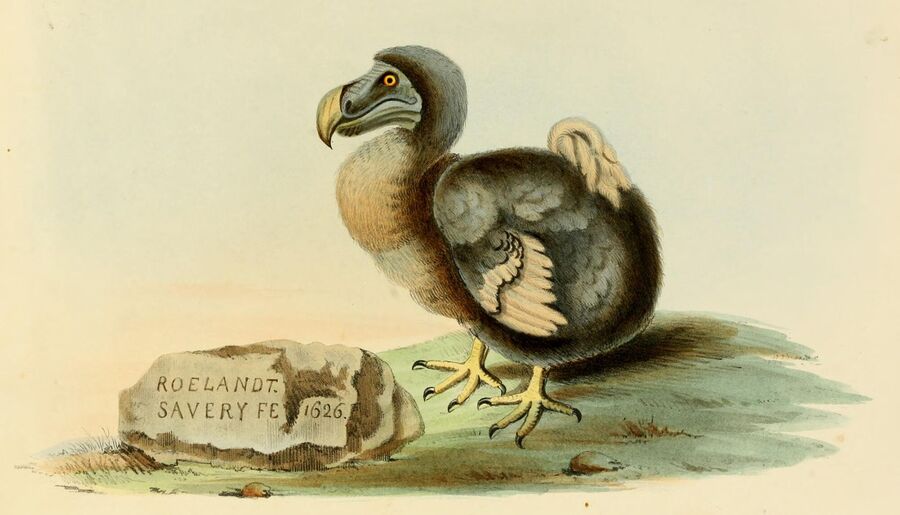
Common Ostrich
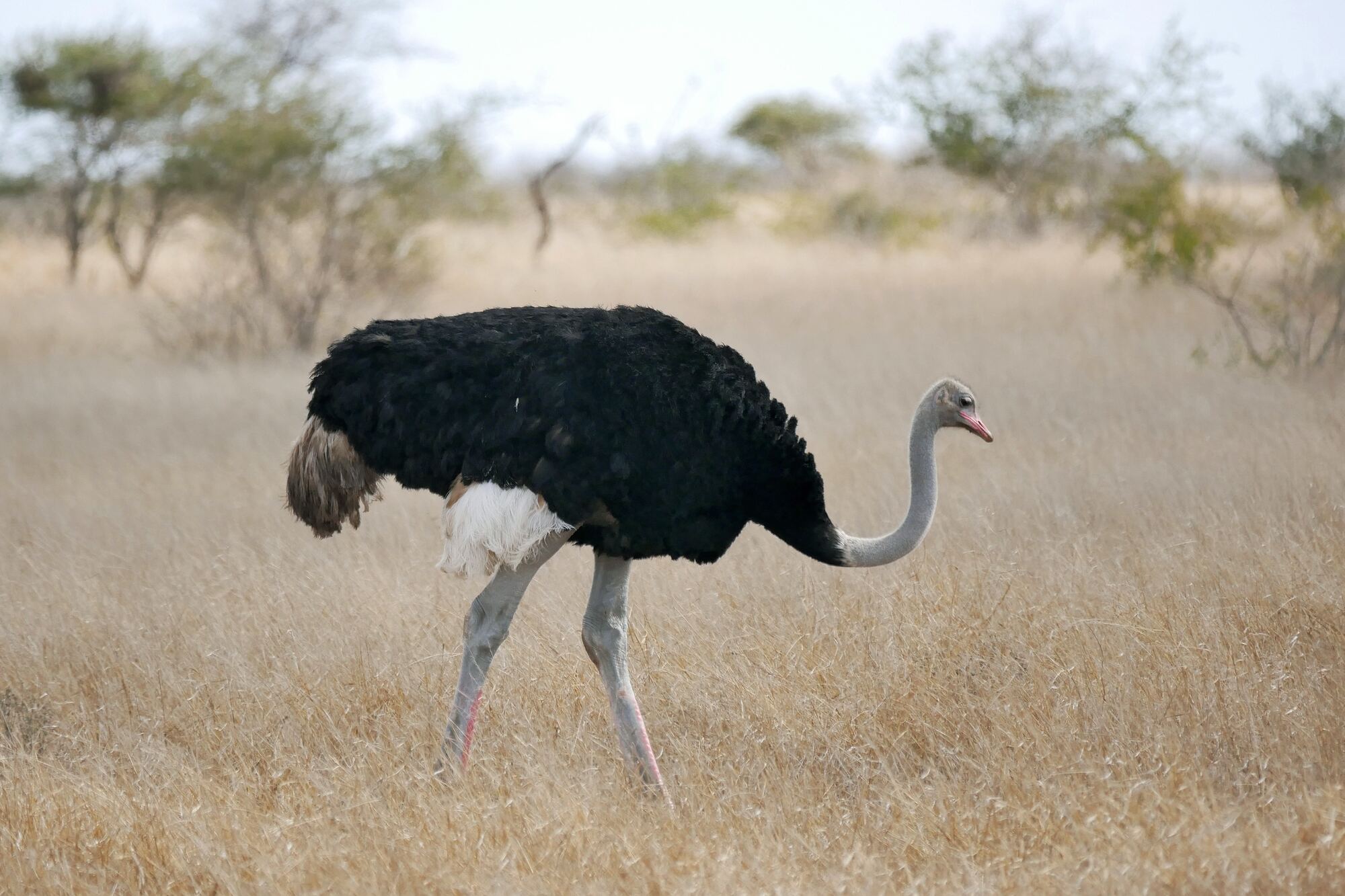
The world’s largest living bird — flightless, fast, and laying eggs that weigh about 1.4 kg.
Meet the bird
The Common Ostrich is the largest living bird: a flightless giant of African savannas and semi-deserts that relies on long, powerful legs to outrun predators. It feeds mainly on plants, nests communally, and once ranged into Arabia and across North Africa. Today it is widespread in East and southern Africa and the Sahel, but hunting, the plume trade and habitat loss have eliminated it from many northern areas.
Appearance
Unmistakable: a huge, long-necked, long-legged flightless bird with a small head, large eyes and only two toes on each foot. Males stand about 2.1–2.75 m tall.
Plumage & colour
Adult males have black body plumage with white wing and tail plumes; females and young are greyish-brown. The neck and legs are largely bare.
Behaviour
Ostriches nest communally. A male holds a territory and a harem of two to seven hens; the dominant (major) female lays first, and other females add their eggs to the same nest. Usually around 20 eggs are incubated, by females during the day and by the male at night, for about 35–45 days. Ostriches can sustain about 55 km/h for long periods and reach about 70 km/h in short bursts.
Measurements: Height (males 2.1–2.75 m) and weight (males 100–130 kg) as summarised on Wikipedia from standard references; body length and wingspan are not meaningful field measurements for this flightless bird. Females are smaller. No reliable wild longevity figure was found.
Did you knowAn ostrich egg averages about 15 cm long, 13 cm wide and around 1.4 kg in weight — and its shell is tough enough that Egyptian Vultures use stones to break it.
Range shown at country level (countries of regular occurrence). Native, extant countries per BirdLife International. Extinct in Libya. Introduced populations in Australia and Eswatini are not shown, nor are farmed birds worldwide.
- Where
- Sahel and southern Sahara from Mauritania and Senegal east to Sudan, Eritrea and Ethiopia; East Africa (Kenya, Uganda, Tanzania); and southern Africa from Angola and Zambia to South Africa. Formerly also in North Africa and Arabia.
- Continents
- Africa
- Habitat
Open, arid and semi-arid country: short-grass plains, savanna, semi-desert and dry scrub. Recorded up to about 3,000 m.
- Movement · resident
- Not migratory (BirdLife International).
What it eats
Mainly plants: seeds, shrubs, grasses, fruit and flowers.
Feeding strategy
Feeds on a wide range of plant material. Also swallows sand and pebbles, which help grind food in the gizzard.
- PlantGrasses and shrubs
- PlantSeeds, fruit and flowers
- OtherSand and pebbles (gastroliths)Swallowed to grind food in the gizzard.
What eats it
The animals that prey on the Common Ostrich, grouped by the life stage they attack: its eggs, its chicks, or grown birds.
EggsWho eats its eggs
- BirdEgyptian VultureDocumentedBreaks ostrich eggs by throwing stones at them — one of the first documented cases of tool use by a bird (van Lawick-Goodall & van Lawick 1966).
- MammalJackalsDocumentedRecorded nest predators (Bertram 1992).
ChicksWho kills its chicks
- MammalJackalsDocumentedTake young ostriches as well as eggs.
AdultsWho kills grown birds
- MammalLionLikelyListed among predators of ostriches of all ages.
- MammalCheetahLikelyListed among predators of ostriches of all ages.
- MammalLeopardLikelyListed among predators of ostriches of all ages.
Eggs and chicks suffer heavy predation; adults rely on speed and powerful kicks, which can kill or injure attackers. The large cats are reported as predators in general reference works, but quantitative studies of predation on adult ostriches are few.
Its place in nature
As a large plant-eater, the ostrich is part of the grazing community of African savannas and semi-deserts, and its eggs and chicks are eaten by jackals, vultures and other predators. Its huge eggs support one of the most famous examples of animal tool use: Egyptian Vultures hurling stones to crack them. Its wider ecological effects — for example on plants or seed dispersal — have been little studied.
- Preyed on byDocumentedEgyptian Vulture
Egyptian Vultures throw stones at ostrich eggs to crack the thick shells. Jane Goodall and Hugo van Lawick described the behaviour in Tanzania in 1966; later experiments suggested the behaviour is largely innate.
- Feeds onDocumentedGrasses, shrubs and forbs
The bulk of the diet is plant material, including seeds, leaves, fruit and flowers.
- Preyed on byDocumentedJackals
Jackals are among the main predators of ostrich nests and young.
- Preyed on byLikelyLarge cats (lion, cheetah, leopard)
Reported to prey on ostriches of all ages; frequency not quantified.
What if it disappeared?
The ostrich has already disappeared from Arabia, Libya and much of North Africa. No studies appear to have measured the ecological consequences, so effects are inferred.
Press Remove to see which organisms could be affected, how, and how confident scientists are. 3 possible effects are recorded for this species.
Mammalian grazers and browsers overlap in diet and would probably absorb the ostrich’s role as a plant-eater; nothing would replace its eggs as a food source.
The ostrich’s ecological role is poorly studied. Whether its loss from North Africa and Arabia changed vegetation or other species is unknown.
These scenarios summarise published ecology. They are not predictions: ecosystems are complex, other pressures interact, and documented, likely and hypothesised effects are labelled separately.
Conservation
- LCLeast Concern
- NTNear Threatened
- VUVulnerable
- ENEndangered
- CRCritically Endangered
- EWExtinct in the Wild
- EXExtinct
Although the species as a whole is Least Concern, it is extinct in Libya and the Arabian subspecies has been lost; North African populations have disappeared from much of their former range.
- Population estimate
- c. 300,000–900,000 birds (estimated from densities of 0.05–0.2 birds/km² over c. 6,000,000 km² of suitable habitat)
- Estimate year: 2025
- Trend
- Decreasing
- Source
- BirdLife International factsheet (2025 assessment), based on densities from Brown et al. (1982), Okello et al. (2016) and Griffin et al. (2021), and habitat area from Jung et al. (2020).
No reliable historical time series is available for this species, so no population chart is shown. We do not interpolate or estimate missing data.
Threats
- Habitat loss
Now the main threat according to BirdLife, as rangelands are converted and degraded.
- Hunting and the plume trade (historical and ongoing)
Ostriches were heavily hunted, and their plumes traded. The Arabian subspecies was hunted to extinction by the mid-20th century, and the species has been lost from much of North Africa.
What is being done
No species-wide conservation programme is listed by BirdLife. The main need is to protect remaining rangeland populations, especially in the Sahel and North Africa where numbers have collapsed. Attempts to reintroduce ostriches to Israel after the Arabian subspecies was lost did not succeed.
- Occurs in many protected areas in eastern and southern Africa.
Sources
Conservation status: IUCN Red List (assessed by BirdLife International), assessed 2025. Media credits accompany each image and recording; see Sources & credits.
Taxonomy. The Somali Ostrich (Struthio molybdophanes) of the Horn of Africa was formerly included in this species but has been recognised as a separate species by BirdLife International (and therefore the IUCN Red List) since 2014 (del Hoyo & Collar 2014). Four subspecies of the Common Ostrich are usually recognised, including the Arabian Ostrich (S. c. syriacus), which is extinct.
- BirdLife International (2025 assessment). Species factsheet: Common Ostrich Struthio camelus.
- van Lawick-Goodall, J. & van Lawick, H. (1966). Use of tools by the Egyptian vulture, Neophron percnopterus. Nature 212: 1468–1469.
- Bertram, B.C.R. (1992). The Ostrich Communal Nesting System. Princeton University Press (via Wikipedia summary).
- Guinness World Records. First known tool-using bird (Egyptian vulture and ostrich eggs).