Dodo
The flightless pigeon of Mauritius that became the world’s best-known symbol of extinction.
What it was like
The Dodo was a large, flightless pigeon found only on Mauritius in the Indian Ocean. Within decades of regular Dutch visits and settlement in the 17th century it had vanished, killed by sailors and settlers and by the animals they brought. It is known today from bones, a few specimen fragments, travellers’ accounts and paintings.
Appearance
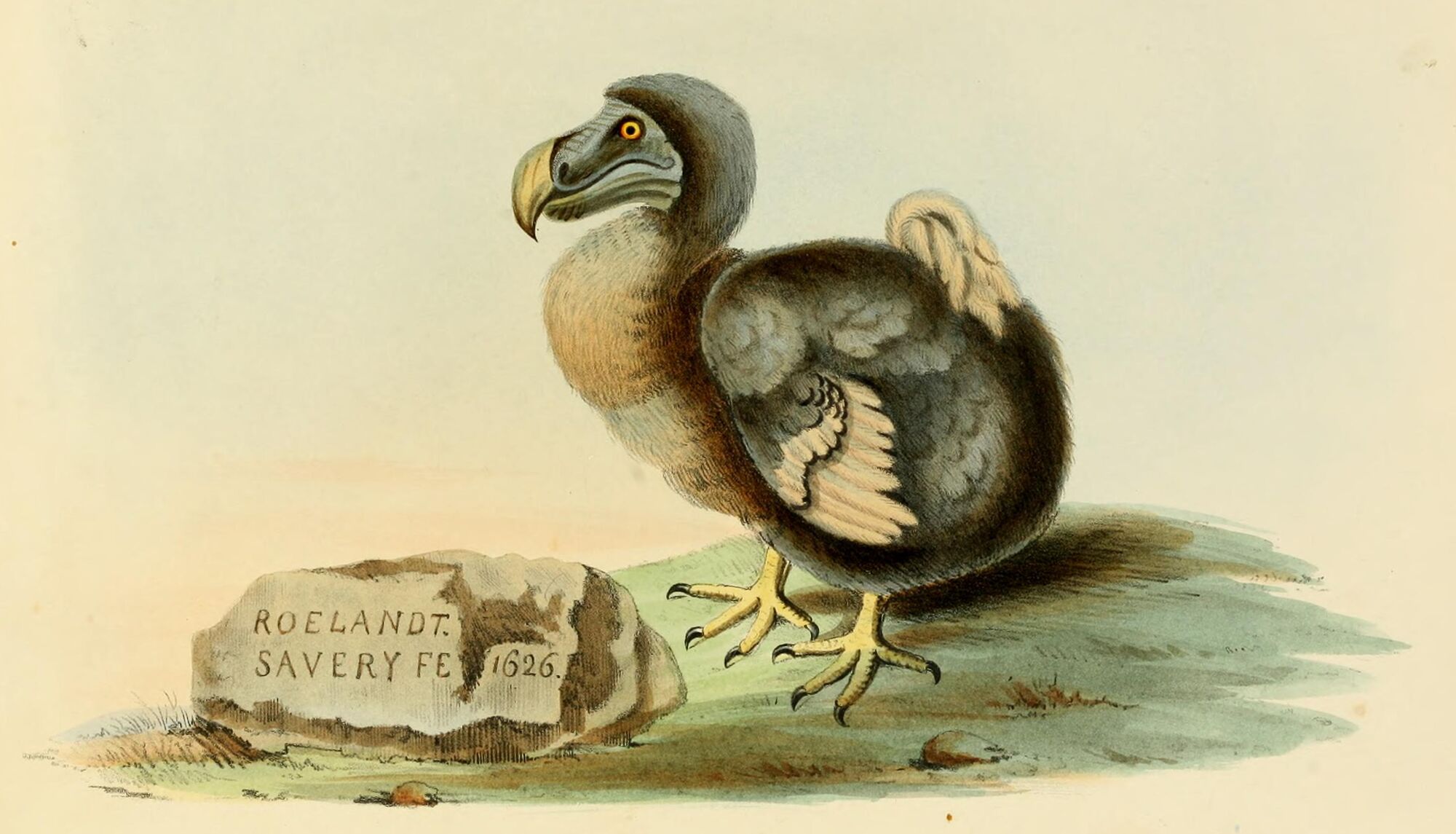
A bulky, flightless bird with a large, hooked bill, small wings and stout legs. The Natural History Museum, London estimates it stood about 70 cm tall and probably weighed around 12 kg. Older reconstructions showed a much fatter bird; its weight is now thought to have varied with the seasons and with breeding.
Plumage & colour
No complete skin survives, and contemporary paintings and descriptions differ from one another, so its true colours are uncertain. Accounts generally describe a greyish or brownish bird with a tuft of curled tail feathers.
Behaviour
Flightless and famously tame, which made it easy to catch. Little about its breeding or social life was recorded reliably. Some live birds were shipped off the island: one was reportedly on show in London in 1638, and others were reported from a menagerie in India.
Measurements: Natural History Museum, London (estimates: height c. 70 cm, weight c. 12 kg; weight probably varied seasonally)
Did you knowThe “dodo tree” story, which claimed a tree could not germinate without the Dodo, became a textbook favourite even though the seeds were already known to germinate on their own.
Historical range shown at country level (countries of regular occurrence). Historical range. The last accepted sighting (1662) came from a small islet off the Mauritian coast.
- Where
- Endemic to Mauritius, Mascarene Islands, western Indian Ocean.
- Continents
- Africa
- Habitat
BirdLife International describes it as mainly a bird of the dry lowland forests, which included tambalacoque (Sideroxylon grandiflorum), screwpines (Pandanus) and other endemic plants. The Natural History Museum notes records from the coast and offshore islets as well as lowland and upland forest.
- Movement · resident
- A flightless island resident.
What it ate
Probably mainly plant food. BirdLife International (citing Hume 2017) suggests it ate hard seeds, fallen fruits and land snails, and possibly marine invertebrates.
Feeding strategy
Foraged on the ground. A large gizzard stone found with remains suggests it ground up tough fruits and seeds, as many pigeons do with grit.
- PlantFallen fruitsInferred from gizzard stones and contemporary accounts.
- PlantHard seeds
- InvertebrateLand snailsSuggested by Hume (2017).
- InvertebrateMarine invertebratesPossible only.
What hunted it
The animals that preyed on the Dodo, grouped by the life stage they attacked.
EggsWho ate its eggs
- MammalIntroduced pigsLikelyBrought by sailors and settlers. Thought to have eaten eggs and competed for food.
- MammalBlack rat (Rattus rattus)LikelyIntroduced. BirdLife lists it as contributing through egg predation.
- MammalIntroduced monkeysHypothesisedBirdLife International says monkeys “possibly” contributed.
ChicksWho killed its chicks
- MammalIntroduced dogs, cats and pigsLikelyThe Natural History Museum lists dogs, cats, pigs and rats among the animals that killed dodos and probably ate their eggs.
AdultsWho killed grown birds
- PeoplePeopleDocumentedHunted for food by visiting sailors and settlers.
There is no record of any native predator of adult dodos. All the predators listed here were brought to Mauritius by people.
Its place in nature
As the largest land bird on Mauritius and a probable eater of fallen fruit and seeds, the Dodo may well have swallowed and moved seeds, but this has never been measured. Its best-known supposed role, as the only bird able to germinate the seeds of the “dodo tree”, turned out to be a cautionary tale. The famous claim was weak, and other fruit-eaters such as giant tortoises, parrots and a giant skink were probably also involved.
- Disperses seeds ofHypothesisedTambalacoque or “dodo tree” (Sideroxylon grandiflorum)
In 1977 Stanley Temple argued that the tree’s seeds could only germinate after passing through a dodo’s gut, and that the tree was dying out as a result. Later work found that the seeds germinate without passing through any animal, and that the tree’s decline had other causes. See “What was lost?” below.
- Commensal withDocumentedRed rail (Aphanapteryx bonasia)
Not an ecological partner, but a historical one. After the Dodo disappeared, sailors appear to have used the name “dodo” for this flightless Mauritian rail, which has confused efforts to date the Dodo’s extinction.
How it disappeared
- Extinct
- Last accepted sighting 1662; extinct by c. 1693 at the latest
- Last confirmed record
- 1662: birds reported on an offshore islet by the shipwrecked sailor Volkert Evertsz (spelled Iversen by BirdLife, citing Cheke 1987). Later “dodo” reports up to 1688 are disputed and may refer to the Red Rail.
- Where
- Mauritius, Indian Ocean
Once Dutch ships began calling at Mauritius, and a small Dutch settlement was established, sailors’ journals described catching dodos for food. They also describe a bird that was easy to approach and could not fly.
The damage did not come from hunting alone. Rats, pigs, goats and other animals spread through the forests, and a ground-nesting bird laying on an island without predators had no defence against them. Within a lifetime the Dodo had become rare.
The last sighting that is broadly accepted dates from 1662, when shipwrecked sailors found birds on a small islet off the coast. Later Dutch records mention “dodos” until the late 1680s, but by then the name may have been applied to the Red Rail. Statistical estimates place the true end between about 1662 and 1693.
The Dodo’s disappearance went largely unnoticed at the time. Only in the 19th century, when its bones were studied scientifically, did it become the best-known example of a species wiped out by people.
The human role
Entirely human-caused. People hunted dodos directly and brought rats, pigs, goats, dogs, cats and probably monkeys to an island that had no native ground predators.
About the date. The last sighting accepted by BirdLife International and the IUCN is from 1662, on an islet off Mauritius. Roberts & Solow (2003) used a statistical model of the sighting record and estimated that the species actually died out around 1690. Hume, Martill & Dewdney (2004) added Dutch hunting records from 1685–1688 that mention “dodos” and calculated a date about three years later still. Cheke (2006) and BirdLife argue that after the Dodo had gone the name was transferred to the Red Rail, so these later “dodos” were probably rails. BirdLife sums up: extinct sometime between 1662 and 1693.
What was lost
Mauritius lost its largest land bird and a probable ground-feeding fruit and seed eater. How much native plants depended on it is unknown. The idea that the tambalacoque tree could not reproduce without the Dodo is now considered unsupported, and the case is often taught as a warning against over-confident ecological stories.
Historical population
Nothing reliable is known about how many dodos lived on Mauritius. Contemporary accounts describe them as easy to find in the early 17th century and rare later on.
- Tambalacoque (Sideroxylon grandiflorum)
Temple (1977) claimed that only a few old trees survived and that their seeds needed a dodo’s gizzard to germinate. Hershey (2004) summarised the problems. Germination without abrasion had been reported in the 1940s; Temple’s turkey-feeding test had no control seeds (three of the ten seeds that survived germinated); and several hundred trees, some younger than 300 years, are known. The tree’s decline is linked to forest clearance, invasive plants and animals, and fungal disease. Temple’s claim of near-coextinction is not supported.
- Large-fruited native plants
If dodos regularly swallowed fallen fruit, their loss may have reduced seed movement for some native plants. Giant tortoises, parrots and other fruit-eaters, now also extinct on Mauritius, probably shared this role. The Dodo’s own contribution cannot be measured.
Uncertainty. Almost nothing about the Dodo’s ecology was recorded while it lived. Fossil sites such as the Mare aux Songes marsh, discovered in 1865, show what its environment was like but cannot show which plants depended on it.
Legacy
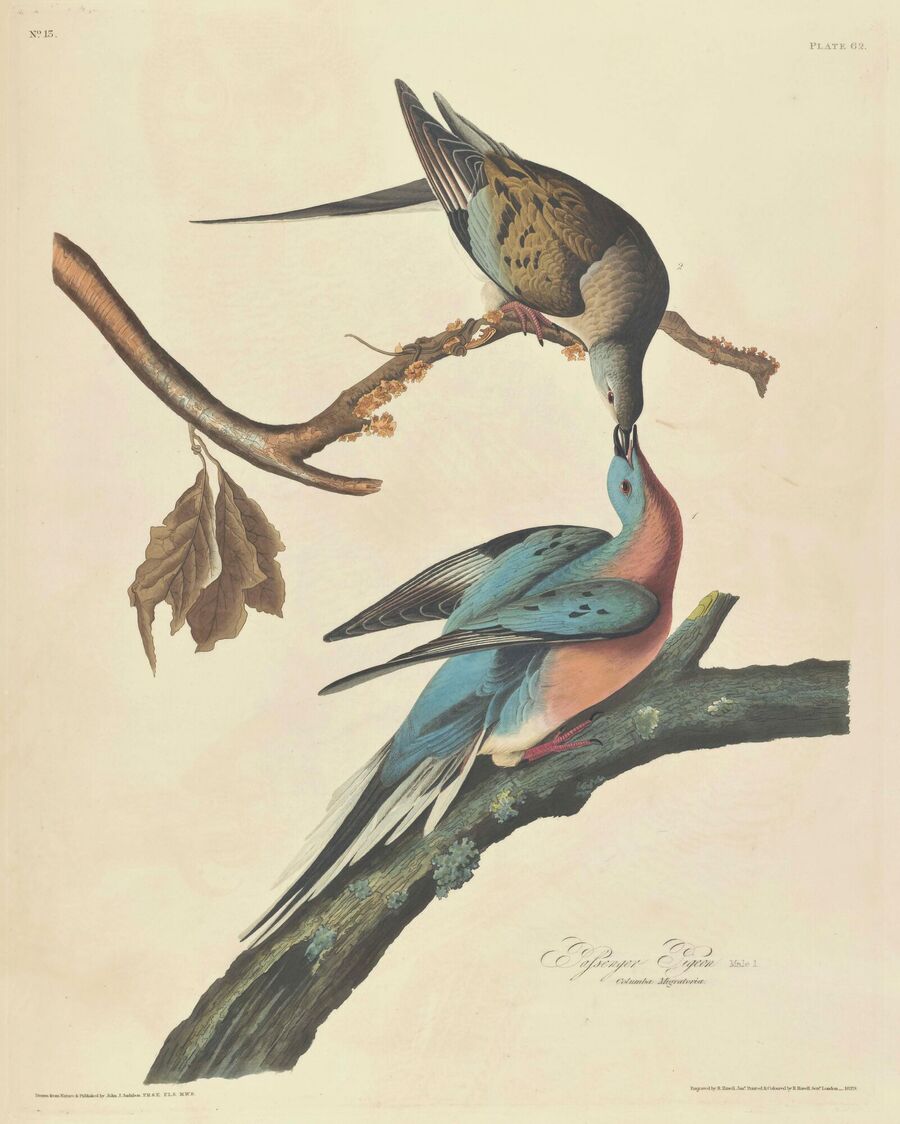
No conservation action was taken while the Dodo survived. Its extinction was not widely recognised until much later, and the bird has since become the global symbol of human-caused extinction. Mauritius now runs intensive programmes for its surviving endemic birds, such as the Pink Pigeon, which have been bred in captivity and released into native forest.
Sources
Conservation status: IUCN Red List (assessed by BirdLife International), assessed 2024. Media credits accompany each image and recording; see Sources & credits.
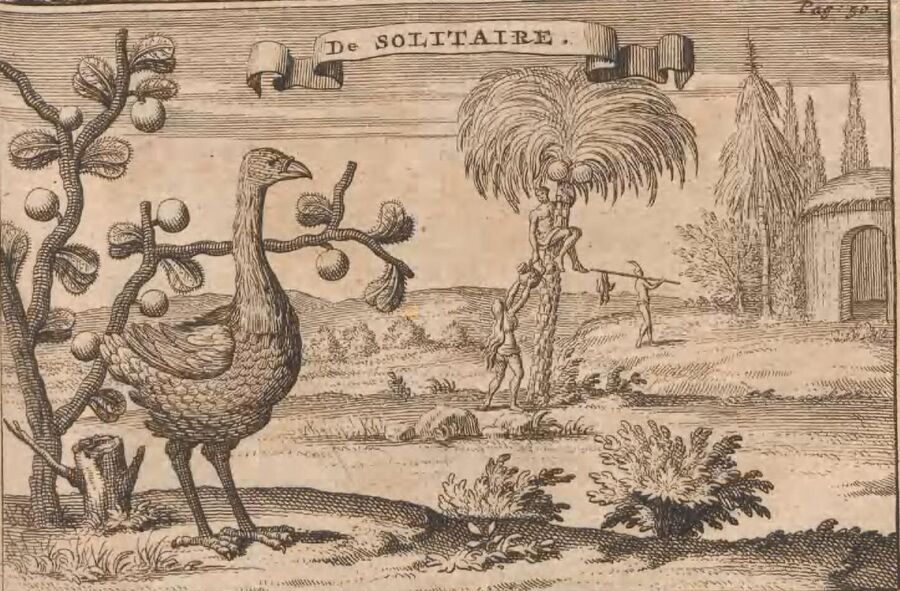
Taxonomy. A giant, flightless member of the pigeon family. Its closest known relative was the Rodrigues Solitaire (Pezophaps solitaria), another extinct flightless pigeon of the Mascarene Islands.
- BirdLife International (2024). Species factsheet: Dodo Raphus cucullatus.
- Natural History Museum, London. The dodo bird: the real facts about this icon of extinction.
- Roberts, D.L. & Solow, A.R. (2003). When did the dodo become extinct? Nature 426: 245.
- Hume, J.P., Martill, D.M. & Dewdney, C. (2004). Dutch diaries and the demise of the dodo. Nature 429.
- Hershey, D.R. (2004). The widespread misconception that the tambalacoque or calvaria tree absolutely required the dodo bird for its seeds to germinate. Plant Science Bulletin 50(4): 105–108.