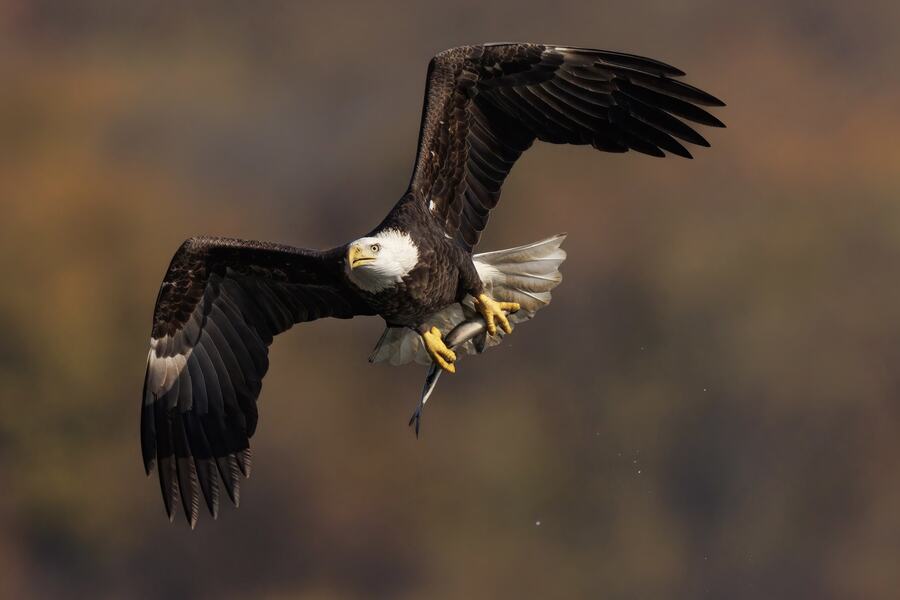
Atlantic Puffin
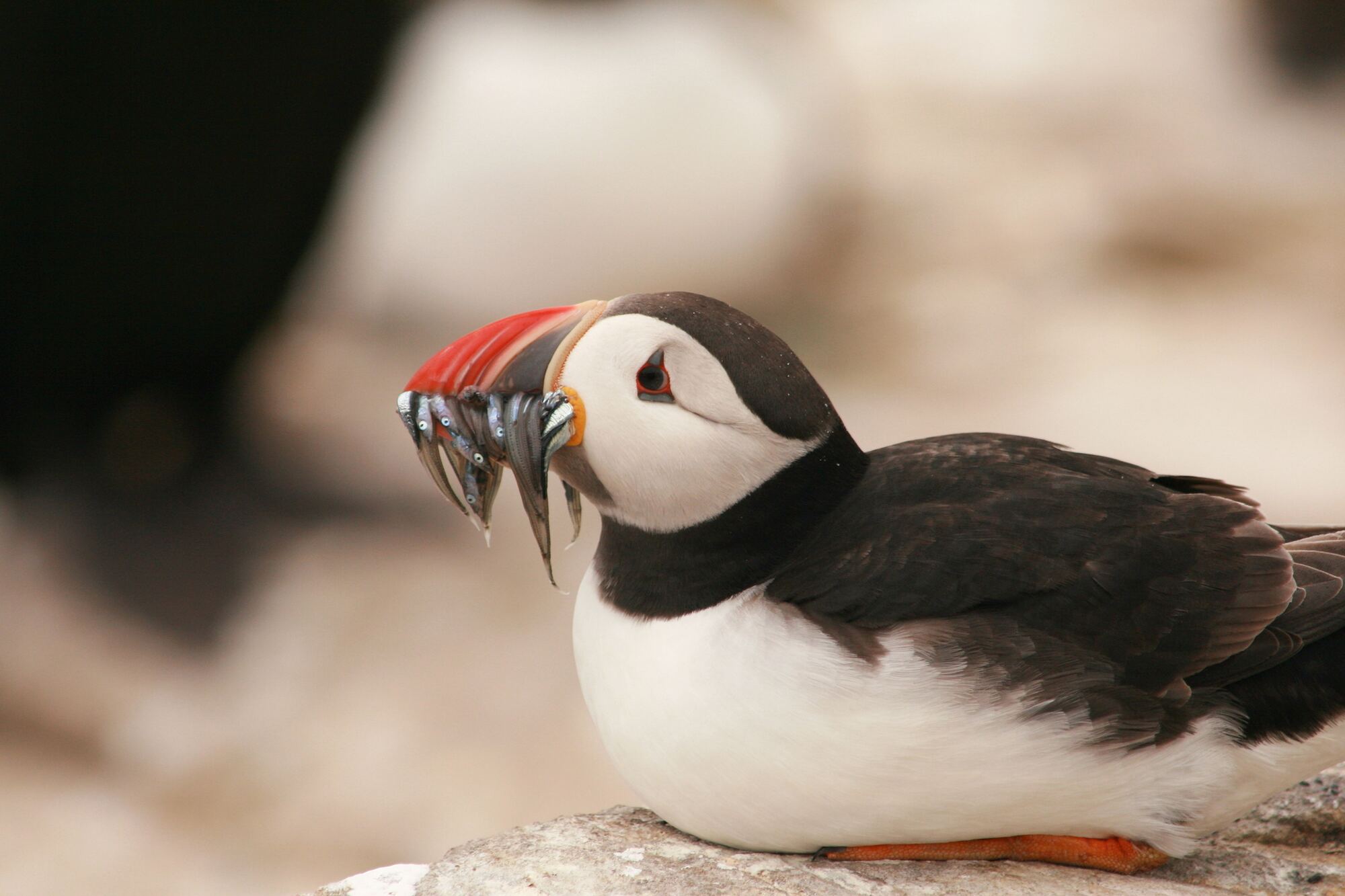
A burrow-nesting seabird whose fortunes rise and fall with the small fish of the North Atlantic.
Meet the bird
A small, stocky auk of the North Atlantic, famous for its brightly coloured summer bill. Puffins nest in burrows on islands and grassy cliff-tops and feed their single chick on small schooling fish such as sandeels, capelin and herring. Food shortages linked to warming seas and fisheries, invasive predators such as rats and mink, hunting and oil spills have driven steep declines at many European colonies.
Appearance
A compact, upright seabird with a large head, short wings that whirr rapidly in flight, and a deep, laterally flattened bill. It swims and dives well, using its wings to “fly” underwater, and stands on bright orange legs.
Plumage & colour
Black upperparts and collar, white underparts and pale grey to whitish cheeks. In the breeding season the bill is banded red, yellow and blue-grey, and there are small fleshy ornaments around the eye. In winter the face becomes greyer and the colourful outer bill plates are shed, leaving a smaller, duller bill. Juveniles have a much smaller, dark bill. Sexes look alike.
Behaviour
Puffins are colonial and usually return to the same burrow and partner each year. The single egg is incubated by both parents for 36–45 days, and the chick is fed on small fish carried crosswise in the bill. About 38–44 days after hatching the chick leaves the burrow, usually at night, and flies straight out to sea alone. Breeding adults generally forage within about 10 km of the colony, though they can travel 50–100 km or more.
Measurements: National Audubon Society, Guide to North American Birds
Did you knowPuffin chicks leave their burrows alone, usually at night, and fly straight out to sea — their parents do not go with them.
Range shown at country level (countries of regular occurrence). Includes breeding and regular non-breeding countries listed by BirdLife; vagrant records are not shown.
- Where
- Breeds around the North Atlantic, from north-west Russia, Norway (including Svalbard), Iceland, the Faroes, Britain, Ireland and north-west France to Greenland, eastern Canada and Maine. In winter it disperses offshore across the North Atlantic, south to the Bay of Biscay, the western Mediterranean and north-west Africa.
- Continents
- Europe · North America · Africa
- Habitat
Exclusively marine. It nests on offshore islands, grassy maritime slopes and cliff-tops, digging burrows in soft soil or using crevices among rocks. Outside the breeding season it lives far offshore in the open ocean.
- Movement · migratory
- Leaves the colonies after breeding and spends autumn and winter at sea, dispersing widely across the North Atlantic; some birds reach the Mediterranean and the coasts of north-west Africa.
What it eats
Small schooling fish — especially sandeels, capelin, herring and sprat — plus juvenile cod-family fish, planktonic crustaceans and marine worms.
Feeding strategy
A pursuit diver that catches most prey within 30 m of the surface but can dive to about 60 m. In the southern and eastern parts of the range sandeels usually make up most of the chicks’ food, whereas in Norway’s Lofoten islands young herring are often the commonest chick food. The winter diet is poorly known.
- FishSandeels (Ammodytes spp.)Main chick food in much of Britain and the southern range.
- FishCapelinImportant in Newfoundland and other northern colonies.
- FishYoung herring and spratHerring dominates chick diet in Lofoten, Norway.
- FishJuvenile gadids (cod family)
- InvertebratePlanktonic crustaceans and polychaete worms
What eats it
The animals that prey on the Atlantic Puffin, grouped by the life stage they attack: its eggs, its chicks, or grown birds.
EggsWho eats its eggs
- MammalRats (Rattus spp.)DocumentedIntroduced; linked to colony declines and local extinctions (e.g. Lundy, Shiant Islands, Faroes).
- MammalAmerican minkDocumentedIntroduced in Iceland and Norway; takes puffins from burrows.
ChicksWho kills its chicks
- MammalRats (Rattus spp.)DocumentedIntroduced.
- MammalAmerican minkDocumentedCausing low chick survival at Hornøya, Norway.
- BirdGreat Black-backed GullDocumentedTakes chicks in burrow areas (Newfoundland).
AdultsWho kills grown birds
- BirdGreat Black-backed GullDocumentedDirect predation added substantially to adult mortality on Burhou, Channel Islands.
- BirdGreat SkuaLikelyA major predator of seabirds at some colonies; puffin-specific rates were not verified for this profile.
Native gulls and skuas are natural predators, and Herring and Lesser Black-backed Gulls also steal fish from adults returning to the colony. Introduced mammals — rats and American mink — have had the most damaging effects, wiping out or reducing colonies; puffins recolonise once rats are removed.
Its place in nature
Puffins are mid-level predators that convert small, energy-rich fish into food for gulls, skuas and, historically, people. Because they depend on a few prey species within reach of their colonies, their breeding success is a sensitive gauge of the health of forage-fish stocks: colonies have failed repeatedly when sandeel or herring stocks collapsed.
- Preys onDocumentedSandeels
The key chick food in much of the range. The collapse of sandeels near Shetland in 1985–1990 caused successive breeding failures, and another sandeel crash in Iceland and the Faroes in 2003–2005 left some colonies with no breeding success.
- Preys onDocumentedCapelin and Atlantic herring
Main prey in northern and western colonies. At Røst, Norway, long-term food shortage linked to herring stocks is considered the most likely cause of the colony’s decline.
- Parasitic relationship withDocumentedHerring Gull
Herring Gulls steal fish from puffins returning to their burrows (kleptoparasitism) and in Newfoundland preferentially targeted puffins carrying the most profitable loads (Busniuk et al. 2020).
- Preyed on byDocumentedGreat Black-backed Gull
Kills adult puffins and takes chicks at colonies in Britain, the Channel Islands and Newfoundland.
- Preyed on byDocumentedRats
Introduced rats eat eggs and chicks in burrows and have driven colonies to near-extinction; on Lundy, puffins recovered after the rats were eradicated.
- Preyed on byDocumentedAmerican mink
After mink escaped from fur farms in Iceland in the early 1930s, many puffin colonies there were wiped out in the following decades.
What if it disappeared?
Puffins remain numerous overall, but many colonies have already disappeared or shrunk. The scenario below considers what would change if they vanished from a stretch of coast.
Press Remove to see which organisms could be affected, how, and how confident scientists are. 3 possible effects are recorded for this species.
Other auks such as Razorbills and Common Guillemots eat similar fish and share the same predators, so the food-web role would be partly filled where they persist. However, neither digs burrows, so the puffin’s particular way of using grassy island slopes would not be replaced.
Puffins spend most of the year far out at sea, where their ecological role is poorly known. Trends outside Europe are uncertain, and separating the effects of climate, fishing and predators on colonies remains difficult.
These scenarios summarise published ecology. They are not predictions: ecosystems are complex, other pressures interact, and documented, likely and hypothesised effects are labelled separately.
Conservation
- LCLeast Concern
- NTNear Threatened
- VUVulnerable
- ENEndangered
- CRCritically Endangered
- EWExtinct in the Wild
- EXExtinct
Listed as Vulnerable because of rapid declines in Europe, which holds more than 90% of the population; trends outside Europe are uncertain.
- Population estimate
- 12–14 million mature individuals (estimated; data quality poor)
- Estimate year: 2011
- Trend
- Decreasing
- Source
- BirdLife International factsheet (2018 assessment), citing Harris & Wanless (2011) and Berglund & Hentati-Sundberg (2014)
No reliable historical time series is available for this species, so no population chart is shown. We do not interpolate or estimate missing data.
Threats
- Food shortages linked to warming seas and fisheries
Rising sea temperatures shift the distribution, abundance and quality of prey fish, and overfishing has contributed to prey collapses. Norway’s largest colony, Røst, fell from almost 1.5 million breeding pairs in 1979 to about 289,000 pairs in 2015 and produced virtually no chicks for years.
- Invasive predators
Introduced rats eat eggs and chicks, and escaped American mink take puffins from burrows; both have caused colony declines and local extinctions.
- Hunting
Puffins are legally hunted in Iceland and the Faroe Islands. Annual takes of about 150,000 birds in Iceland and 10,000 at Nólsoy (Faroes) have been recorded and may limit recovery.
- Oil spills, storms and pollution
The Amoco Cadiz spill in 1978 killed at least 1,391 puffins and coincided with a 44% fall in the Sept-Îles population in Brittany. Severe winter storms cause “wrecks” in which thousands of starving birds die.
What is being done
Removing introduced predators from breeding islands has produced some of the clearest successes, while protecting forage fish from overfishing and reducing climate change are needed for the species as a whole. In Maine, Audubon’s restoration project has re-established puffins on former nesting islands since the 1970s.
- Rat eradications on breeding islands, such as Lundy (UK).
- Control of American mink in Iceland and Norway.
- Audubon’s Project Puffin reintroductions on islands off Maine.
- Monitoring of colonies and breeding success across the North Atlantic.
A conservation story
Lundy, an island in the Bristol Channel, had only 13 puffins in 2000. Between 2002 and 2004 the Lundy Seabird Recovery Project — Natural England, the RSPB, the National Trust and the Landmark Trust — eradicated the island’s rats, and Lundy was declared rat-free in 2006. Puffins increased to 375 birds by the late 2010s (Booker et al. 2019) and 1,335 in 2026, while Manx Shearwaters rose from fewer than 600 to more than 25,000 individuals.
Sources
Conservation status: IUCN Red List (assessed by BirdLife International), assessed 2018. Media credits accompany each image and recording; see Sources & credits.
- BirdLife International (2018 assessment). Species factsheet: Atlantic Puffin Fratercula arctica.
- National Audubon Society. Guide to North American Birds: Atlantic Puffin.
- Cornell Lab of Ornithology. All About Birds: Atlantic Puffin.
- Booker, H., Price, D., Slader, P., Frayling, T., Williams, T. & Bolton, M. (2019). Seabird recovery on Lundy: population change in Manx Shearwaters and other seabirds in response to the eradication of rats. British Birds 112 (summary by ACAP).
- Countryfile (2026). Seabirds rebound on Lundy Island 20 years after rats eradicated.
- Busniuk, K. et al. (2020). Herring gulls target profitable Atlantic puffins during kleptoparasitic attack. Memorial University of Newfoundland research repository.