Spoon-billed Sandpiper
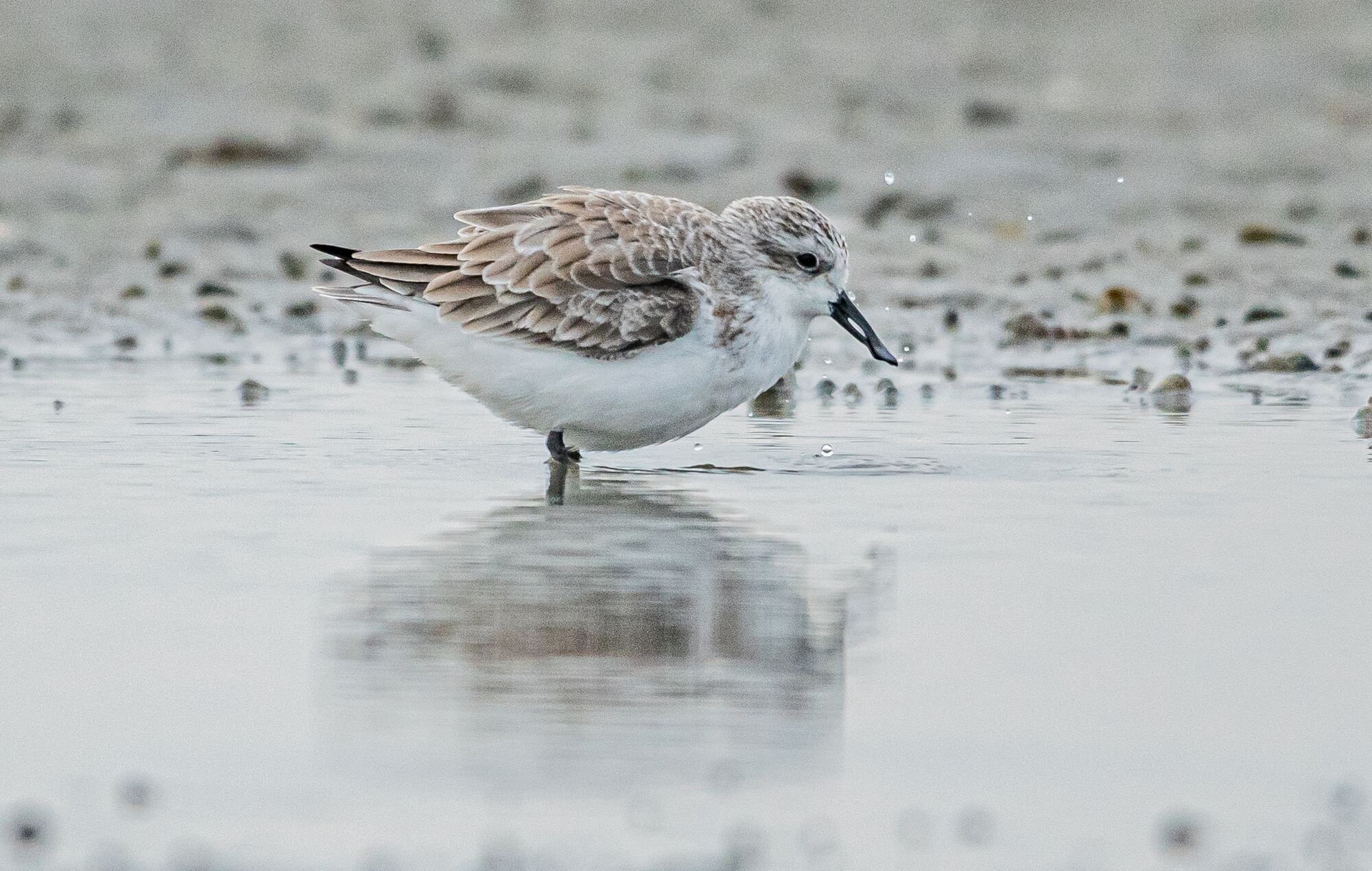
A tiny shorebird with a spoon-tipped bill, migrating between Arctic Russia and tropical Asian mudflats.
Meet the bird
The Spoon-billed Sandpiper is a tiny shorebird that breeds only on coastal tundra in Chukotka and northern Kamchatka, in Russia’s far north-east, and winters on mudflats in southern and South-East Asia. Its population collapsed in the 2000s because of the loss of tidal flats along its flyway and the trapping of shorebirds for food. Head-starting chicks in Chukotka and anti-trapping work on the wintering grounds have slowed, but not stopped, the decline.
Appearance
A small, stint-like sandpiper whose bill widens at the tip into a flat "spoon" (spatulate), the species’ most distinctive feature.
Plumage & colour
In breeding plumage the head, neck and breast are rusty red-brown with dark streaks, and the upperparts are blackish with buff and pale rufous fringes. In non-breeding plumage it is pale brownish-grey above with whitish fringes to the wing-coverts and white below. Legs are black.
Behaviour
Nests in June–July, in single pairs or loose groups, and breeding birds are very faithful to their sites. Breeding success is naturally low, and in the 2000s recruitment of young birds into the breeding population was close to zero in most years. Birds that lose a clutch early can lay a second one, which head-starting exploits.
Measurements: Length: several references agree on 14–16 cm (e.g. Thai National Parks species account). Published weights disagree (roughly 29–40 g across sources) and no reliable wingspan was found, so these are not given.
Did you knowIts bill widens at the tip into a tiny spoon. No other sandpiper has a bill like it.
Range shown at country level (countries of regular occurrence). Vagrants recorded in Cambodia, Indonesia, the Philippines, Singapore, Canada and the USA are not shown.
- Where
- Breeds on the Chukotsk Peninsula and south to the isthmus of the Kamchatka Peninsula, north-east Russia. Migrates along the western Pacific coast through Russia, Japan, the Koreas, mainland China, Hong Kong and Taiwan to wintering grounds in southern China, Viet Nam, Thailand, Myanmar and Bangladesh, with smaller numbers in India, Sri Lanka and Peninsular Malaysia. The Jiangsu coast of China (Rudong and Tiaozini mudflats) is the only known moulting site.
- Continents
- Asia
- Habitat
Breeds on coastal tundra: lagoon spits with crowberry and lichen, or dwarf birch and willow with sedges near lakes and marshes, never recorded nesting more than about 5–7 km from the sea. Adults feed on nearby estuaries and mudflats while nesting. In winter it prefers sandy tidal mudflats with an uneven surface and very shallow water at the outer edges of river deltas and offshore islands, and in heavily converted coasts it uses salt pans.
- Movement · migratory
- A long-distance migrant along the East Asian–Australasian Flyway. Young birds are thought to stay on the wintering grounds through their first summer and return to breed at two years old, which exposes them to trapping for longer.
What it eats
Small invertebrates and some seeds: terrestrial insects and beetle larvae on the breeding grounds, and small aquatic invertebrates such as amphipods on the mudflats.
Feeding strategy
Uses a variety of feeding techniques on wet mud and in very shallow water, taking a wider range of food items than once thought.
- InsectTerrestrial insects and beetle larvaeMainly on the breeding grounds.
- InvertebrateSmall aquatic amphipodsOn tidal flats.
- PlantSmall seeds
What eats it
The animals that prey on the Spoon-billed Sandpiper, grouped by the life stage they attack: its eggs, its chicks, or grown birds.
EggsWho eats its eggs
- MammalFoxesDocumentedNest predation; may increase where people disturb nests.
- BirdSkuasDocumentedNest predation on the breeding grounds.
- MammalDomestic dogsDocumentedDestroy nests near villages.
ChicksWho kills its chicks
No predators documented at this stage.
AdultsWho kills grown birds
No predators documented at this stage.
Poor breeding productivity has been blamed on heavy nest predation and bad weather. Predators of chicks and adults are not well documented. People are the main documented threat to adults and immatures, through trapping in nets set for larger shorebirds.
Its place in nature
With only a few hundred birds left, the Spoon-billed Sandpiper has a negligible measurable effect on the invertebrates it eats or on its predators. Its importance today lies mainly in what it represents: it is a flagship for the threatened mudflats of the East Asian–Australasian Flyway, which many other shorebirds also depend on.
- Feeds onDocumentedSmall invertebrates of tundra and mudflats
Insects, beetle larvae and amphipods make up most of the diet.
- Preyed on byDocumentedFoxes
Take eggs on the breeding grounds; disturbance by people may increase nest desertion and predation.
- Preyed on byDocumentedSkuas
Predatory seabirds that take eggs in Chukotka.
- Preyed on byDocumentedDomestic dogs
Destroy nests close to villages.
What if it disappeared?
At current numbers, the Spoon-billed Sandpiper’s direct ecological role is already very small. Its extinction would be a loss of a unique species more than a loss of an ecological function.
Press Remove to see which organisms could be affected, how, and how confident scientists are. 3 possible effects are recorded for this species.
Other small shorebirds, such as stints, feed on the same mudflats and would take the same food. No other shorebird has a spoon-shaped bill, however, so the species itself is irreplaceable.
The precise population size, the share of young birds that survive to breed, and the scale of hunting in the Russian far north-east are all poorly known.
These scenarios summarise published ecology. They are not predictions: ecosystems are complex, other pressures interact, and documented, likely and hypothesised effects are labelled separately.
Conservation
- LCLeast Concern
- NTNear Threatened
- VUVulnerable
- ENEndangered
- CRCritically Endangered
- EWExtinct in the Wild
- EXExtinct
Critically Endangered since 2008 (Vulnerable in 2000, Endangered in 2004). Listed on CMS Appendices I and II and as a Class 1 national key protected species in China.
- Population estimate
- 240–620 mature individuals, with a best estimate of 490 (2014–2019). Recent winter counts suggest about 330–340 birds in total, so mature birds may already number fewer than 250.
- Estimate year: 2021
- Trend
- Decreasing
- Source
- BirdLife International factsheet (2021 assessment), citing Green et al. (2021) and Zöckler et al. (2021)
No reliable historical time series is available for this species, so no population chart is shown. We do not interpolate or estimate missing data.
Threats
- Loss of tidal flats
Reclamation for industry, ports, aquaculture and agriculture has destroyed key mudflats along the flyway. At Saemangeum, South Korea, "hundreds" of Spoon-billed Sandpipers were recorded before reclamation in 2007, and only about one bird on average since. Invasive smooth cordgrass (Spartina alterniflora) makes Chinese mudflats unsuitable.
- Trapping and hunting
Birds are caught in nets set for larger shorebirds in Bangladesh, Myanmar, China and Viet Nam. In 2009–10, eight hunters on Sonadia Island, Bangladesh, said they had caught 22 Spoon-billed Sandpipers. Monofilament nets on the Chinese coast also kill shorebirds, and hunting in the Russian far north-east is larger than once thought.
- Low breeding success
Nest predation, bad weather and disturbance keep productivity low on the breeding grounds.
- Climate change
Models suggested that 57% of breeding habitat could be lost by 2070, and shrubs are already spreading into coastal tundra in the south of the range while the north is drying.
What is being done
An international task force under the East Asian–Australasian Flyway Partnership coordinates work that combines head-starting in Chukotka, conservation breeding, anti-trapping and livelihood projects on the wintering grounds, and protection of key mudflats.
- Head-starting in Meinypil’gyno, Chukotka, since 2012 (WWT and Birds Russia).
- Conservation breeding flock at WWT Slimbridge (UK), founded from eggs collected in 2011 and 2012.
- Alternative livelihoods and hunting agreements with former trappers in Myanmar and Bangladesh.
- New Ramsar sites in Myanmar (Nan Thar Island, Ayeyarwady Delta), protection plans for the Gulf of Mottama, and China’s 2018 halt on new reclamation of intertidal land.
- Inscription of the Yellow Sea–Bohai Gulf migratory bird sanctuaries (Phase I) on the World Heritage List in 2019.
A conservation story
Surveys on the breeding grounds traced a collapse from an estimated 2,000–2,800 pairs in the 1970s to fewer than 1,000 pairs in 2000 and perhaps 120–200 pairs in 2009–10, an annual decline of about 26% between 2002 and 2008. Few young birds were joining the breeding population, and WWT describes a very real threat that the species would be extinct by 2019.
The response targeted both ends of the flyway. Since 2012, teams from WWT and Birds Russia have collected eggs in Chukotka, hatched them, reared the chicks in aviaries and released them as fledglings, protecting them from the high losses at the egg and chick stage. Pairs that lose their first clutch often lay again, so wild production rises too. From 2012 to 2021, 82% of 309 viable eggs hatched and 93% of the hatchlings were released. On the wintering grounds, conservationists persuaded hunters in Myanmar and Bangladesh to give up trapping in exchange for other livelihoods, and key sites gained protection, including in China, which stopped approving new reclamation of tidal flats in 2018.
The decline has slowed, to about 8% a year by 2014–2019, but it has not stopped. BirdLife notes that head-started birds had stopped offsetting the decline at the release site by 2019, and in 2023 only 10 breeding pairs were found at Meinypil’gyno. Fieldwork in Russia has been disrupted since 2020 and by the war in Ukraine. The species’ survival depends on keeping the remaining mudflats and ending trapping across its range.


Sources
Conservation status: IUCN Red List (assessed by BirdLife International), assessed 2021. Media credits accompany each image and recording; see Sources & credits.
Taxonomy. Formerly placed in its own genus as Eurynorhynchus pygmeus.
- BirdLife International (2021 assessment). Species factsheet: Spoon-billed Sandpiper Calidris pygmaea.
- Wildfowl & Wetlands Trust (2023). Spoonie update.
- International Wader Study Group (2019). Coast of Yellow Sea–Bohai Gulf of China inscribed on the World Heritage List.
- UNESCO World Heritage Centre. Migratory Bird Sanctuaries along the Coast of Yellow Sea–Bohai Gulf of China (Phase I).
- Thai National Parks. Spoon-billed Sandpiper (species account).