Guanay Cormorant
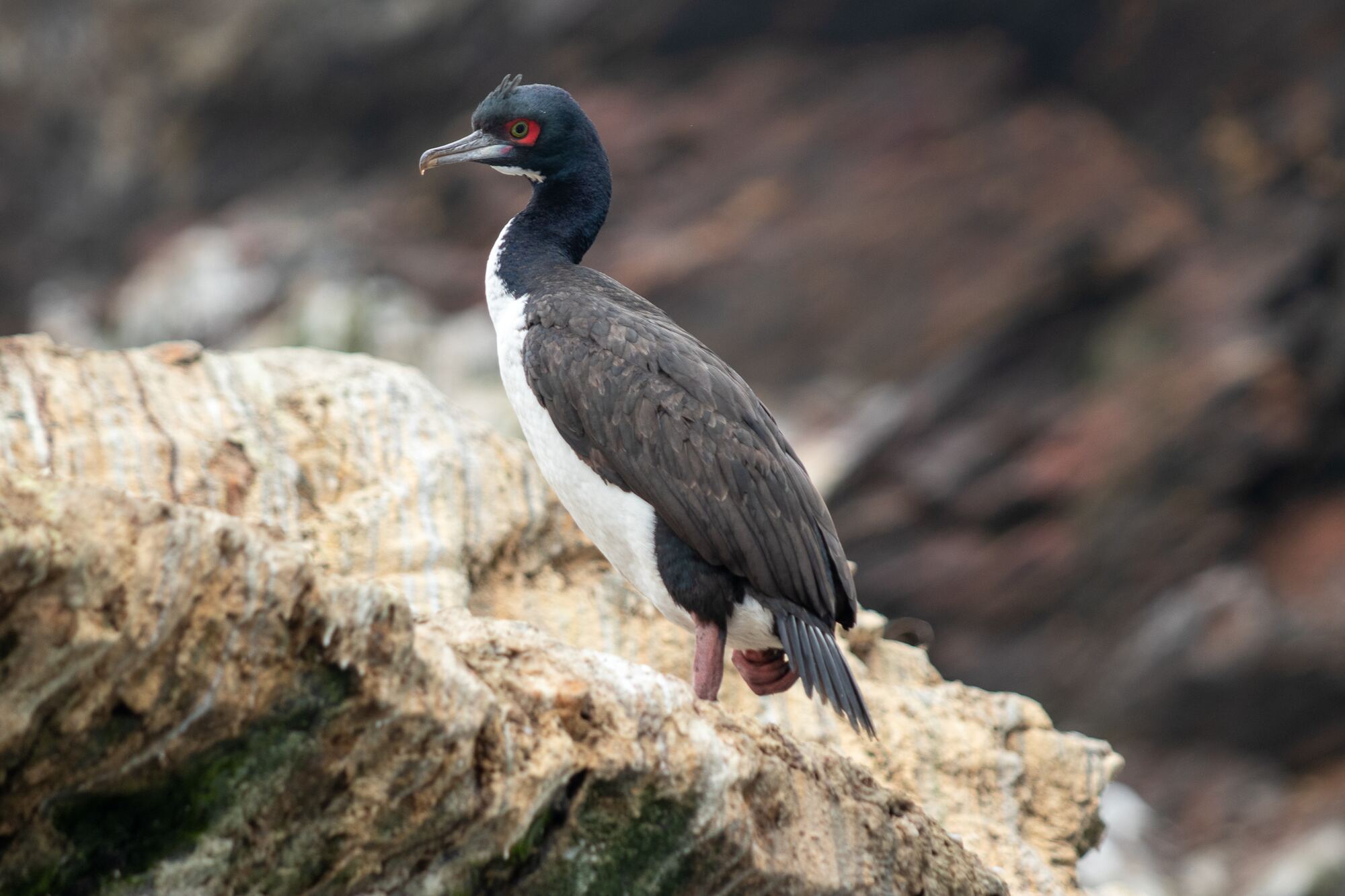
The great guano-maker of Peru’s desert islands, living almost entirely on anchovies.
Meet the bird
A sociable, black-and-white cormorant of the cold, fish-rich Humboldt Current off Peru and northern Chile. It nests in huge, dense colonies on offshore islands, and its accumulated droppings — guano — were once mined and exported as fertiliser on an enormous scale. Its numbers rise and crash with the supply of Peruvian anchovy, which is driven by El Niño events and by one of the world’s largest fisheries.
Appearance
A large, heavy-bodied cormorant with a long neck and hooked bill. It swims low in the water, dives from the surface to chase fish, and flies in long lines low over the sea between colonies and feeding areas.
Plumage & colour
Head, neck and upperparts dark glossy blue-black; throat patch, foreneck and underparts white; bare skin around the eye red and feet pinkish. Sexes look alike; juveniles are browner.
Behaviour
Highly colonial: nests built of guano are packed very closely together on flat ground. Breeding can occur year-round, with most eggs laid between May and December. Birds feed in large flocks that dive together on schools of anchovy, a communal strategy that may make them especially vulnerable when prey becomes scarce.
Measurements: Oiseaux-birds.com species card (length 71–76 cm) and SeaLifeBase (maximum length 76 cm; maximum published weight 1.8 kg). Reliable wingspan and typical weight ranges were not found.
Did you knowIn 1954 an estimated 21 million Guanay Cormorants lived along the coast of Peru.
Range shown at country level (countries of regular occurrence). A small population that bred on the Atlantic coast of Argentinian Patagonia appears to be ecologically extinct. Vagrants have reached Colombia and Panama.
- Where
- Pacific coast of Peru and northern Chile, within the Humboldt (Peru) Current; non-breeding birds reach Ecuador.
- Continents
- South America
- Habitat
Breeds on offshore islands and remote coastal headlands and feeds exclusively in inshore waters, usually within about 19 km of the colony. It depends on the cold, upwelling waters of the Humboldt Current.
- Movement · resident
- Not a migrant, but during strong El Niño events, when anchovy become scarce, birds disperse en masse along the coast, breeding fails and many die.
What it eats
Almost exclusively Peruvian anchovy (anchoveta, Engraulis ringens), with Peruvian silverside and mote sculpin also recorded.
Feeding strategy
Unlike most cormorants it is not mainly a bottom-feeder: it hunts schooling fish in mid-water. Large rafts and lines of birds form over anchovy schools and dive together.
- FishPeruvian anchovy (anchoveta)The overwhelming bulk of the diet.
- FishPeruvian silverside
- FishMote sculpin
What eats it
The animals that prey on the Guanay Cormorant, grouped by the life stage they attack: its eggs, its chicks, or grown birds.
EggsWho eats its eggs
- BirdGullsLikelyReported as a problem at colonies; species and impact not quantified in the sources consulted.
ChicksWho kills its chicks
No predators documented at this stage.
AdultsWho kills grown birds
- BirdAndean CondorLikelyNamed in William Vogt’s 1940s report on Peru’s guano birds as possibly the only significant predator; the guano administration once killed condors visiting the islands.
Natural predation on Guanay Cormorants is poorly documented in modern studies. Food shortage during El Niño, competition with the fishery, bycatch and human harvest are far better documented causes of mortality.
Its place in nature
Historically the most numerous seabird of the Peruvian Coastal Current, the Guanay Cormorant converts vast quantities of anchovy into guano deposited on desert islands. In a dry climate the droppings accumulate rather than wash away, building deposits rich in nitrogen and phosphorus that people have harvested as fertiliser — on an industrial scale during Peru’s 19th-century guano boom. The bird is thus a living link between the productivity of the upwelling ocean, the anchovy fishery and agriculture on land.
- Preys onDocumentedPeruvian anchovy (anchoveta)
Its near-exclusive prey. Guanay numbers track anchovy abundance, and in recent years the proportion of anchovy biomass removed by fishing has been negatively correlated with guanay abundance (Barbraud et al. 2017).
- Competes withDocumentedAnchoveta fishery
A model of carbon flow from upwelling to anchovy to seabirds closely matched guano-bird numbers from 1925 to 2000; the authors attributed the decline after the 1960s mainly to competition with the industrial fishery (Jahncke et al. 2004).
- Commensal withDocumentedGuano harvesters and farmers
People harvest the guano that accumulates in the colonies as fertiliser. Unregulated mining in the 19th century caused severe declines through disturbance and loss of colonies; harvesting today is smaller-scale and regulated within guano reserves.
- Competes withHypothesisedPeruvian Booby and Peruvian Pelican
The two other main guano-producing seabirds share the same islands and also feed on anchovy. Overlap in diet is documented, but whether they limit each other’s numbers has not been demonstrated.
- Preyed on byLikelyAndean Condor
William Vogt’s report on Peru’s guano birds (1940s) considered the Andean Condor possibly the only significant predator of the Guanay; modern data on this are lacking.
What if it disappeared?
The guanay population has already crashed several times — during strong El Niño events and as the anchovy fishery expanded — so some consequences of fewer guanays are known from history. A complete loss would go further than anything yet observed.
Press Remove to see which organisms could be affected, how, and how confident scientists are. 3 possible effects are recorded for this species.
Peruvian Boobies and Peruvian Pelicans also eat anchovy and produce guano on the same islands, so part of the role would continue. Guanays have historically been by far the most numerous of the three, so compensation would probably be incomplete.
Population counts are irregular and use different methods and areas, which makes long-term comparisons approximate. How El Niño, fishing and climate change will interact in future is uncertain.
These scenarios summarise published ecology. They are not predictions: ecosystems are complex, other pressures interact, and documented, likely and hypothesised effects are labelled separately.
Conservation
- LCLeast Concern
- NTNear Threatened
- VUVulnerable
- ENEndangered
- CRCritically Endangered
- EWExtinct in the Wild
- EXExtinct
Near Threatened because of a suspected moderately rapid decline (20–29% over three generations, i.e. 33 years).
- Population estimate
- c. 3.7 million individuals on the north-central Peruvian coast; BirdLife places the global population in the band 2.5–5 million individuals
- Estimate year: 1996
- Trend
- Decreasing
- Source
- BirdLife International factsheet (2018 assessment), citing Zavalaga & Paredes (1999)
No reliable historical time series is available for this species, so no population chart is shown. We do not interpolate or estimate missing data.
Threats
- Competition with the anchovy fishery
The guanay depends almost entirely on Peruvian anchovy, the target of one of the world’s largest single-species fisheries. Heavy fishing reduces the food available to the birds.
- El Niño events
During El Niño, warm water drives anchovy deeper or away. The 1982–83 El Niño caused total breeding failure and the death of an estimated 1.7 million adults at study sites on the Peruvian coast. More frequent El Niños under climate change could exhaust the species’ ability to recover.
- Bycatch and hunting
Guanays drown in fishing nets, including surface driftnets, and around 20,000 birds were reported to be taken each year for food in northern Peru.
- Guano extraction
Nineteenth-century guano mining destroyed colonies and caused severe declines. Extraction continues on a much smaller, regulated scale but can still disturb breeding birds.
What is being done
The species is protected in Peru, and several breeding colonies lie within managed guano reserves or marine protected areas where guano harvesting is regulated. Recommended measures include standardised population counts, assessing the impact of the anchovy fishery, and regulating human consumption of the birds.
- Legal protection in Peru.
- Breeding colonies within managed guano reserves and marine protected areas.
- Systematic monitoring of guano-bird populations.
- Education and awareness programmes that have raised the species’ local profile.
A conservation story
Estimates for the Peruvian population illustrate its boom-and-bust history: fewer than 4 million birds during 1909–1920, about 21 million in 1954, and about 3.7 million on the north-central coast in 1996. Severe El Niño events in particular caused mass mortality and breeding failure, from which the population has repeatedly recovered — but each recovery has taken place in competition with an industrial fishery.
Sources
Conservation status: IUCN Red List (assessed by BirdLife International), assessed 2018. Media credits accompany each image and recording; see Sources & credits.
Taxonomy. Formerly placed in the genus Phalacrocorax; BirdLife now uses Leucocarbo.
- BirdLife International (2018 assessment). Species factsheet: Guanay Cormorant Leucocarbo bougainvilliorum.
- Jahncke, J., Checkley, D.M. & Hunt, G.L. (2004). Trends in carbon flux to seabirds in the Peruvian upwelling system: effects of wind and fisheries on population regulation. Fisheries Oceanography 13: 208–223.
- Vogt, W. A report on the guano-producing birds of Peru (English edition of “Informe sobre Aves Guaneras”). University of Hawaiʻi ScholarSpace.
- SeaLifeBase. Phalacrocorax bougainvillii, Guanay cormorant.
- Oiseaux-birds.com. Guanay Cormorant species card.
- History Today. The Guano Age in Peru.