Rodrigues Solitaire
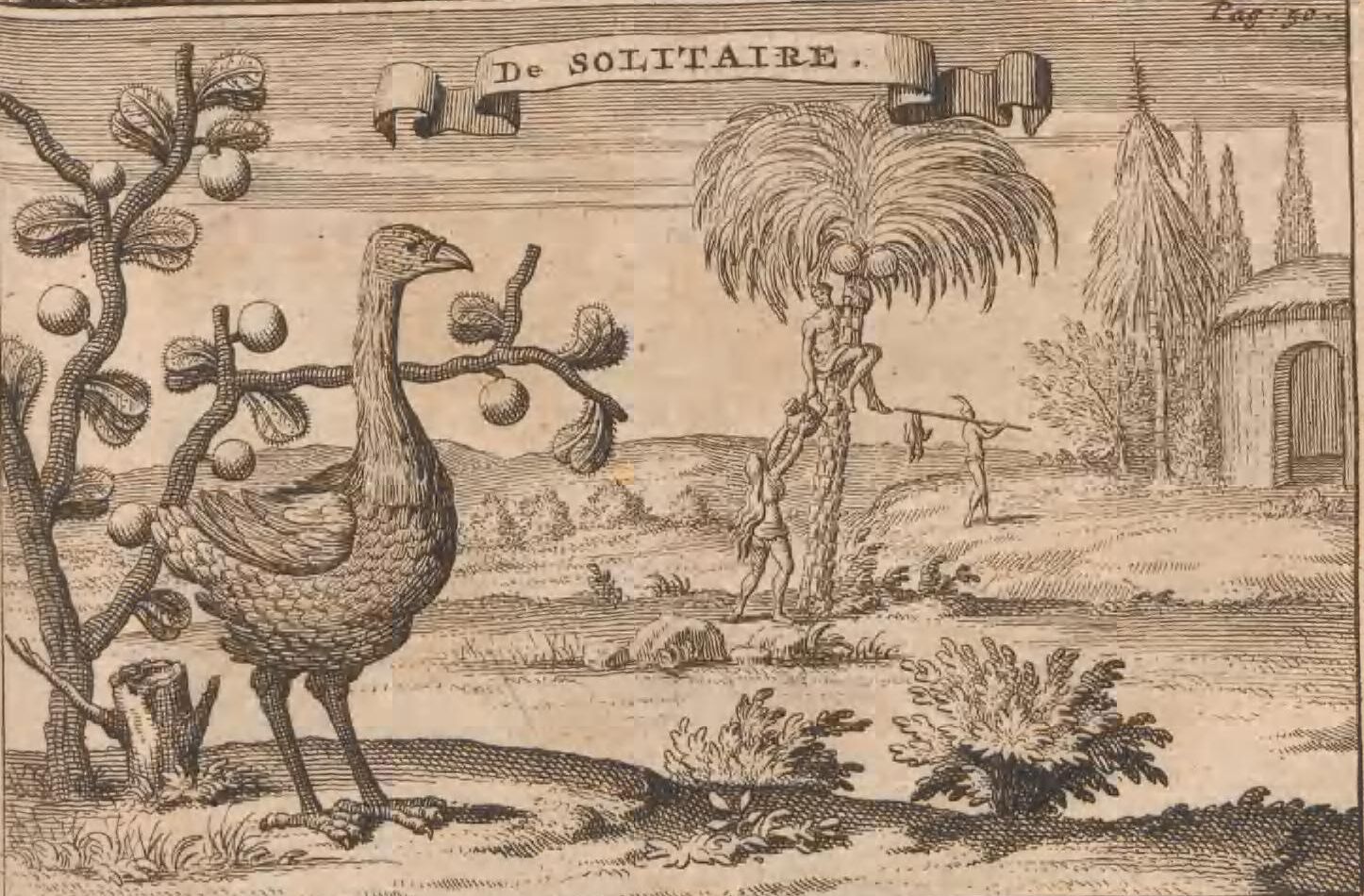
A flightless giant pigeon that fought with bony wing knobs “as big as a musket ball”.
What it was like
The Rodrigues Solitaire was a large, flightless pigeon found only on the small Indian Ocean island of Rodrigues. It is known from many bones and from unusually detailed accounts by François Leguat, who lived on the island from 1691 to 1693. Hunting by visiting tortoise collectors and the introduction of cats and goats drove it to extinction, probably in the 1760s.
Appearance
A tall, long-necked, flightless pigeon with long legs and a slightly hooked bill. Leguat wrote that it was taller than a turkey and that “some of the Males weigh forty five Pound”. Modern estimates from bones (summarised by Wikipedia) give males 75.7–90 cm tall and up to 28 kg, and females 63.8–70 cm and up to 17 kg. Both sexes had a bony knob on the wrist of each small wing, much larger in males.
Plumage & colour
Leguat described males as brownish grey. Females were “some fair, some brown”, with a dun-coloured patch “like a Widow’s cap” on the breast and whiter feathers on the crop. Females were paler than males.
Behaviour
Strongly territorial. Leguat saw birds whirl round 20 or 30 times in four or five minutes, beating their wings to make a rattling noise audible 200 paces away. A pair would not let another solitaire within 200 yards of its nest. Males chased away males and females chased away females. Hume & Steel (2013) showed that the bony wing knobs were weapons, used in these fights. Pairs built a nest of heaped palm leaves about a foot and a half high and laid a single egg, larger than a goose’s. Both parents incubated it for about seven weeks, and the chick depended on them for several months.
Measurements: Leguat (1708) for a historical weight claim; modern height and weight estimates as summarised by Wikipedia (Parish 2013; Hume & Walters 2012)
Did you knowLeguat wrote that the bone at the end of each wing formed “a little round Mass under the Feathers, as big as a Musket Ball”. Hume & Steel (2013) showed these knobs were weapons used in fights.
Historical range shown at country level (countries of regular occurrence). Historical range: Rodrigues only.
- Where
- Endemic to Rodrigues, an island now part of the Republic of Mauritius, in the western Indian Ocean.
- Continents
- Africa
- Habitat
Probably dry forest and perhaps scrubland (BirdLife International). Leguat noted it was hard to catch in the woods but easy to run down in open places.
- Movement · resident
- A flightless island resident.
What it ate
Hard seeds, fallen fruit and leaves (BirdLife International, citing Hume 2017).
Feeding strategy
Leguat found one brown stone “of the bigness of a Hens Egg” in the gizzard of every bird, which the settlers used to sharpen knives. Such stones help grind tough seeds and fruit.
- PlantHard seeds
- PlantFallen fruit
- PlantLeaves
What hunted it
The animals that preyed on the Rodrigues Solitaire, grouped by the life stage they attacked.
EggsWho ate its eggs
- MammalIntroduced catsLikelyIntroduced after 1726. Thought to have taken eggs, chicks or adults (BirdLife International).
ChicksWho killed its chicks
No predators documented at this stage.
AdultsWho killed grown birds
- PeoplePeopleDocumentedHunted for food. Leguat noted the birds were very fat and good to eat from March to September.
No native predators are recorded. All known predators were introduced by or were people.
Its place in nature
As one of the largest land animals on Rodrigues, alongside giant tortoises, the solitaire ate fallen fruit, seeds and leaves. It may have dispersed some seeds and browsed low vegetation, but no study has measured these roles. The island’s original forest has since been largely lost, so the plants that might have depended on it are themselves largely gone.
- Feeds onDocumentedRodrigues forest plants (fruit and seeds)
Contemporary accounts and later studies record fallen fruit, hard seeds and leaves in its diet.
- Competes withHypothesisedRodrigues giant tortoises
Rodrigues held a very dense population of giant tortoises, which also ate plants. Whether they competed with solitaires is unknown. The tortoise trade brought the hunters who helped wipe out the solitaire.
How it disappeared
- Extinct
- Reported as rare in 1761; probably extinct in the 1760s
- Last confirmed record
- 1761: the astronomer Pingré, visiting Rodrigues to observe the transit of Venus, was told by M. de Puvigné that the birds still existed but had retreated to the most inaccessible parts of the island. This was a second-hand report, not an observation.
- Where
- Rodrigues, Mauritius, Indian Ocean
In 1691 a small group of French Huguenot refugees led by François Leguat was left on Rodrigues, where they stayed until 1693. Leguat’s book, published in 1708, describes the solitaire in remarkable detail. He noted its rattling wing display, its fierce defence of territory, its single egg on a mound of palm leaves, and the bony knob on each wing “as big as a Musket Ball”.
In the 18th century Rodrigues became a source of giant tortoises for ships and for the colonies on Mauritius and Réunion. Crews and tortoise hunters ate solitaires too, and cats and goats were introduced after 1726. The solitaire was still reported as common in 1733.
By 1761 it was said to survive only in the most inaccessible parts of the island. Soon afterwards it was gone. Its bones, later dug from the island’s caves, confirmed that Leguat had described it accurately.
The human role
Human-caused: hunting by visiting crews and tortoise collectors, cats and goats introduced after 1726, and the destruction of the island’s vegetation.
About the date. BirdLife International states that the solitaire was reported as rare, surviving in isolated parts of the island in 1761, and likely became extinct sometime in the 1760s. There is no confirmed later record. A resident interviewed around 1830 said he had never seen a bird that large during his 40 years on the island.
What was lost
Rodrigues lost one of its two largest native plant-eaters (the other, its giant tortoises, was also wiped out). Any role in seed dispersal or browsing is inferred, not measured. Science also lost one of the few birds known to have fought with bony clubs on its wings.
Historical population
Leguat wrote that there were “abundance of them”, though they were seldom seen in groups. No numbers were ever recorded.
- Native fruiting plants of Rodrigues
A large fruit- and seed-eater may have helped disperse some plants, or destroyed their seeds in its gizzard. Which of these mattered more is unknown.
- Low forest vegetation
Together with the giant tortoises, the solitaire was one of the island’s main plant-eaters. The loss of both probably changed browsing pressure, but forest clearance and introduced goats had far larger effects.
Uncertainty. Everything known about the living bird comes from a few 17th- and 18th-century accounts and from bones. Its ecological role is a matter of inference only.
Legacy
Nothing was done to protect the solitaire. Its story, like the Dodo’s, shows how quickly large, flightless island birds can be lost once people and introduced animals arrive.
Sources
Conservation status: IUCN Red List (assessed by BirdLife International), assessed 2024. Media credits accompany each image and recording; see Sources & credits.
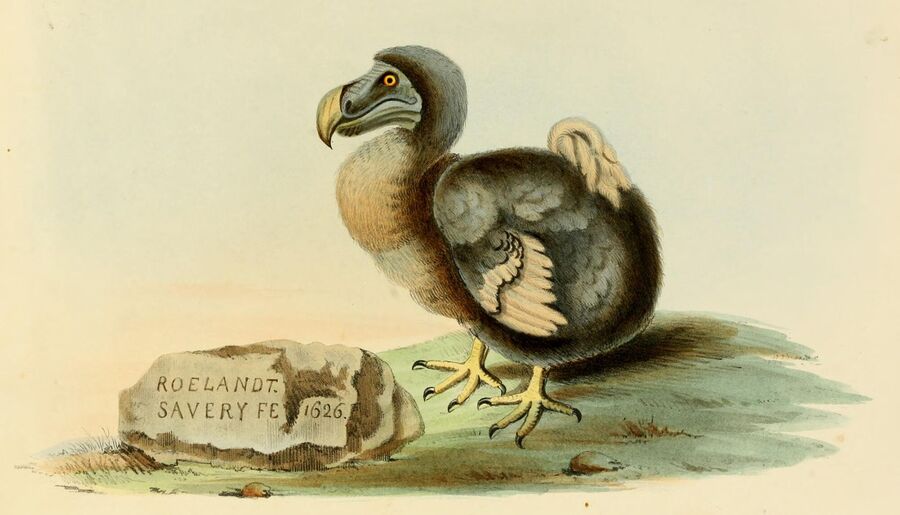
Taxonomy. A giant, flightless pigeon and the closest known relative of the Dodo of Mauritius.
- BirdLife International (2024). Species factsheet: Rodrigues Solitaire Pezophaps solitaria.
- Leguat, F. (1708). A New Voyage to the East-Indies. London. (Scanned original edition, Internet Archive.)
- Oliver, S.P. (ed.) (1891). The Voyage of François Leguat of Bresse, to Rodriguez, Mauritius, Java, and the Cape of Good Hope. Hakluyt Society. (Reprints Leguat’s text and Pingré’s 1761 note.)
- Hume, J.P. & Steel, L. (2013). Fight club: a unique weapon in the wing of the solitaire, Pezophaps solitaria. Biological Journal of the Linnean Society. (News summary, Sci.News.)
- Wikipedia. Rodrigues solitaire (summary of size estimates and of Cheke & Hume 2008 on extinction causes).