Ruby-throated Hummingbird
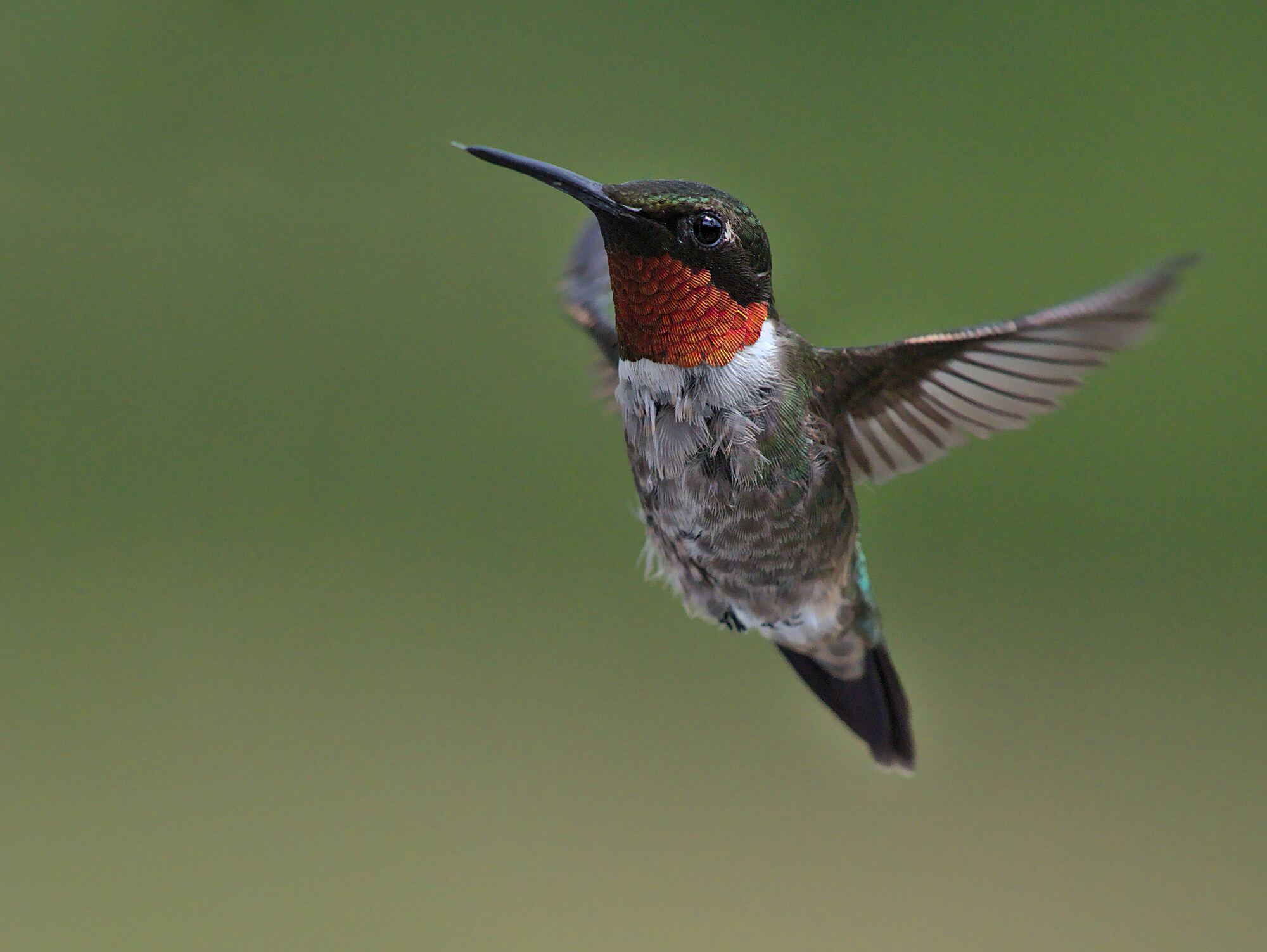
Eastern North America’s only breeding hummingbird — a 3-gram pollinator that migrates to Central America.
Meet the bird
The Ruby-throated Hummingbird is the only hummingbird that breeds across eastern North America, from southern Canada to the Gulf coast. It feeds on nectar from red, tubular flowers and on small insects, and is an important pollinator of several native wildflowers and vines. Each autumn nearly all birds leave for Mexico and Central America — some apparently crossing the Gulf of Mexico, many following its coast.
Appearance
A tiny, slender hummingbird with a straight, needle-like bill, short legs and long, pointed wings that beat too fast to see. Usually feeds while hovering at flowers or feeders. Females are slightly larger than males.
Plumage & colour
Bright green upperparts and pale greyish-white underparts. Adult males have an iridescent ruby-red throat (gorget) that can look dark in poor light; females and young birds lack the red throat.
Behaviour
Males take no part in nesting. The female builds a tiny, compact cup of plant fibres and down bound with spider silk on a branch, lays two white eggs, incubates them alone for about 12–14 days, and the young first fly at about 20–22 days old. At the Bon Secour stopover site in Alabama, autumn passage ran from late August to late October, and males generally migrated earlier than females.
Measurements: Cornell Lab of Ornithology, All About Birds; National Audubon Society Guide to North American Birds (same ranges).
Did you knowBefore autumn migration some Ruby-throats roughly double their body mass at stopover sites on the Gulf coast — fuel for an estimated non-stop flight range of over 2,000 km.
Range shown at country level (countries of regular occurrence). Vagrants recorded in Bermuda, Jamaica, Hispaniola, the Cayman Islands and St Pierre and Miquelon are not shown.
- Where
- Breeds across eastern and central North America, from southern Canada south to the Gulf coast and Florida. Winters from Mexico through Central America to Costa Rica and Panama. Passes through the Bahamas and Cuba on migration.
- Continents
- North America
- Habitat
In summer uses a variety of semi-open habitats: deciduous and mixed woodland edges and clearings, orchards, parks and gardens with flowering plants. In winter it favours open or dry tropical scrub. Recorded up to about 1,900 m.
- Movement · migratory
- Nearly all birds leave North America in autumn. What is documented: birds fatten heavily before migration (some roughly doubling their body mass at stopover sites on the northern Gulf coast), and estimated flight ranges are long enough for a non-stop crossing of the Gulf of Mexico to the Yucatán Peninsula. What is debated: how many birds actually make that crossing. Radio-tracked juveniles leaving coastal Alabama in autumn mostly headed along the coastline, consistent with a route around the Gulf, and many birds are known to migrate along the Texas coast.
What it eats
Nectar, mainly from red or orange tubular flowers, plus small insects and spiders, which supply protein. Also drinks tree sap and readily uses sugar-water feeders.
Feeding strategy
Hovers at flowers to extract nectar with its long tongue, favouring flowers such as trumpet creeper and cardinal flower. Catches small flying insects in mid-air or picks them from leaves and spider webs. When nectar is scarce it feeds at sap wells drilled by Yellow-bellied Sapsuckers.
- PlantNectar of red tubular flowers (e.g. trumpet creeper, cardinal flower)Main energy source.
- InsectSmall flying insectsProtein, especially for nestlings.
- InvertebrateSmall spiders
- PlantTree sap from sapsucker wellsImportant when nectar is scarce.
What eats it
The animals that prey on the Ruby-throated Hummingbird, grouped by the life stage they attack: its eggs, its chicks, or grown birds.
EggsWho eats its eggs
No predators documented at this stage.
ChicksWho kills its chicks
No predators documented at this stage.
AdultsWho kills grown birds
- InsectPraying mantisesDocumentedA global review found that in the eastern USA mantises preyed almost exclusively on Ruby-throated Hummingbirds, often at feeders; many records involved non-native mantis species.
Predation on this tiny bird is poorly quantified. Records of mantises catching hummingbirds were compiled by Nyffeler et al. (2017), many from informal reports. Predators of eggs and nestlings are not well documented in the sources reviewed.
Its place in nature
As the only breeding hummingbird across most of eastern North America, the Ruby-throat is the main bird pollinator there for flowers adapted to hummingbirds, which are typically red and tubular with nectar deep in the tube. Trumpet creeper, for example, is pollinated mostly by hummingbirds in its native range. It also eats large numbers of tiny insects, though its effect on insect populations has not been measured.
- PollinatesDocumentedTrumpet creeper (Campsis radicans)
A classic hummingbird-pollinated vine whose floral biology and pollination by hummingbirds were studied in detail by Bertin (1982); hummingbirds are reported as its main pollinators in its native range.
- PollinatesLikelyCardinal flower (Lobelia cardinalis)
A favoured nectar source with a typical hummingbird flower; in eastern North America the Ruby-throat is the only hummingbird available to pollinate it over most of its range.
- Commensal withDocumentedYellow-bellied Sapsucker
Hummingbirds feed at sap wells drilled by sapsuckers when nectar is scarce. Some authors link the northern edge of the hummingbird’s range to the presence of sapsuckers.
- Preys onDocumentedSmall insects and spiders
Insects and spiders caught in flight or gleaned from foliage and webs provide protein.
- Preyed on byDocumentedPraying mantises
Large mantises, including introduced species released for garden pest control, have repeatedly been recorded catching hummingbirds.
What if it disappeared?
The Ruby-throat is common and increasing. As a thought experiment, its disappearance matters mainly because no other hummingbird could replace it across eastern North America.
Press Remove to see which organisms could be affected, how, and how confident scientists are. 3 possible effects are recorded for this species.
Over most of the eastern breeding range there is no other hummingbird to step in. Insects might partly pollinate some flowers, but red tubular flowers adapted for birds would probably suffer. In the Central American winter range, many other hummingbird species overlap with it.
How strongly each eastern wildflower depends on hummingbirds — rather than insects — varies by species and has been measured for only a few, so the overall effect on plant communities is uncertain.
These scenarios summarise published ecology. They are not predictions: ecosystems are complex, other pressures interact, and documented, likely and hypothesised effects are labelled separately.
Conservation
- LCLeast Concern
- NTNear Threatened
- VUVulnerable
- ENEndangered
- CRCritically Endangered
- EWExtinct in the Wild
- EXExtinct
- Population estimate
- c. 36,000,000 mature individuals (estimated; data quality poor)
- Estimate year: 2019
- Trend
- Increasing
- Source
- BirdLife International factsheet (2021 assessment), citing Partners in Flight (2019). Breeding Bird Survey data indicate increases over the past five decades, including about 9% over ten years (Pardieck et al. 2018).
No reliable historical time series is available for this species, so no population chart is shown. We do not interpolate or estimate missing data.
Threats
- No major threats identified
The population is large and increasing, and BirdLife does not list significant threats for this species.
- Release of non-native mantises
Nyffeler et al. (2017) advise caution in releasing large mantises, especially non-native species, for pest control because they catch hummingbirds at feeders and flowers. The population-level impact is unknown.
What is being done
No targeted conservation is needed. Planting native red tubular flowers, providing clean feeders and limiting pesticide use in gardens support local populations.
- Protected in the United States under the Migratory Bird Treaty Act.
- Monitored by the North American Breeding Bird Survey and by banding studies at migration stopover sites.
Sources
Conservation status: IUCN Red List (assessed by BirdLife International), assessed 2021. Media credits accompany each image and recording; see Sources & credits.
- BirdLife International (2021 assessment). Species factsheet: Ruby-throated Hummingbird Archilochus colubris.
- Cornell Lab of Ornithology. All About Birds: Ruby-throated Hummingbird identification.
- National Audubon Society. Guide to North American Birds: Ruby-throated Hummingbird.
- Zenzal, T.J. & Moore, F.R. (2016). Stopover biology of Ruby-throated Hummingbirds (Archilochus colubris) during autumn migration. The Auk 133: 237–250.
- Zenzal, T.J., Moore, F.R., Diehl, R.H., Ward, M.P. & Deppe, J.L. (2018). Migratory hummingbirds make their own rules: the decision to resume migration along a barrier. Animal Behaviour 137: 215–224.
- Nyffeler, M., Maxwell, M.R. & Remsen, J.V. (2017). Bird predation by praying mantises: a global perspective. Wilson Journal of Ornithology 129: 331–344.