Eurasian Jay
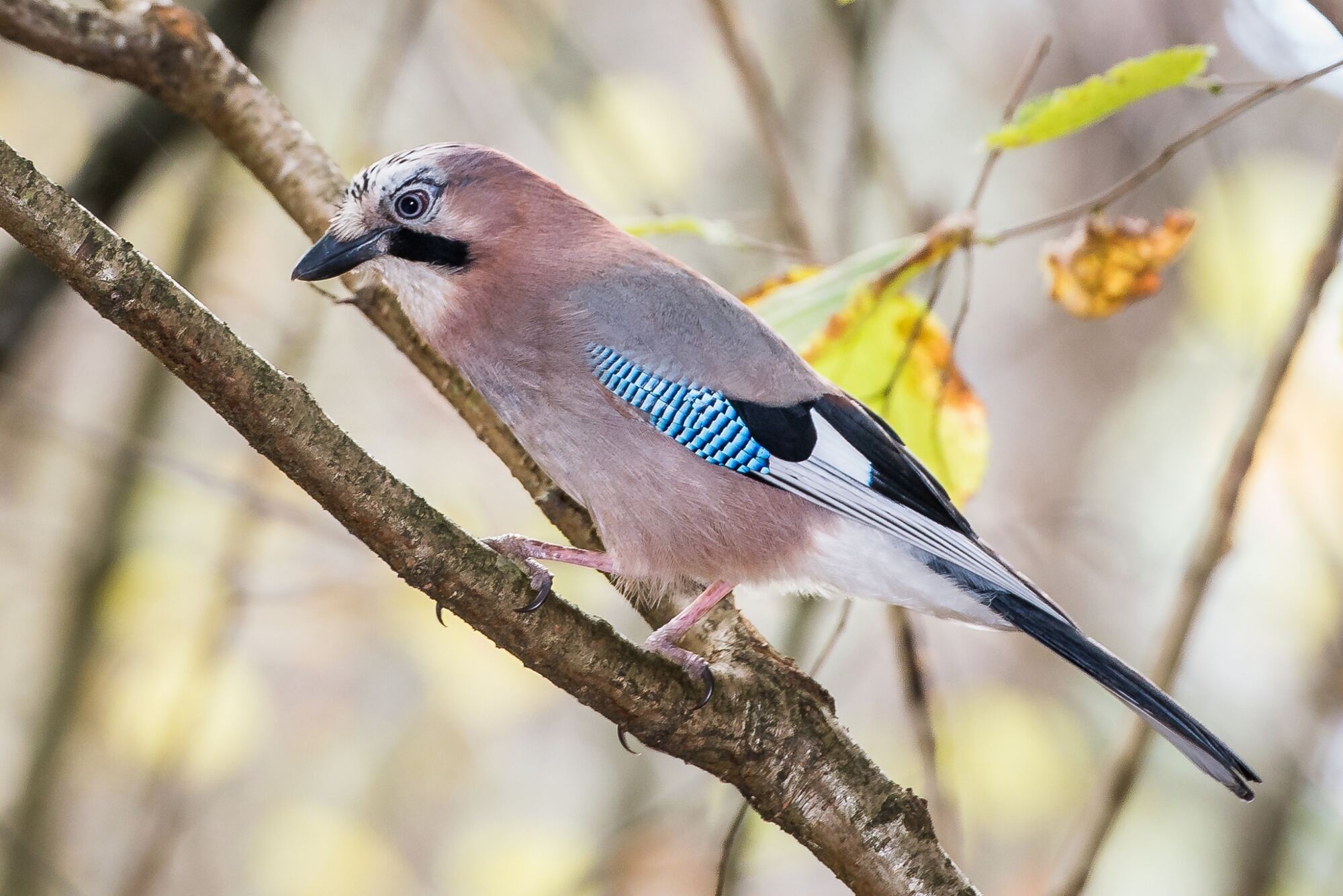
A shy, colourful crow that plants oak woods — burying thousands of acorns every autumn.
Meet the bird
The Eurasian Jay is a colourful, wary member of the crow family found in woodland across Europe, North Africa and temperate Asia. Every autumn it harvests acorns and buries them one by one to eat later; those it never recovers can grow into new oaks, making the jay one of the most important dispersers of oak trees. It is also an omnivore that raids other birds’ nests in spring.
Appearance
A medium-sized crow with a rounded body, short rounded wings and a fairly long tail. In flight it shows a conspicuous white rump contrasting with a black tail. Usually first noticed by its harsh, rasping screech. It is also a skilled mimic, imitating the calls of birds such as Common Buzzard and Northern Goshawk.
Plumage & colour
Body pinkish-brown; streaked pale crown; bold black moustache stripe; white rump; black tail. The wing has a striking patch of bright blue feathers finely barred with black, plus a white wing patch. Sexes look alike. Plumage varies between the many regional subspecies.
Behaviour
Secretive in the breeding season but conspicuous in autumn, when birds fly back and forth carrying acorns. Both sexes build a platform of twigs around a deep, lined cup, usually 4–6 m up near the trunk. In Britain clutches are typically 4–5 eggs, incubation takes about 18 days and the young fledge after about three weeks. Experiments suggest male jays adjust which food they share with their mate according to what she has recently eaten — evidence that they may track another bird’s desires (Ostojić et al. 2013).
Measurements: Length and wingspan: Cramp et al. (1994), Birds of the Western Palearctic Vol. 8, as summarised on Wikipedia. Weight (adult range, n = 1,113; mean 166.8 g) and longevity: BTO BirdFacts.
Did you knowA single jay has been estimated to bury around 3,000 acorns in one month of autumn caching.
Shown at continent level — this species is too widespread for a country list. Consult BirdLife International or eBird for detailed range maps. Occurs as a native resident or breeder in more than 60 countries and territories (BirdLife International), so the map shades continents.
- Where
- Throughout most of Europe and in north-west Africa (Morocco, Algeria, Tunisia), through Turkey, the Caucasus, the Middle East and Iran, and east across Russia and Siberia to Mongolia, China, Korea, Japan and Taiwan.
- Continents
- Europe · Asia · Africa
- Habitat
Woodland and forest of all kinds, especially with oak, but also beech and hornbeam; in the north also conifer and birch forest. Also found in parks, orchards and large gardens with trees. Recorded up to 4,000 m in Asia.
- Movement · resident
- Mainly resident, with irregular movements including occasional irruptions and seasonal altitudinal movements.
What it eats
Omnivorous. Mostly invertebrates in the breeding season, along with eggs and nestlings of other birds; acorns, beech mast, chestnuts, grain and berries in autumn and winter.
Feeding strategy
Through autumn into winter it caches acorns individually in the soil, leaf litter or under brambles and ferns; one bird has been estimated to store c. 3,000 acorns in a month. Radio-tracked acorns in eastern Spain were carried about 3–550 m (median c. 49 m) and preferentially buried in open sites such as recently abandoned fields and forest tracks.
- PlantAcorns (oak seeds)Main cached winter food.
- PlantBeech mast, chestnuts and other seeds
- InsectInsects and other invertebratesMain summer food.
- BirdEggs and nestlings of other birdsTaken mainly in spring.
- PlantBerriesAutumn.
What eats it
The animals that prey on the Eurasian Jay, grouped by the life stage they attack: its eggs, its chicks, or grown birds.
EggsWho eats its eggs
No predators documented at this stage.
ChicksWho kills its chicks
No predators documented at this stage.
AdultsWho kills grown birds
- BirdNorthern GoshawkDocumentedJays appear regularly in goshawk diets; in central Poland their share of goshawk prey increased over recent decades (Gryz & Krauze-Gryz 2019).
Predation on jays and their nests is not well documented in the sources reviewed; forest raptors are the best-recorded predators of adults. Historically, the heaviest pressure came from people: gamekeepers and farmers persecuted jays as nest-raiders, and their blue wing feathers were collected for hats and salmon flies.
Its place in nature
The Eurasian Jay is a key planter of oaks. By carrying acorns away from the parent tree and burying them singly in open ground where rodents are less active, it places seeds exactly where young oaks can establish — on woodland edges, clearings and abandoned farmland. In a radio-tracking study in a Mediterranean mosaic landscape, researchers concluded that oak regeneration was primarily driven by jay dispersal. At the same time, jays are significant predators of songbird nests in spring.
- Mutualism withDocumentedOaks (Quercus)
Jays get a storable, energy-rich winter food; oaks get their seeds carried and buried. Bossema (1979) described this as a symbiosis, and radio-tracking showed jays bury acorns hundreds of metres away in sites favourable for seedling establishment (Pons & Pausas 2007).
- Feeds onDocumentedBeech
Beech mast is an important autumn and winter food and is also cached.
- Preys onDocumentedWoodland songbirds
A synthesis of nest-camera studies in Britain and Ireland found jays were the main avian predator of passerine broods, accounting for 23% of recorded predation events, mostly in woodland (Barton et al. 2025).
- Competes withDocumentedWood mice and other rodents
Rodents pilfer jay caches: in a Spanish study 8.3% of cached acorns were robbed by rodents. Jays favour open caching sites where rodent activity is lower.
- Preyed on byDocumentedNorthern Goshawk
Goshawks take jays as prey; in central Poland jays have become a more frequent goshawk prey in recent decades.
What if it disappeared?
The jay is common and stable, so this is a thought experiment — but it highlights how much oak woodland depends on one bird.
Press Remove to see which organisms could be affected, how, and how confident scientists are. 3 possible effects are recorded for this species.
Rodents also cache acorns, but usually closer to the source and in places where they themselves eat many of them. No other European bird is known to disperse acorns on the jay’s scale, so compensation would probably be partial.
Most quantitative dispersal studies come from a few landscapes; how much oak regeneration depends on jays varies with landscape structure, rodent numbers and grazing, and has not been modelled at continental scale.
These scenarios summarise published ecology. They are not predictions: ecosystems are complex, other pressures interact, and documented, likely and hypothesised effects are labelled separately.
Conservation
- LCLeast Concern
- NTNear Threatened
- VUVulnerable
- ENEndangered
- CRCritically Endangered
- EWExtinct in the Wild
- EXExtinct
Green-listed in the UK Birds of Conservation Concern.
- Population estimate
- c. 24,000,000–46,200,000 mature individuals (estimated; Europe holds c. 12,000,000–23,100,000 and about half the global range)
- Estimate year: 2021
- Trend
- Stable
- Source
- BirdLife International factsheet (2025 assessment), citing BirdLife International (2021) European Red List of Birds. UK: c. 170,000 territories in 2016 (APEP4, via BTO).
No reliable historical time series is available for this species, so no population chart is shown. We do not interpolate or estimate missing data.
Threats
- Persecution
Long persecuted by gamekeepers and farmers because it raids nests; persecution is now much less widespread than in the past.
- Forest loss
The species has a medium dependency on forest; tree cover within its mapped range declined by an estimated 8.2% over three generations (Global Forest Watch data cited by BirdLife), though this is not thought to have caused population decline.
- Historical feather trade
In the early 20th century its blue wing feathers were fashionable for hat decoration and for tying salmon-fishing flies.
What is being done
BirdLife considers that no conservation measures are currently needed. Because jays plant oaks, keeping healthy jay populations in mixed landscapes of woodland and open ground supports natural oak regeneration.
- Monitored through European breeding bird surveys.
- Listed on Annex II of the EU Birds Directive (species that may be hunted under national legislation).
Sources
Conservation status: IUCN Red List (assessed by BirdLife International), assessed 2025. Media credits accompany each image and recording; see Sources & credits.
Taxonomy. BirdLife International (following the HBW–BirdLife checklist, del Hoyo & Collar 2016) splits the Himalayan Plain-crowned Jay (G. bispecularis) and the White-faced Jay of South-East Asia (G. leucotis) from Garrulus glandarius. Many other checklists, including the IOC World Bird List, still include them in a broader Eurasian Jay. Status, population and range here follow the narrower BirdLife species.
- BirdLife International (2025 assessment). Species factsheet: Eurasian Jay Garrulus glandarius.
- British Trust for Ornithology. BirdFacts: Jay (biometrics, ringing longevity, breeding, UK population).
- Pons, J. & Pausas, J.G. (2007). Acorn dispersal estimated by radio-tracking. Oecologia 153: 903–911.
- Barton, M.G. et al. (2025). Identity of predators of bird nests in the British Islands. Ibis (BTO summary page).
- Ostojić, L. et al. (2013). Evidence suggesting that desire-state attribution may govern food sharing in Eurasian jays. PNAS 110: 4123–4128.
- Wikipedia. Eurasian jay (summary of measurements from Cramp et al. 1994, and mimicry).