Clark's Nutcracker
A mountain corvid that plants forests — burying tens of thousands of pine seeds every autumn.
Meet the bird
A grey, black and white crow of high western North American mountains, Clark's Nutcracker harvests pine seeds and buries them in thousands of small caches to eat later. The seeds it never retrieves can germinate, which makes this bird the principal planter of whitebark pine, a keystone tree of subalpine ecosystems.
Appearance
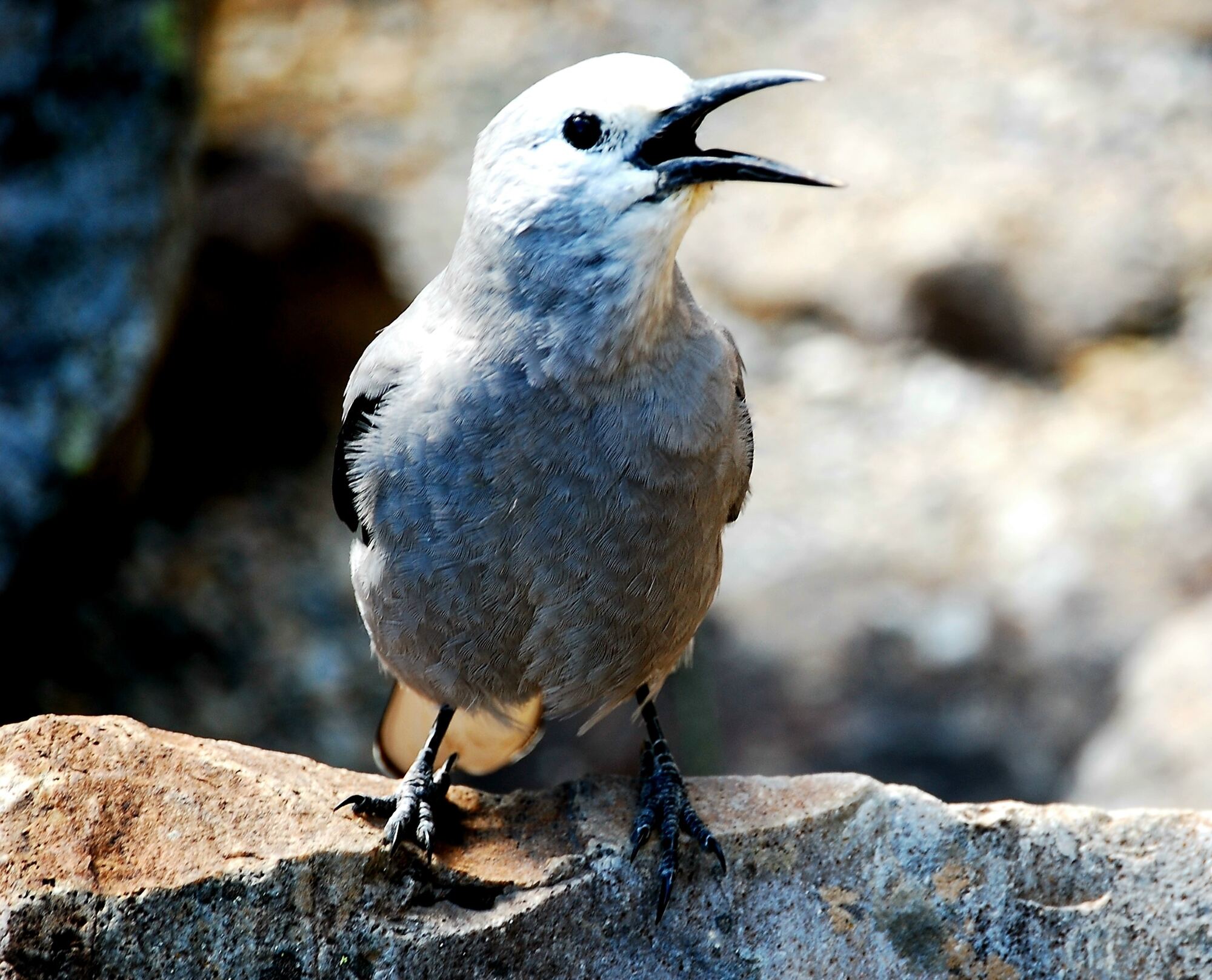
A stocky, jay-sized corvid with a long, dagger-like black bill, a short tail and broad wings. In flight it shows striking white patches on the trailing edge of the black wings and white outer tail feathers. A pouch beneath the tongue (the sublingual pouch) lets it carry large loads of seeds.
Plumage & colour
Body pale ash-grey, paler around the face; wings and central tail feathers glossy black, with white secondaries forming a bold panel. Sexes look alike. Juveniles are similar but browner-grey.
Behaviour
Nutcrackers spend late summer and autumn harvesting seeds, carrying them in the sublingual pouch and burying them a few at a time in the soil, often on open, south-facing slopes and recently burned ground where snow melts early. They recover caches months later with remarkable spatial memory, and rely on them to breed unusually early — nest building can begin in late winter while snow is still on the ground. Both parents incubate, and chicks are fed largely on stored seeds.
Measurements: Cornell Lab of Ornithology, All About Birds
Did you knowA pouch under its tongue can carry around 150 pine seeds in a single trip.
Range shown at country level (countries of regular occurrence). During irruptions after cone-crop failures, birds can appear well outside their normal mountain range.
- Where
- Mountains of western North America, from British Columbia and Alberta south through the western United States, with small resident populations in northern Mexico (Baja California).
- Continents
- North America
- Habitat
Open conifer forests near the tree line, especially stands of whitebark pine, limber pine and pinyon pine, typically between about 2,000 and 3,100 m elevation. Birds move to lower slopes and pinyon–juniper woodland outside the breeding season or when pine crops fail.
- Movement · irruptive
- Not a regular migrant: most birds stay in their mountain ranges year-round. When pine-cone crops fail across a region, large numbers may move far from their usual range (irruptions).
What it eats
Mainly large, wingless pine seeds — whitebark, limber and pinyon pines above all — supplemented by insects and other invertebrates in summer. Occasionally takes carrion and the eggs or nestlings of other birds.
Feeding strategy
Uses its strong bill to hack open green cones and extract seeds, testing them for soundness by "bill-clicking". A single pouch load averages around 50–80 seeds, with up to about 150 recorded. Each bird stores tens of thousands of seeds per year in small caches of a few seeds each, retrieving them through winter and spring.
- PlantWhitebark pine seedsPrimary cached food in subalpine forests.
- PlantLimber and pinyon pine seedsImportant where whitebark pine is absent.
- InsectInsects (beetles, caterpillars and others)Mainly in summer.
- InvertebrateOther invertebrates
What eats it
The animals that prey on the Clark's Nutcracker, grouped by the life stage they attack: its eggs, its chicks, or grown birds.
EggsWho eats its eggs
No predators documented at this stage.
ChicksWho kills its chicks
No predators documented at this stage.
AdultsWho kills grown birds
- BirdAccipiter hawks (e.g. Northern Goshawk)Large forest hawks take corvids of this size; specific records for nutcrackers are sparse.
Predation on Clark’s Nutcracker is poorly documented. Its early, snowbound nesting season may reduce exposure of eggs and chicks to some nest predators, but this has not been quantified.
Its place in nature
Whitebark pine cones do not open on their own and its seeds have no wings, so the tree depends on animals to release and move them. Clark’s Nutcracker is its principal disperser: it carries seeds kilometres from the parent tree and buries them at exactly the depth and type of site where seedlings can establish — including burned ground and exposed ridges. Seeds left in forgotten caches become the next generation of trees. Because whitebark pine stabilises snowpack and soils near the tree line and feeds red squirrels and bears, the nutcracker’s planting work supports an entire high-mountain community.
- Mutualism withDocumentedWhitebark pine
The nutcracker gets a rich, storable food; the pine gets its seeds planted. Studies in the Rocky Mountains and Sierra Nevada showed nutcrackers are the primary agent of whitebark pine seed dispersal and seedling establishment.
- Disperses seeds ofDocumentedPinyon and limber pines
Nutcrackers also harvest and cache seeds of these pines, contributing to their regeneration.
- Competes withDocumentedAmerican red squirrel
Red squirrels cut and hoard whitebark pine cones in middens; where squirrels harvest heavily, fewer seeds remain for nutcrackers to disperse.
- Commensal withDocumentedGrizzly and black bears
Bears raid squirrel middens for whitebark pine seeds, a high-fat autumn food in the Greater Yellowstone region. The pines producing those seeds were largely planted by nutcrackers — an indirect link.
What if it disappeared?
Clark’s Nutcracker is not threatened, but its disappearance is a useful thought experiment because so much of one tree’s life cycle passes through this bird.
Press Remove to see which organisms could be affected, how, and how confident scientists are. 3 possible effects are recorded for this species.
Steller’s Jays and small rodents such as chipmunks and deer mice also take and cache some whitebark pine seeds, and rodent caches can produce seedlings. However, none is known to move seeds as far, in such numbers, or to the open sites where new stands begin, so compensation would probably be partial at best.
Whitebark pine is already declining from white pine blister rust, mountain pine beetle outbreaks, fire suppression and climate change. Separating the effect of losing nutcrackers from these pressures — and predicting effects on bears or water — would require long-term data that do not exist.
These scenarios summarise published ecology. They are not predictions: ecosystems are complex, other pressures interact, and documented, likely and hypothesised effects are labelled separately.
Conservation
- LCLeast Concern
- NTNear Threatened
- VUVulnerable
- ENEndangered
- CRCritically Endangered
- EWExtinct in the Wild
- EXExtinct
Its key food tree, whitebark pine, was listed as Threatened under the US Endangered Species Act in 2022.
- Population estimate
- c. 270,000 mature individuals (estimated; data quality poor)
- Estimate year: 2016
- Trend
- Stable
- Source
- BirdLife International factsheet, citing Partners in Flight (Rosenberg et al. 2016)
No reliable historical time series is available for this species, so no population chart is shown. We do not interpolate or estimate missing data.
Threats
- Decline of whitebark pine
The introduced fungal disease white pine blister rust, mountain pine beetle outbreaks, altered fire regimes and warming have killed large numbers of whitebark pines. Research in the northern Rockies found nutcrackers become unlikely to visit stands where cone production falls below roughly 1,000 cones per hectare.
- Climate change
Warming may shift or shrink high-elevation pine habitat on which the species depends.
What is being done
The nutcracker itself is not targeted by specific programmes, but its fate is tied to whitebark pine restoration — planting blister-rust-resistant seedlings, protecting healthy cone-producing trees and restoring fire to subalpine landscapes.
- Monitored through the North American Breeding Bird Survey and Christmas Bird Count.
- Whitebark pine listed as Threatened under the US Endangered Species Act (2022).
- Rust-resistance breeding and planting programmes for whitebark pine in the US and Canada.
Sources
Conservation status: IUCN Red List (assessed by BirdLife International), assessed 2018. Media credits accompany each image and recording; see Sources & credits.
- BirdLife International (2018 assessment). Species factsheet: Clark’s Nutcracker Nucifraga columbiana.
- Cornell Lab of Ornithology. All About Birds: Clark’s Nutcracker.
- Tomback, D.F. (1982). Dispersal of whitebark pine seeds by Clark’s nutcracker: a mutualism hypothesis. Journal of Animal Ecology 51: 451–467.
- Hutchins, H.E. & Lanner, R.M. (1982). The central role of Clark’s nutcracker in the dispersal and establishment of whitebark pine. Oecologia 55: 192–201.
- McKinney, S.T., Fiedler, C.E. & Tomback, D.F. (2009). Invasive pathogen threatens bird–pine mutualism: implications for sustaining a high-elevation ecosystem. Ecological Applications 19: 597–607.
- U.S. Fish & Wildlife Service (2022). Whitebark pine listed as threatened under the Endangered Species Act.