Greater Honeyguide
A wild bird that leads people to bees’ nests — and answers when they call it.
Meet the bird
The Greater Honeyguide is a small (about 20 cm) bird of African woodland famous for guiding human honey-hunters to wild bees’ nests. After people break open the nest and take the honey, the bird feeds on the leftover wax and bee larvae — a cooperative relationship between humans and a wild animal that has been confirmed experimentally. Less charmingly, it is also a brood parasite whose newly hatched chicks kill their foster siblings.
Appearance
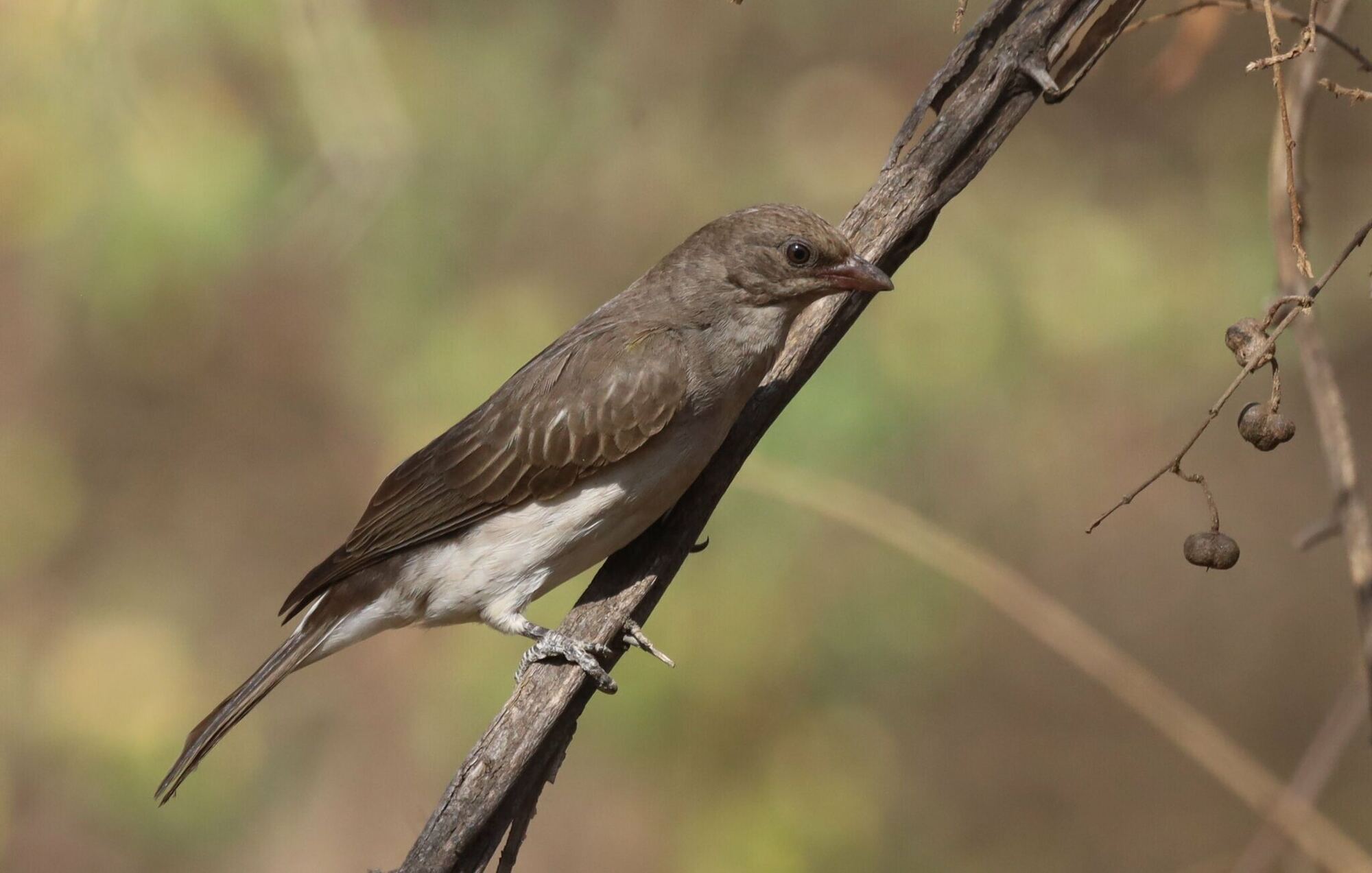
A rather plain bird of about 20 cm. Often first noticed by its wavering, chattering guiding call.
Plumage & colour
Males have a black throat, pink bill and dark grey-brown upperparts. Females are duller, with a blackish bill.
Behaviour
To recruit a human partner, the bird approaches people and gives a distinctive chattering call, then leads them towards a bees’ nest. Honey-hunters in turn use special calls to summon honeyguides — a “brrr-hm” trill among the Yao of Mozambique and a whistle (fuulido) among the Boran of Kenya. As a brood parasite, the female lays in the nests of hole-nesting birds and often punctures the host’s eggs; the newly hatched honeyguide chick, equipped with sharp bill hooks, kills the host’s chicks — in filmed nests, host chicks survived at most eight hours.
Measurements: Approximate length (about 20 cm) and weight (about 50 g) as given on Wikipedia; no primary measurement source was verified. Plumage: Maclean (1996), Roberts’ Birds of Southern Africa field companion.
Did you knowWhen Yao honey-hunters in Mozambique make their traditional “brrr-hm” call, they are twice as likely to be guided by a honeyguide as when making other sounds.
Range shown at country level (countries of regular occurrence). Resident throughout its range (BirdLife International lists 41 countries).
- Where
- Widespread in sub-Saharan Africa, from Senegal and Gambia east to Ethiopia, Eritrea and Somalia and south to South Africa. Absent from the West African rainforest belt.
- Continents
- Africa
- Habitat
Habitats with trees, especially dry open woodland and wooded savanna; not found in West African rainforest. BirdLife suspects that habitat degradation (opening of forest) is creating new suitable habitat.
- Movement · resident
- Not migratory.
What it eats
Primarily the contents of bee colonies — beeswax, eggs, larvae and pupae — plus waxworms and other insects.
Feeding strategy
Unusually among birds, it eats beeswax. Because wild bees’ nests are usually inside tree cavities, honeyguides cannot open them alone; they rely on people (and historically, perhaps other animals) to break them open, then feed on the comb left behind.
- OtherBeeswax and combA key food, scavenged from opened nests.
- InsectHoneybee eggs, larvae and pupae
- InsectWaxworms (wax-moth larvae)
- InsectOther insects
What eats it
The animals that prey on the Greater Honeyguide, grouped by the life stage they attack: its eggs, its chicks, or grown birds.
EggsWho eats its eggs
No predators documented at this stage.
ChicksWho kills its chicks
No predators documented at this stage.
AdultsWho kills grown birds
No predators documented at this stage.
Predators of Greater Honeyguides are not well documented. Notably, the main threat to honeyguide eggs is other honeyguides: females puncture eggs already present in a host nest, including those of rival honeyguides (Spottiswoode & Colebrook-Robjent 2007; Spottiswoode 2013).
Its place in nature
The honeyguide’s best-known role is as a partner to people. Experiments with Yao honey-hunters in Mozambique showed the human “brrr-hm” call doubled the chance of being guided (from about 33% to 66%) and raised the overall chance of finding a bees’ nest from 17% to 54% (Spottiswoode et al. 2016). Among the Boran of Kenya, guiding cut search time by about two-thirds (Isack & Reyer 1989). As a brood parasite, it also lowers the breeding success of a range of hole-nesting birds.
- Mutualism withDocumentedHuman honey-hunters
Birds guide people to bees’ nests; people open the nests, take honey and leave wax and brood for the bird. Both sides benefit, and both use specialised signals to recruit the other (Isack & Reyer 1989; Spottiswoode et al. 2016).
- Feeds onDocumentedHoneybees
Wax, eggs, larvae and pupae from wild honeybee colonies are the core of the diet.
- Parasitic relationship withDocumentedLittle Bee-eater
A host of the honeyguide. Infrared video in host burrows in Zambia showed honeyguide chicks repeatedly gripping and shaking bee-eater nestmates with their bill hooks; the host chicks survived at most eight hours (Spottiswoode & Koorevaar 2011).
- Parasitic relationship withDocumentedOther hole-nesting birds (barbets, woodpeckers, kingfishers, wood hoopoes, starlings)
Recorded hosts; parasitised nests lose the host brood to the honeyguide chick.
- Mutualism withHypothesisedHoney badger
The popular story that honeyguides lead honey badgers to bees’ nests is NOT well documented. Dean et al. (1990) found that no biologist had recorded it, and later field researchers have found no direct evidence. Interviews with 394 honey-hunters found most doubtful, though some in Tanzania reported seeing the two interact; it remains unproven (van der Wal et al. 2023).
What if it disappeared?
The Greater Honeyguide is common and its population is thought to be increasing. But its partnership with people is fragile: where honey-hunting has declined, guiding behaviour has faded too.
Press Remove to see which organisms could be affected, how, and how confident scientists are. 3 possible effects are recorded for this species.
Honey-hunters can find nests without honeyguides, only much less efficiently. Other honeyguide species occur in Africa, but guiding of people is documented for the Greater Honeyguide.
Little is known about how much the honeyguide depends on human-opened nests in areas without honey-hunters, and the population-level effects of its brood parasitism on hosts have not been measured.
These scenarios summarise published ecology. They are not predictions: ecosystems are complex, other pressures interact, and documented, likely and hypothesised effects are labelled separately.
Conservation
- LCLeast Concern
- NTNear Threatened
- VUVulnerable
- ENEndangered
- CRCritically Endangered
- EWExtinct in the Wild
- EXExtinct
- Population estimate
- No reliable global estimate
- Trend
- Increasing
- Source
- BirdLife International factsheet (2024 assessment): global population not quantified; described as fairly common and widespread (del Hoyo et al. 2002), and suspected to be increasing as habitat degradation creates new suitable habitat.
No reliable historical time series is available for this species, so no population chart is shown. We do not interpolate or estimate missing data.
Threats
- Loss of the honey-hunting partnership
Guiding behaviour appears to have ceased in parts of Kenya, thought to reflect people no longer responding to the birds. The species itself is not threatened, but this cultural-ecological relationship is.
What is being done
No conservation action is needed for the species itself. The human–honeyguide relationship, however, depends on the continued practice of traditional honey-hunting.
- Long-term research on human–honeyguide cooperation in Niassa Special Reserve, Mozambique, and in Tanzania.
Sources
Conservation status: IUCN Red List (assessed by BirdLife International), assessed 2024. Media credits accompany each image and recording; see Sources & credits.
- BirdLife International (2024 assessment). Species factsheet: Greater Honeyguide Indicator indicator.
- Spottiswoode, C.N., Begg, K.S. & Begg, C.M. (2016). Reciprocal signaling in honeyguide–human mutualism. Science 353: 387–389.
- Isack, H.A. & Reyer, H.-U. (1989). Honeyguides and honey gatherers: interspecific communication in a symbiotic relationship. Science 243: 1343–1346.
- Spottiswoode, C.N. & Koorevaar, J. (2011). A stab in the dark: chick killing by brood parasitic honeyguides. Biology Letters 8: 241–244.
- Dean, W.R.J., Siegfried, W.R. & MacDonald, I.A.W. (1990). The fallacy, fact, and fate of guiding behavior in the Greater Honeyguide. Conservation Biology 4: 99–101.
- van der Wal, J.E.M. et al. (2023). Do honey badgers and greater honeyguide birds cooperate to access bees’ nests? Ecological evidence and honey-hunter accounts. Journal of Zoology 321: 22–32.
- Spottiswoode, C.N. & Colebrook-Robjent, J.F.R. (2007). Egg puncturing by the brood parasitic Greater Honeyguide and potential host counteradaptations. Behavioral Ecology 18: 792–799.