Hyacinth Macaw
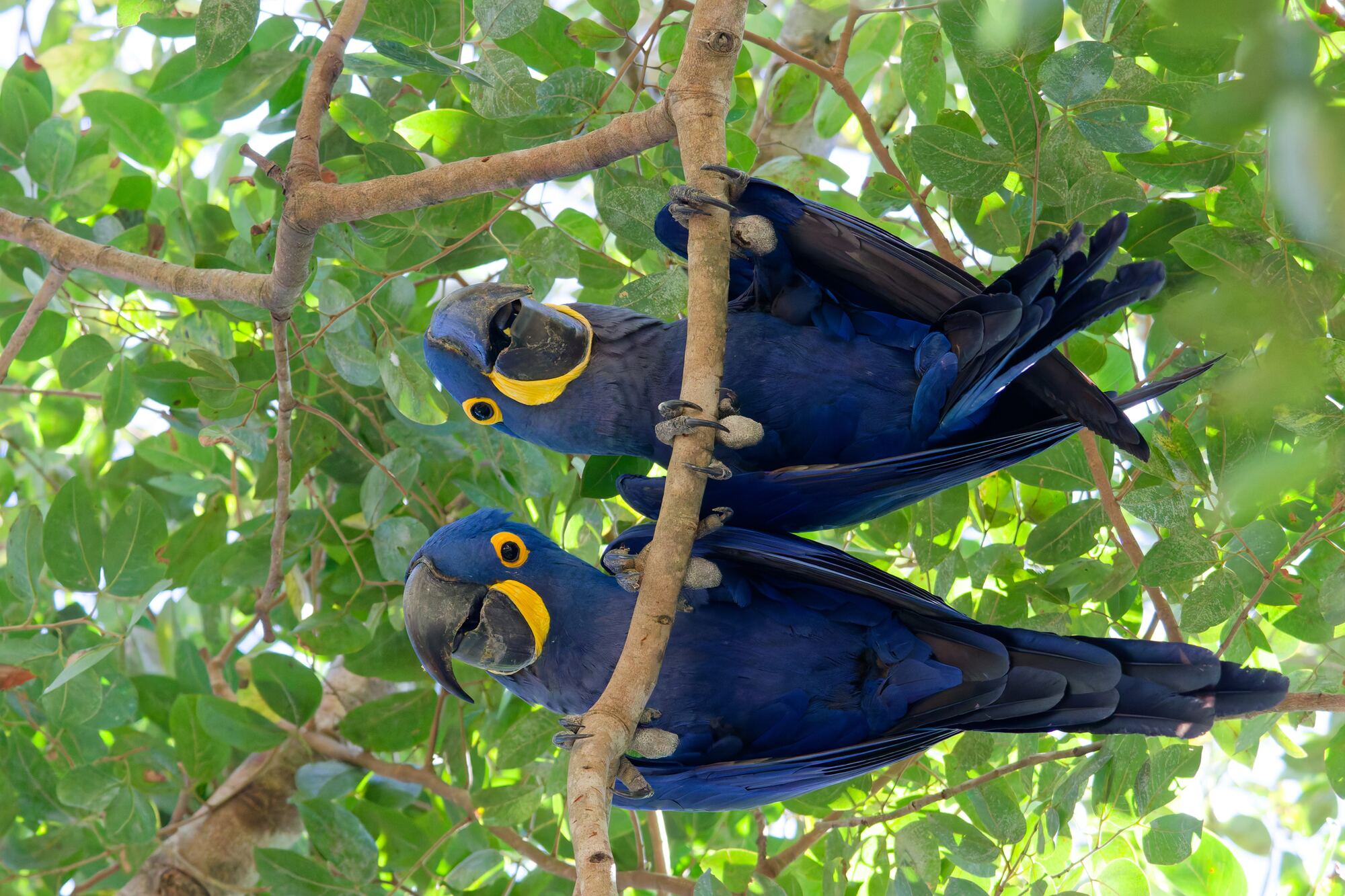
A giant cobalt-blue parrot that cracks the hardest palm nuts — and plants some of them.
Meet the bird
Among the largest of all parrots, the Hyacinth Macaw lives in palm savannas, forest edges and wetlands of Brazil, eastern Bolivia and north-east Paraguay, with its stronghold in the Pantanal. Its massive bill opens palm nuts that few other animals can crack. Trapping for the pet trade reduced it to a few thousand birds by the late 1980s, but enforcement, ranchers’ support and a long-running nest-box programme have allowed a significant recovery.
Appearance
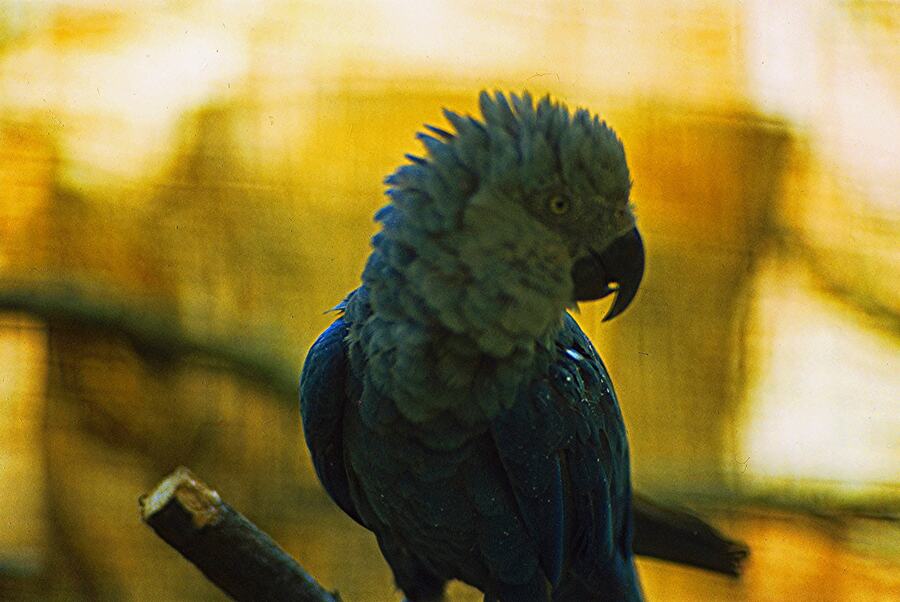
A very large, long-tailed parrot — the tail makes up about half its length — with a huge, deep black bill. Its blue plumage and size make it unmistakable.
Plumage & colour
Entirely deep cobalt or hyacinth blue, with bare yellow skin around the eyes and a yellow strip at the base of the lower mandible. The underside of the wings and tail is darker. Sexes look alike.
Behaviour
Hyacinth Macaws live in pairs and family groups and gather at communal roosts. In the Pantanal they nest from July to December, mainly in natural cavities in large manduvi trees; elsewhere they use other trees and, in the north-east, cliffs. Usually two eggs are laid but normally only one chick fledges. Their slow breeding made the species very vulnerable to the removal of birds for trade.
Measurements: Animal Diversity Web (University of Michigan)
Did you knowHyacinth Macaws have been recorded carrying palm nuts up to 1.6 km from the parent tree — and some of the nuts they drop grow into new palms.
Range shown at country level (countries of regular occurrence). Formerly more widespread; it has not been recorded recently in parts of Maranhão, Goiás and Mato Grosso.
- Where
- Three main areas: eastern Amazonia (Pará and Amazonas); the “Gerais” of central and north-eastern Brazil (Maranhão, Piauí, Bahia, Tocantins, Goiás, Mato Grosso); and the Pantanal of Mato Grosso and Mato Grosso do Sul, extending into eastern Bolivia (Santa Cruz) and north-east Paraguay.
- Continents
- South America
- Habitat
Palm savannas in the Pantanal, várzea (seasonally flooded forest) and savanna next to tropical forest in eastern Amazonia, and cerrado, caatinga and palm stands in the Gerais, below about 800 m. It prefers forest edges and tolerates some habitat degradation, but disappears where clearance passes a threshold.
- Movement · resident
- Not a migrant, but some long-distance seasonal movements appear to follow the fruiting of food plants, and birds may fly long distances daily between feeding and roosting or nesting sites. In Bolivia numbers appear to increase in the dry season.
What it eats
Specialises on the hard nuts of a few palm species. In the Pantanal these are mainly acuri (Attalea phalerata) and bocaiúva (Acrocomia aculeata); other palms are used elsewhere in the range.
Feeding strategy
The macaw cracks hard palm endocarps with its powerful bill to eat the kernel. It takes bocaiúva nuts from the palms and acuri nuts from the ground — including nuts regurgitated or passed by cattle, which have removed the fruit pulp. Birds often carry nuts away to perches or nests before eating them, and some are dropped intact.
- PlantAcuri palm nuts (Attalea phalerata)Main Pantanal food; often taken after cattle have ruminated the fruit.
- PlantBocaiúva palm nuts (Acrocomia aculeata / A. totai)Main Pantanal food, taken directly from bunches.
- PlantNuts of other palms (e.g. Attalea, Astrocaryum, Syagrus species)In Amazonia and north-east Brazil.
What eats it
The animals that prey on the Hyacinth Macaw, grouped by the life stage they attack: its eggs, its chicks, or grown birds.
EggsWho eats its eggs
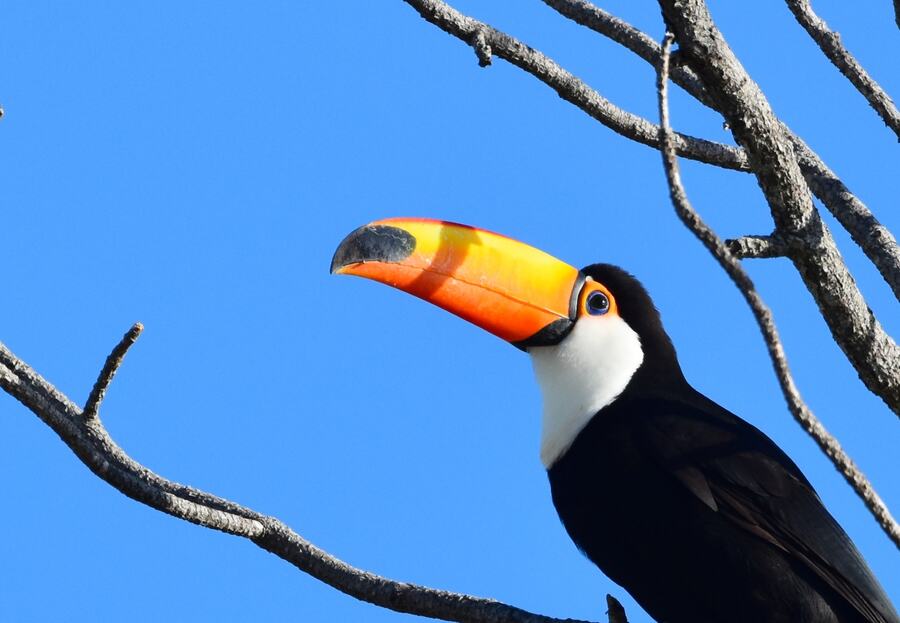
- BirdToco ToucanDocumentedResponsible for about 53% of predated eggs in the Pantanal (Pizo et al. 2008).
- BirdJaysLikelyListed as egg predators by Animal Diversity Web; not quantified.
- MammalCoatisLikelyListed as egg predators by Animal Diversity Web; not quantified.
ChicksWho kills its chicks
No predators documented at this stage.
AdultsWho kills grown birds
No predators documented at this stage.
Nest predation is the best-documented natural threat. Predation on free-flying adults is not well documented; historically, trapping by people was by far the greatest cause of loss.
Its place in nature
Hyacinth Macaws were long assumed simply to destroy the palm seeds they eat. A multi-region study found that they also carry nuts up to 1.6 km and drop or cache some intact, making them legitimate dispersers of large “megafaunal” palm fruits that few living animals can move. In the Pantanal the species is woven into an unusual web: cattle process acuri fruits, toucans plant the manduvi trees the macaws nest in, and the same toucans eat their eggs.
- Nests in / depends onDocumentedManduvi (Sterculia apetala)
In the Pantanal, the macaw nests almost exclusively in natural hollows of this large tree. Manduvi recruitment depends heavily on seed dispersal by the Toco Toucan.
- Preyed on byDocumentedToco Toucan
The toucan is the main predator of Hyacinth Macaw eggs in the Pantanal (about 53% of predated eggs) but also disperses 83% of manduvi seeds — so the macaw depends for future nest trees on its own nest predator (Pizo et al. 2008).
- Disperses seeds ofDocumentedAcuri palm (Attalea phalerata)
A main food. Macaws destroy many seeds, but Tella et al. (2020) recorded them carrying acuri and other palm nuts to perches and nests, where some remained intact and germinated.
- Disperses seeds ofDocumentedBocaiúva palm (Acrocomia)
The other main Pantanal food. Acrocomia totai in the Bolivian Pantanal was among the palms whose nuts macaws dispersed in the 2020 study.
- Commensal withDocumentedCattle
Cattle eat acuri fruits and regurgitate the hard nuts after removing the pulp; macaws feed on these nuts and carry some away, a chain that has been described as tertiary seed dispersal.
What if it disappeared?
The Hyacinth Macaw came close to disappearing from much of its range in the 1980s. Its full loss is a thought experiment, but recent research on seed dispersal suggests it would be more than the loss of a spectacular bird.
Press Remove to see which organisms could be affected, how, and how confident scientists are. 3 possible effects are recorded for this species.
Other animals that move large palm seeds — such as tapirs, which pass acuri seeds intact and deposit them in latrines — would continue some dispersal, but they move seeds in different ways and to different places, so they are unlikely to replace the macaw exactly.
The macaw’s net effect on palms — how many seeds it destroys versus disperses successfully — varies between palm species and regions and remains debated. Population sizes outside the Pantanal are poorly known.
These scenarios summarise published ecology. They are not predictions: ecosystems are complex, other pressures interact, and documented, likely and hypothesised effects are labelled separately.
Conservation
- LCLeast Concern
- NTNear Threatened
- VUVulnerable
- ENEndangered
- CRCritically Endangered
- EWExtinct in the Wild
- EXExtinct
Vulnerable because the population may still be less than half its size three generations ago, after heavy trapping for the cage-bird trade; it has recovered substantially since a low point in the late 1980s. Listed on CITES Appendix I.
- Population estimate
- 4,700–11,000 mature individuals (estimated)
- Estimate year: 2025
- Trend
- Stable
- Source
- BirdLife International factsheet (2025 assessment)
Threats
- Illegal trade
Trade grew rapidly from the 1960s to the 1980s; at least 10,000 birds were taken from the wild in the 1980s. Trade was almost halted by the early 2000s but continues at a low level, and the species remains highly valuable in international markets.
- Habitat loss and fire
Forest is being converted to pasture, soya and plantations. Wildfires in 2020 affected over 40,000 km² — about 26% of the Brazilian Pantanal — and in 2019 almost half of 98 recorded nests at the Refúgio Ecológico Caiman were affected by fire or heat; fires also destroyed large areas of acuri and bocaiúva palms.
- Disease
From 2015 to 2018, 177 birds were found dead from herpesvirus in the Brazilian Pantanal.
- Local hunting
Some hunting and trapping occur for food and for feathers used in indigenous handicrafts.
What is being done
Protection under CITES and national laws, ranchers’ refusal to allow trappers on their land, and decades of field conservation in the Pantanal have reversed the decline. The Hyacinth Macaw Project, begun by biologist Neiva Guedes in 1990 and now run by the Instituto Arara Azul, uses artificial nests, chick management and education with ranchers and children.
- CITES Appendix I; protected by Brazilian and Bolivian law and banned from export in all range countries.
- Artificial nest boxes and management of nests and chicks in the Brazilian Pantanal (Instituto Arara Azul).
- Supplementary feeding after the 2020 Pantanal fires destroyed food palms.
- Included in Brazil’s National Action Plan for the Conservation of the Birds of the Cerrado and Pantanal.
- Ecotourism and environmental education initiatives since the 1990s.
A conservation story
In 1987 the world population was estimated at about 3,000 birds (range 2,500–5,000), after an estimated 10,000 or more had been trapped for the pet trade during the 1980s. As enforcement improved and Pantanal ranchers began to protect the birds, numbers grew: by 2003 the population was estimated at about 6,500 individuals, around 62% of them in the southern Pantanal. At one Pantanal roost, counts tripled from 234 birds in 2001 to 708 in 2015. BirdLife now estimates 4,700–11,000 mature individuals and considers the population stable, though recent fires and disease are new concerns.
Sources
Conservation status: IUCN Red List (assessed by BirdLife International), assessed 2025. Media credits accompany each image and recording; see Sources & credits.
- BirdLife International (2025 assessment). Species factsheet: Hyacinth Macaw Anodorhynchus hyacinthinus.
- Pizo, M.A., Donatti, C.I., Guedes, N.M.R. & Galetti, M. (2008). Conservation puzzle: endangered hyacinth macaw depends on its nest predator for reproduction. Biological Conservation 141: 792–796.
- Tella, J.L. et al. (2020). Conserving the diversity of ecological interactions: the role of two threatened macaw species as legitimate dispersers of “megafaunal” fruits. Diversity 12(2): 45.
- Mongabay (2020). These blue macaws help grow the forest around them, a new study finds.
- Instituto Arara Azul (Hyacinth Macaw Institute).
- Animal Diversity Web (University of Michigan). Anodorhynchus hyacinthinus.
- Barros & Pires (2022). Seed predation by macaws favors fruits with less seeds and thicker endocarps in the palm Attalea phalerata. Acta Botanica Brasilica.