Resplendent Quetzal
A jewel of the cloud forest that swallows wild avocados whole and plants their seeds as it travels.
Meet the bird
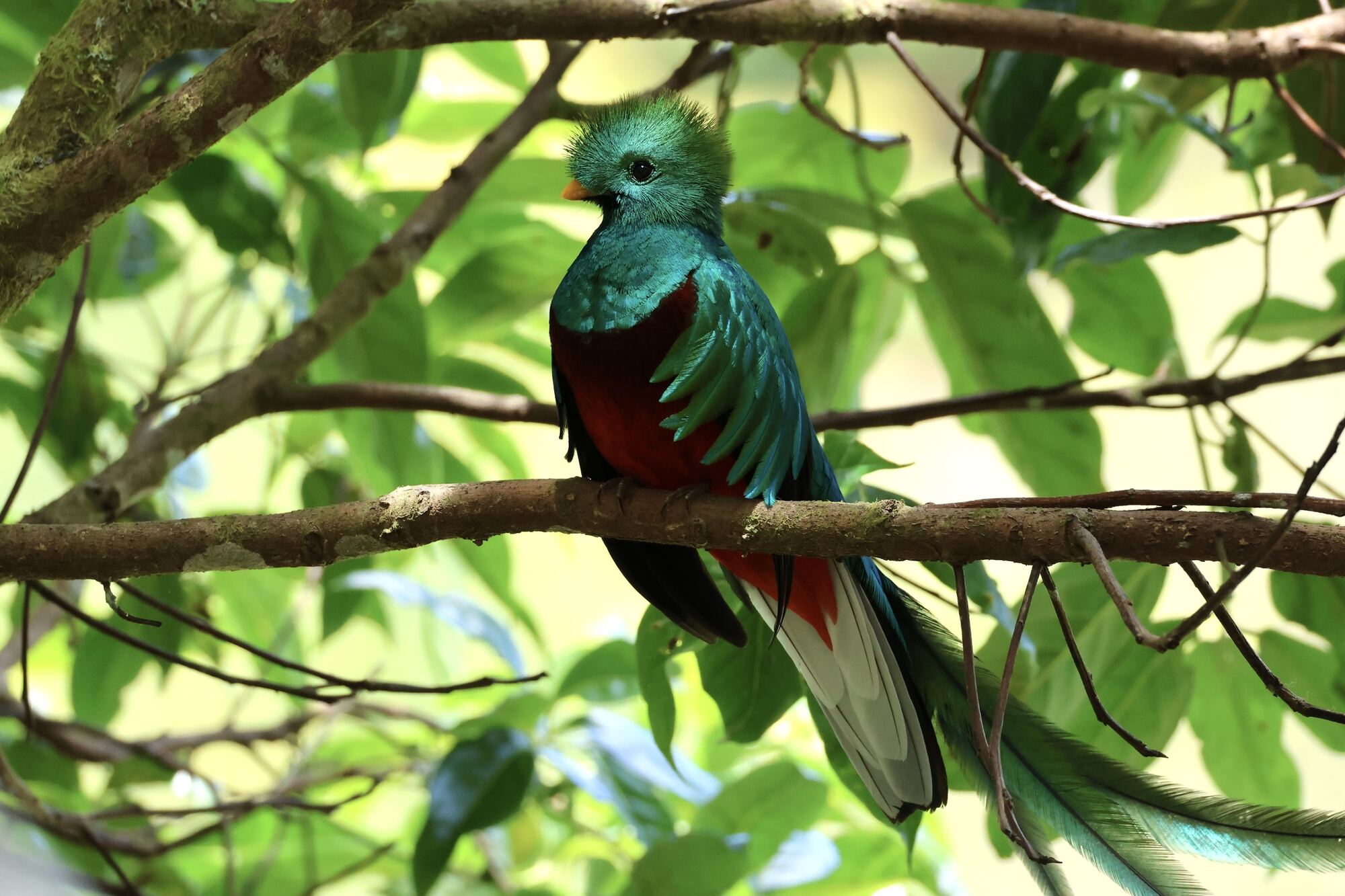
An iridescent green trogon of Central American cloud forests, the male famous for tail streamers that trail far beyond its body. Quetzals live mainly on the fruits of wild trees in the laurel family, swallowing them whole and regurgitating the large seeds, which makes them important seed dispersers. They move up and down mountain slopes through the year following fruiting laurels, so they need forest at several elevations, not just in their breeding areas.
Appearance
A medium-sized, stocky trogon with a short bill, a rounded crest and very short legs. Breeding males have elongated upper-tail coverts that form two long, flexible streamers extending well beyond the tail — up to about 65 cm in some sources. Its gape is unusually wide for a bird of its size (about 2.1 cm), allowing it to swallow large fruits whole.
Plumage & colour
Males are brilliant iridescent green on the head, crest, back, breast and streamers, with a crimson belly and white undertail. Females are duller green with a grey breast, a smaller crest, a red lower belly and no long streamers. The colour of the green changes with the angle of light.
Behaviour
Breeding takes place from about March to August. Pairs excavate or enlarge a cavity in a rotting trunk or stump and lay one or two eggs; incubation lasts 17–19 days and the young fledge after 23–31 days. Both parents feed the chicks, which are brought whole fruits from their second day but, even near fledging, receive mostly insects, snails and lizards. Outside the breeding season quetzals are quiet but easily located by their noisy flight and the large seeds they regurgitate.
Measurements: Body length (36–40 cm, excluding male streamers) and streamer length: Handbook of the Birds of the World figures as reproduced by Oiseaux-birds.com; adult weight (180–200 g) and gape width: Wheelwright (1983).
Did you knowA quetzal swallows avocado-like laurel fruits whole, then regurgitates the big seeds — planting the next generation of cloud-forest trees.
Range shown at country level (countries of regular occurrence).
- Where
- Montane cloud forests of southern Mexico, Guatemala, Honduras, El Salvador, Nicaragua, Costa Rica and western Panama (east to Veraguas).
- Continents
- North America
- Habitat
Canopy and subcanopy of humid, epiphyte-laden montane evergreen forest and cloud forest, recorded from about 170 m to 3,420 m elevation. It strongly prefers mature forest but forages at times in clearings and pastures with scattered trees next to forest. It nests in cavities in decaying, still-standing trunks, which are found mainly in old, undisturbed forest.
- Movement · migratory
- An altitudinal (intratropical) migrant. At Monteverde, Costa Rica, the timing and direction of its seasonal movements between forest types appear to be dictated by the fruiting of laurel-family trees, and radio-tracking showed that quetzals use habitats at lower elevations outside their breeding areas.
What it eats
Mainly fruit. At Monteverde quetzals ate at least 41 fruit species over a year, but depended mostly on the large drupes of about 18 species in the laurel family (Lauraceae). Insects, snails, small frogs and lizards are taken mainly in the breeding season, especially for chicks.
Feeding strategy
Quetzals pluck fruit in short flying sallies from a perch, swallow it whole, and later regurgitate the large seeds; their thin-walled, elastic oesophagus is thought to aid this. They may spend hours in or near a fruiting tree.
- PlantWild laurels / “wild avocados” (Lauraceae, e.g. Ocotea, Nectandra)About 18 species; the core of the diet.
- PlantSmall-seeded berries of second-growth plantsPart of a total of at least 41 fruit species at Monteverde.
- InsectInsects (e.g. beetles, grasshoppers)Especially fed to nestlings.
- InvertebrateSnails
- ReptileLizards and small frogs
What eats it
The animals that prey on the Resplendent Quetzal, grouped by the life stage they attack: its eggs, its chicks, or grown birds.
EggsWho eats its eggs
- MammalWeasel (Mustela frenata)DocumentedProbably the chief cause of egg and nestling losses at Monteverde.
- BirdKeel-billed ToucanDocumentedHas expanded into Monteverde’s highlands and preys on quetzal nests.
ChicksWho kills its chicks
- MammalWeasel (Mustela frenata)Documented
AdultsWho kills grown birds
- MammalMargayDocumentedOne record of a margay catching a brooding adult.
- BirdHawksDocumentedOne record of predation by an unidentified hawk.
Nest failure at Monteverde was high (67–78% of nests in one year). Squirrels, snakes and other mammals are suspected nest predators; quetzals defend their nests vigorously against squirrels. Adults probably face little predation, with only isolated records.
Its place in nature
By swallowing the large fruits of wild laurels whole and regurgitating the seeds elsewhere, quetzals move seeds that few other birds in the cloud forest can handle. Wheelwright (1983) suggested mutual dependence, and possibly coevolution, between quetzals and these trees, because the bird’s wide gape, diet, movements and life history are so closely tuned to them. Their seasonal movements also carry seeds between forest types at different elevations.
- Disperses seeds ofDocumentedWild laurels (Lauraceae: Ocotea, Nectandra and relatives)
Quetzals depend mostly on the large drupes of about 18 laurel species and regurgitate their seeds intact. A close mutualism between bird and trees has been proposed, but its strength has not been measured.
- Nests in / depends onDocumentedDecaying laurel snags (e.g. Ocotea tonduzii)
At Monteverde, 8 of 10 nests were excavated in decaying trunks of Ocotea tonduzii and other Lauraceae. Only standing, rotting trunks are suitable, which ties nesting to old forest.
- Competes withDocumentedKeel-billed Toucan
As the climate warmed, Keel-billed Toucans expanded upslope into Monteverde’s highlands, where they compete with quetzals for nest holes and prey on their nests (Pounds et al. 1999, cited by BirdLife).
- Preyed on byDocumentedWeasel (Mustela frenata)
Considered the main predator of eggs and nestlings at Monteverde.
What if it disappeared?
Quetzals are still locally common in some mountain ranges, but they have disappeared from many deforested areas. What their loss means for cloud-forest trees has not been measured directly; the effects below are inferred from their diet.
Press Remove to see which organisms could be affected, how, and how confident scientists are. 3 possible effects are recorded for this species.
Other cloud-forest fruit-eaters, such as Emerald Toucanets (which ate fruits of 83 species at Monteverde) and Three-wattled Bellbirds, also take laurel fruits, so some dispersal would continue. How well they substitute for quetzals for the largest-seeded species is unknown.
Most detailed knowledge comes from Monteverde, Costa Rica; diet, movements and seed dispersal elsewhere in the range are much less studied.
These scenarios summarise published ecology. They are not predictions: ecosystems are complex, other pressures interact, and documented, likely and hypothesised effects are labelled separately.
Conservation
- LCLeast Concern
- NTNear Threatened
- VUVulnerable
- ENEndangered
- CRCritically Endangered
- EWExtinct in the Wild
- EXExtinct
Near Threatened because of a suspected moderately rapid decline, largely owing to deforestation.
- Population estimate
- 50,000–499,999 mature individuals (suspected; data quality poor)
- Estimate year: 2022
- Trend
- Decreasing
- Source
- BirdLife International factsheet (2023 assessment), citing Partners in Flight (2022)
No reliable historical time series is available for this species, so no population chart is shown. We do not interpolate or estimate missing data.
Threats
- Deforestation and fragmentation
Forests are logged and converted to farmland and pasture; about 11% of tree cover within the range was lost over three generations (16.5 years). Loss is most severe in the northern part of the range.
- Loss of mid-elevation habitat used outside the breeding season
Reserves protecting breeding areas may not include the lower-elevation forests quetzals need at other times of year, so populations can decline even where breeding habitat is protected.
- Climate change
Warming has allowed Keel-billed Toucans to spread into quetzal habitat at Monteverde, adding competition for nest holes and nest predation.
- Hunting and trapping
Some direct persecution probably still occurs locally, particularly in southern Mexico, though it appears to have decreased.
What is being done
Several montane reserves in Central America protect quetzal populations, but research at Monteverde showed that reserves designed around breeding areas can be too small because the birds migrate seasonally to other forest types. Protecting connected forest across elevations is therefore key.
- Protected areas in montane forests, e.g. the Cordillera de Talamanca (Costa Rica) and Sierra de las Minas (Guatemala), where the species is locally common.
- Designing reserves and corridors that include the seasonal, lower-elevation habitats used outside the breeding season.
- Forest restoration and protection of old trees and standing dead trunks for nesting.
Sources
Conservation status: IUCN Red List (assessed by BirdLife International), assessed 2023. Media credits accompany each image and recording; see Sources & credits.
- BirdLife International (2023 assessment). Species factsheet: Resplendent Quetzal Pharomachrus mocinno.
- Wheelwright, N.T. (1983). Fruits and the ecology of Resplendent Quetzals. The Auk 100: 286–301.
- Powell, G.V.N. & Bjork, R. (1995). Implications of intratropical migration on reserve design: a case study using Pharomachrus mocinno. Conservation Biology 9: 354–362.
- Oiseaux-birds.com. Resplendent Quetzal species card.